Limited Time Offer!
For Less Than the Cost of a Starbucks Coffee, Access All DevOpsSchool Videos on YouTube Unlimitedly.
Master DevOps, SRE, DevSecOps Skills!
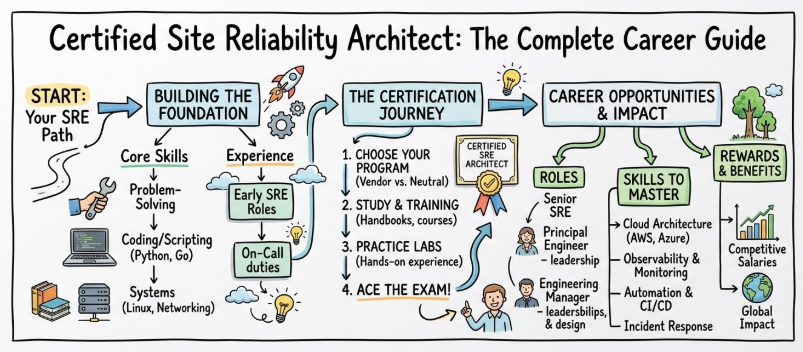
Introduction
The Certified Site Reliability Architect is a professional milestone designed for those who wish to master the art of building resilient, scalable, and highly available systems. This guide is crafted for engineers and technical leaders who are navigating the complexities of modern cloud-native environments and platform engineering. As organizations shift from traditional operations to automated, reliability-focused models, understanding the architectural principles of SRE becomes a non-negotiable skill for career longevity.
Navigating the landscape of certifications can be overwhelming, but this guide provides a clear roadmap hosted by SREschool to help you evaluate the ROI of your learning. We explore how this certification bridges the gap between software development and systems operations, ensuring you can design systems that handle failure gracefully. By the end of this article, you will have a comprehensive understanding of the curriculum, the preparation required, and how this credential influences your standing in the global engineering market.
What is the Certified Site Reliability Architect?
The Certified Site Reliability Architect represents the pinnacle of expertise in the discipline of reliability engineering, focusing on the high-level design and strategic implementation of SRE principles. Unlike foundational courses that focus on individual tools, this program emphasizes the architectural patterns required to maintain massive, distributed systems in production. It exists to standardize the language and methodology used by senior engineers to balance the velocity of feature delivery with the absolute necessity of system stability.
This certification aligns with modern engineering workflows by integrating deeply with CI/CD pipelines, observability stacks, and automated incident response frameworks. It moves beyond theory by requiring practitioners to understand the trade-offs involved in distributed consensus, data consistency, and global load balancing. For an enterprise, having a certified architect means having a leader who can translate business SLAs into technical SLOs and Error Budgets that actually work in a live environment.
Who Should Pursue Certified Site Reliability Architect?
This certification is primarily designed for senior software engineers, systems architects, and dedicated SREs who have already mastered the basics of Linux, networking, and cloud infrastructure. Cloud professionals and platform engineers who are responsible for the underlying “golden paths” of an organization will find the architectural focus highly beneficial. Furthermore, security and data professionals who need to ensure the integrity and availability of their respective pipelines will gain a new perspective on systemic resilience.
While the depth is significant, engineering managers and technical leaders should also consider this path to better manage high-performing reliability teams. In the context of both the Indian tech hub and the global market, there is a massive shortage of professionals who can look at a system holistically rather than just troubleshooting individual nodes. Whether you are looking to move into a staff engineer role or lead a digital transformation project, this certification provides the necessary technical authority.
Why Certified Site Reliability Architect is Valuable and Beyond
The demand for high-system availability is at an all-time high as every business becomes a software business, making the Certified Site Reliability Architect a future-proof investment. As companies move toward complex microservices and multi-cloud strategies, the risk of catastrophic failure increases, and the industry needs architects who can build “antifragile” systems. This certification ensures that your skills remain relevant even as specific tools like Kubernetes or Terraform evolve, as the underlying principles of reliability remain constant.
Longevity in a tech career is often tied to one’s ability to solve structural problems rather than just syntax errors, and this program focuses on those structural solutions. The enterprise adoption of SRE practices is no longer limited to “Big Tech” firms; retail, finance, and healthcare sectors are now hiring SRE architects to protect their digital revenue streams. The return on investment is seen not just in salary increases, but in the ability to influence organizational culture and technical direction at a high level.
Certified Site Reliability Architect Certification Overview
The Certified Site Reliability Architect program is delivered via the official portal at sreschool and is officially hosted on the SREschool.com platform. The program is structured to move candidates through a logical progression of difficulty, starting from core concepts and moving toward complex architectural simulations. It uses a rigorous assessment approach that combines theoretical knowledge with practical, scenario-based evaluations to ensure real-world readiness.
The certification ownership lies with industry experts who have managed production environments at scale, ensuring the content is always grounded in practical reality. The structure is modular, allowing professionals to focus on specific domains such as observability, capacity planning, or incident management before attempting the full architect level. By providing a clear framework for mastery, the program helps engineers build a verifiable portfolio of skills that are recognized by major employers globally.
Certified Site Reliability Architect Certification Tracks & Levels
The certification ecosystem is divided into three primary levels: Foundation, Professional, and Advanced (Architect). The Foundation level is aimed at establishing a common vocabulary and understanding of SLIs, SLOs, and the SRE manifesto, making it perfect for those transitioning from traditional DevOps. The Professional level dives deeper into automation, advanced monitoring, and toil reduction strategies, intended for mid-level practitioners who are active in the trenches of production support.
The Advanced or Architect level is the final tier, where the focus shifts to cross-organizational strategy, disaster recovery planning at scale, and cost-optimized reliability. There are also specialized tracks available for those who want to pivot their SRE skills into specific domains like DevSecOps for security-first reliability or FinOps for cost-aware architecture. This tiered approach allows for a structured career progression, where each level builds upon the last to create a well-rounded technical leader.
Complete Certified Site Reliability Architect Certification Table
| Track | Level | Who it’s for | Prerequisites | Skills Covered | Recommended Order |
| Reliability Engineering | Foundation | Junior SREs, DevOps | Basic Cloud Knowledge | SLIs/SLOs, Toil, Error Budgets | 1 |
| Reliability Operations | Professional | Mid-level Engineers | Foundation Cert | Observability, Automation, On-call | 2 |
| Systems Architecture | Advanced | Senior Architects | Professional Cert | Distributed Systems, Scalability | 3 |
| Security Reliability | Specialization | Security Engineers | Foundation Cert | Threat Modeling, Secure SRE | 4 |
| Cost Reliability | Specialization | FinOps Practitioners | Foundation Cert | Cloud Economics, Efficiency | 5 |
Detailed Guide for Each Certified Site Reliability Architect Certification
What it is
The Foundation certification validates a professional’s understanding of the core tenets of Site Reliability Engineering as defined by industry standards. it confirms that the candidate knows how to balance the need for new features with the requirement for system stability using data-driven metrics.
Who should take it
This is ideal for software developers looking to understand operations, system administrators transitioning to SRE, and fresh graduates entering the DevOps space. It is also highly recommended for project managers who need to speak the same language as their engineering teams.
Skills you’ll gain
- Defining and calculating Service Level Indicators (SLIs) and Service Level Objectives (SLOs).
- Understanding and managing Error Budgets to drive deployment decisions.
- Identifying and eliminating “Toil” through strategic automation.
- Implementing basic observability and monitoring stacks.
- Understanding the cultural shift required for a successful SRE implementation.
Real-world projects you should be able to do
- Create a reliability dashboard for a web application using standard monitoring tools.
- Draft a basic Error Budget policy for a development team.
- Automate a repetitive manual task using Python or Shell scripting to reduce toil.
Preparation plan
- 7–14 days: Review the SRE Handbook and familiarize yourself with core terminology and the SRE manifesto.
- 30 days: Complete the official Foundation course modules and participate in community study groups to discuss case studies.
- 60 days: Perform hands-on labs involving SLI/SLO creation and take multiple practice exams to ensure conceptual clarity.
Common mistakes
- Treating SRE as just another name for DevOps without understanding the specific metric-driven approach.
- Focusing too much on specific tools (like Prometheus) rather than the underlying principles of reliability.
- Underestimating the importance of the cultural and psychological aspects of blameless post-mortems.
Best next certification after this
- Same-track option: Certified Site Reliability Engineer – Professional
- Cross-track option: Certified DevSecOps Professional
- Leadership option: Engineering Management Foundation
Choose Your Learning Path
DevOps Path
The DevOps path focuses on the seamless integration of development and operations through continuous delivery and feedback loops. In this track, the architect learns how to build pipelines that are not only fast but also resilient by design, incorporating automated testing at every stage. It is designed for those who want to master the entire software delivery lifecycle while ensuring that speed does not compromise the stability of the production environment.
DevSecOps Path
In the DevSecOps path, reliability and security are treated as two sides of the same coin, emphasizing the need for “Secure Reliability.” Practitioners learn how to integrate security scanning, compliance checks, and threat modeling directly into the SRE workflow. This ensures that the systems are not only available and performant but also hardened against attacks, making it a critical path for regulated industries like finance.
SRE Path
The pure SRE path is for those who want to specialize deeply in the mechanics of system uptime and performance optimization. This path covers advanced topics like chaos engineering, complex incident response, and the management of large-scale distributed databases. It is a highly technical route that prepares individuals to handle the most demanding production environments where every second of downtime equals significant revenue loss.
AIOps Path
The AIOps path leverages machine learning and artificial intelligence to enhance the monitoring and management of IT operations. Architects in this track learn how to implement predictive analytics to identify potential failures before they occur and automate the resolution of complex issues. This is an essential path for organizations dealing with massive amounts of telemetry data that exceed human processing capabilities.
MLOps Path
The MLOps path focuses on the reliability and scalability of machine learning models in production, addressing the unique challenges of data drift and model decay. Professionals learn how to build “production-grade” ML pipelines that follow SRE principles, ensuring that AI models are as reliable as traditional software. This path is vital for companies integrating AI into their core products and requiring high availability for their model endpoints.
DataOps Path
The DataOps path applies SRE and DevOps principles to data engineering and data science workflows to ensure data quality and pipeline reliability. It focuses on automating the data lifecycle, from ingestion to transformation and visualization, while maintaining strict SLAs on data freshness and accuracy. This path is designed for data engineers who want to move away from reactive troubleshooting toward a proactive, architected data environment.
FinOps Path
The FinOps path intersects reliability engineering with cloud financial management to ensure that systems are cost-effective as well as stable. Architects learn how to design systems that scale efficiently and how to use error budgets to make informed decisions about resource allocation. This path is increasingly important for senior leaders who are responsible for managing large cloud budgets and proving the value of their technical investments.
Role → Recommended Certified Site Reliability Architect Certifications
| Role | Recommended Certifications |
| DevOps Engineer | Certified Site Reliability Engineer – Foundation, DevOps Professional |
| SRE | Certified Site Reliability Engineer – Professional, SRE Architect |
| Platform Engineer | SRE Architect, Cloud Infrastructure Specialist |
| Cloud Engineer | Certified Site Reliability Engineer – Foundation, Cloud Architect |
| Security Engineer | DevSecOps Professional, Secure SRE Specialist |
| Data Engineer | DataOps Foundation, SRE Professional |
| FinOps Practitioner | FinOps Certified Practitioner, SRE Architect |
| Engineering Manager | SRE Foundation, Technical Leadership Track |
Next Certifications to Take After Certified Site Reliability Architect
Same Track Progression
After achieving the Architect level, professionals should look toward deep specialization in niche areas of reliability. This might involve diving into Chaos Engineering certifications to master the art of controlled failure testing or focusing on specialized hardware reliability if working in edge computing. The goal is to move from being a generalist architect to a subject matter expert in a specific vertical of high-scale systems.
Cross-Track Expansion
Broadening your skillset is essential for a well-rounded technical leader, so consider pursuing advanced certifications in Security or Data Architecture. Understanding how security vulnerabilities impact reliability, or how data bottlenecks affect system latency, will make you a much more effective SRE Architect. This cross-pollination of skills allows you to bridge departmental silos and design more cohesive enterprise systems.
Leadership & Management Track
For those looking to transition into executive roles like CTO or VP of Engineering, moving into the leadership and management track is the logical next step. These certifications focus on team building, strategic planning, budgeting, and organizational psychology. Combining your deep technical knowledge of SRE with formal leadership training prepares you to drive large-scale cultural transformations within an organization.
Training & Certification Support Providers for Certified Site Reliability Architect
DevOpsSchool
DevOpsSchool is a prominent training provider that offers comprehensive programs across the entire spectrum of modern software engineering. They specialize in instructor-led sessions that provide hands-on experience with the most in-demand tools and methodologies in the industry. Their curriculum for SRE and DevOps is designed to bridge the gap between academic knowledge and industrial requirements, making them a go-to for many corporate training needs. With a strong focus on community and continuous learning, they provide candidates with the resources needed to clear high-level certifications and excel in their daily professional tasks.
Cotocus
Cotocus provides highly specialized consulting and training services that focus on high-end technology stacks, including cloud-native and reliability engineering. Their approach is unique as they often involve active practitioners and consultants who bring current market problems into the classroom environment. For professionals eyeing the Architect level, Cotocus offers deep-dive labs and architectural review sessions that are hard to find elsewhere. They are known for their rigorous training standards and their ability to help engineers master complex distributed systems, making them a valuable partner for serious career advancement in the SRE domain.
Scmgalaxy
Scmgalaxy has established itself as a massive knowledge hub for configuration management, DevOps, and site reliability engineering. They offer a vast array of tutorials, blogs, and structured courses that cater to both beginners and advanced professionals. Their training for SRE-related certifications is particularly well-regarded for its practical focus on troubleshooting and automation. By providing a blend of free resources and premium certified training, Scmgalaxy helps democratize technical education for engineers across the globe. Their commitment to staying updated with the latest toolsets ensures that their students are always learning relevant skills.
BestDevOps
BestDevOps focuses on providing curated training experiences that prioritize quality over quantity, ensuring that every student receives personalized attention. Their SRE programs are built around the idea of “learning by doing,” with a heavy emphasis on simulating production environments and real-world outages. This practical focus makes them an excellent choice for engineers who want to gain confidence in managing live systems before taking their certification exams. Their instructors are seasoned veterans who offer insights into the nuances of SRE culture, which is often as important as the technical skills themselves for an aspiring architect.
devsecopsschool.com
Devsecopsschool.com is the primary destination for engineers who want to integrate security into every phase of the software development and reliability lifecycle. Their curriculum is specifically designed to address the growing need for “security-first” engineering, providing deep dives into automated security testing and compliance as code. For an SRE Architect, their courses offer the necessary framework to build systems that are not just reliable but also inherently secure. The platform provides a structured path from foundation to advanced levels, ensuring that security becomes a foundational element of your reliability engineering toolkit.
sreschool.com
Sreschool.com is the definitive authority and hosting platform for the Certified Site Reliability Architect program, offering a laser-focused environment for SRE mastery. The platform provides an end-to-end learning experience, from initial foundation courses to advanced architectural simulations and formal certification exams. Their content is developed by global leaders in the SRE space, ensuring that it reflects the most current practices used by top-tier tech firms. By focusing exclusively on site reliability, they provide a depth of knowledge and a specialized community that is unmatched by more generalist training providers.
aiopsschool.com
Aiopsschool.com caters to the cutting edge of IT operations, focusing on the application of artificial intelligence and machine learning to manage complex systems. Their training programs help SREs and Architects transition from manual monitoring to automated, AI-driven observability and incident management. As systems grow in complexity, the skills taught here become essential for maintaining uptime without exponentially increasing headcount. The platform offers specialized certifications that validate an engineer’s ability to implement AIOps tools and strategies effectively in an enterprise setting, making it a critical resource for modern architects.
dataopsschool.com
Dataopsschool.com provides specialized training for managing the reliability and efficiency of data pipelines, an area often overlooked in traditional SRE programs. They teach how to apply DevOps and SRE principles to the data lifecycle, ensuring that data is delivered accurately and on time to the business. For architects responsible for data-intensive applications, their courses offer invaluable insights into data quality monitoring and pipeline automation. The platform fills a crucial gap in the market, helping data engineers and SREs collaborate more effectively to build robust data-driven organizations.
finopsschool.com
Finopsschool.com addresses the financial side of cloud engineering, teaching professionals how to balance technical performance with cost efficiency. In an era where cloud costs can spiral out of control, the ability to architect for both reliability and profitability is a high-value skill. Their programs cover cloud economics, resource optimization, and the cultural shift required to bring financial accountability to engineering teams. For a Certified Site Reliability Architect, understanding these principles is key to making informed architectural trade-offs that align with the organization’s broader business goals and budget constraints.
Frequently Asked Questions (General)
- How difficult is the SRE certification exam?
The difficulty varies by level; foundation is manageable for most engineers, while the Architect level requires deep experience and critical thinking. - How much time does it take to prepare?
Generally, 30 to 60 days of consistent study are recommended depending on your prior experience with cloud and automation tools. - Are there any prerequisites for the Foundation level?
There are no formal prerequisites, but a basic understanding of Linux, networking, and software development is highly beneficial. - What is the return on investment for this certification?
Professionals often see significant salary increases and access to higher-tier roles like Lead SRE or Principal Architect after certification. - Is this certification recognized globally?
Yes, the standards taught are based on industry-wide practices used by major tech companies worldwide. - Can a manager benefit from this technical certification?
Absolutely, it provides managers with the technical vocabulary and strategic framework needed to lead high-performing reliability teams. - Do I need to know how to code?
A basic proficiency in a scripting language like Python or Go is essential for the automation components of the certification. - Is the exam proctored or open-book?
Most levels are proctored and closed-book to ensure the integrity and value of the credential in the job market. - Does the certification expire?
Most professional certifications require renewal or continuing education every 2-3 years to ensure skills stay current with technology. - How does this differ from a standard Cloud Architect cert?
While Cloud Architect certs focus on provider-specific services, SRE certs focus on the operational reliability and performance of those services. - Are there practice exams available?
Yes, official practice exams are typically provided through the hosting platform to help you gauge your readiness. - Can I skip levels if I have extensive experience?
While foundation is often a prerequisite, some tracks allow experienced professionals to challenge higher-level exams directly after a review.
FAQs on Certified Site Reliability Architect
- What specifically makes the Architect level unique?
It focuses on organizational-wide reliability strategies and cross-service architecture rather than just single-application performance or manual troubleshooting. - How does this certification handle multi-cloud environments?
The principles taught are cloud-agnostic, focusing on architectural patterns that work across AWS, Azure, GCP, and on-premises systems. - Is Chaos Engineering part of the curriculum?
Yes, advanced levels include chaos engineering principles to help architects build systems that can withstand unpredictable failures. - Will this help me move into a Platform Engineering role?
Definitely, as SRE and Platform Engineering share many goals regarding internal developer experience and infrastructure reliability. - Does the program cover incident management?
Yes, it provides a comprehensive framework for blameless post-mortems and efficient incident response coordination at an enterprise scale. - How are SLOs addressed in the Architect exam?
Architects are tested on their ability to negotiate SLOs with business stakeholders and translate them into technical system requirements. - Is there a focus on specific tools like Kubernetes?
While tools are used in labs, the exam evaluates your understanding of the architectural concepts that those tools implement. - What is the primary goal of the Certified Site Reliability Architect?
The goal is to produce leaders who can design and maintain “antifragile” systems that continue to function under extreme stress.
Final Thoughts: Is Certified Site Reliability Architect Worth It?
When you reach a certain point in your engineering career, the ability to write code becomes secondary to the ability to design resilient systems. The Certified Site Reliability Architect is not just a badge; it is a rigorous validation of your ability to handle the “unhappy paths” of software in production. In my two decades of experience, I have seen many engineers struggle when systems scale beyond their initial design—this certification gives you the tools to prevent those failures before they happen.
Is it worth the investment? If you are looking to lead large-scale digital transformations or manage the critical infrastructure of a major enterprise, the answer is a resounding yes. It provides a structured way to think about system health, automation, and organizational culture that you simply cannot get from ad-hoc learning. As a mentor, I recommend this path to anyone who wants to move beyond being a technician and become a true architect of the digital world.
