Limited Time Offer!
For Less Than the Cost of a Starbucks Coffee, Access All DevOpsSchool Videos on YouTube Unlimitedly.
Master DevOps, SRE, DevSecOps Skills!
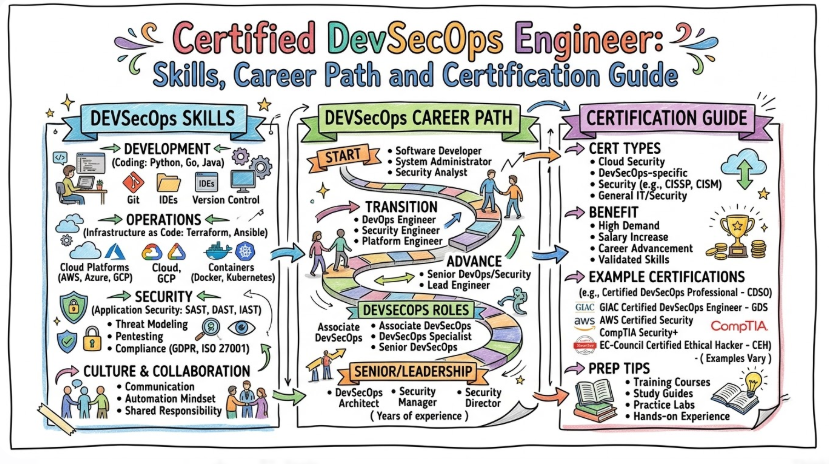
Security is no longer treated as a final barrier in the software delivery process. In modern engineering, protection is integrated into every phase of the lifecycle. A Certified DevSecOps Engineer is a professional focused on this integration, ensuring that safety is automated and continuous. By building security into the development flow, organizations are able to deploy updates rapidly without increasing the risk of vulnerabilities.
This guide provides a structured view for engineers and managers looking to evolve their technical practices. It details the requirements, career benefits, and professional standards needed to succeed in this specialized field.
Master in Observability Engineering Certifications Program
In a complex, distributed environment, security cannot exist without visibility. This is why the Master in Observability Engineering Certifications Program is recognized as a vital component of a modern technical career. While security tools find flaws, observability provides the data needed to understand why a system is behaving in a certain way.
Observability involves the collection of logs, metrics, and traces to create a transparent system. For a DevSecOps professional, this visibility is a primary tool for defense. It allows for the detection of unusual patterns that might indicate a security breach or a performance failure. This program is a necessary step for those who want to ensure their secure systems are also stable and easy to monitor.
A Deep Dive : Certified DevSecOps Engineer
The Certified DevSecOps Engineer credential is a specialized track for those who want to lead the movement toward automated safety.
What it is
The Certified DevSecOps Engineer certification is a formal validation of an individual’s ability to implement security-as-code. It is based on the “Shift-Left” philosophy, where security responsibilities are moved to the earliest stages of development. The program covers automated scanning, infrastructure hardening, and the enforcement of compliance through code. It is designed to replace manual, slow security checks with automated, repeatable workflows.
Who should take it
This path is intended for Software Engineers, DevOps specialists, and Security Analysts who want to excel in automated environments. It is also highly relevant for Engineering Managers who are responsible for leading secure digital transformations. Whether working in India or for a global organization, this track provides the technical depth needed to manage high-velocity production environments.
Skills you’ll gain
The curriculum provides practical technical proficiency in modern security automation. It ensures that the professional can manage the entire security lifecycle within a pipeline.
- Automated Security Scanning: Proficiency in inserting tools like SAST and DAST directly into the build process.
- Infrastructure as Code (IaC) Security: Learning to secure the scripts that build servers and networks to ensure safety from the start.
- Container and Kubernetes Security: Developing the knowledge to protect microservices by hardening Docker images and orchestration layers.
- Compliance as Code: Mastering the ability to write tests that automatically check for standards like GDPR or SOC2.
- Vulnerability Management: Learning how to find and fix security flaws based on the level of risk they pose to the business.
Real-world projects you should be able to do after it
Upon completion, a professional is prepared to handle complex security tasks in a production environment.
- Building a Secure Delivery Pipeline: A system can be created that automatically stops any code that does not meet safety standards from being deployed.
- Implementing Secrets Management: Setting up systems like HashiCorp Vault to manage sensitive data and remove hardcoded passwords.
- Continuous Cloud Auditing: Setting up automated tools to monitor cloud environments for misconfigurations and potential threats.
- Security Health Dashboards: Creating visual reports that provide leadership with a clear view of the security state across all projects.
Preparation plan
Success in this certification requires a structured approach. Depending on current knowledge, the following paths are suggested:
- 14-day Intensive Path: For those already proficient in DevOps and basic security. The focus is placed on a rigorous review of exam domains and hands-on practice with scanning tools.
- 30-day Professional Path: The recommended choice for most engineers. This involves one hour of study per day, focusing on one major topic—such as container security or IaC—each week.
- 60-day Foundational Path: For those transitioning from traditional IT or manual security roles. This path provides time to build a lab environment and learn DevOps basics before moving into automation.
Common mistakes
Many candidates struggle when they fail to treat DevSecOps as a collaborative discipline.
- Focusing Only on Tools: It is a mistake to learn the software without understanding the underlying security principles and the culture of shared responsibility.
- Ignoring the Developer Workflow: If security automation is too slow or complex, it will be bypassed. Security must be integrated in a way that assists developers.
- Lack of Practical Lab Work: Theoretical knowledge is not enough. The exam and the job require the ability to configure and troubleshoot pipelines in real-time.
Best next certification after this
Once the security of the pipeline is established, the Master in Observability Engineering is the logical next step. It ensures that the secure systems you have built can be monitored and analyzed for performance in real-time.
Comparison of Top Certifications for Software Engineers
This table provides a comparison of various technical tracks to help with career planning.
| Track | Level | Who it’s for | Prerequisites | Skills Covered | Recommended Order |
| DevSecOps | Intermediate | Security Engineers | CI/CD Basics | Pipeline Security, Automation | 1st for Security |
| SRE | Intermediate | Reliability Engineers | System Admin | Reliability, SLOs, SLIs | After DevOps |
| AIOps/MLOps | Advanced | Data Professionals | Python/ML | Intelligent Automation | After SRE |
| Cloud Arch | Expert | Senior Architects | Cloud Basics | Design, Strategy, Cost | After 5 Years Exp |
| DataOps | Intermediate | Data Engineers | Data Flows | Quality, Delivery, Security | After Cloud |
| FinOps | Intermediate | Managers/Engineers | Cloud Basics | Cost Optimization | Anytime |
Choose Your Path: 6 Learning Journeys
There are six distinct directions for growth in the modern operational landscape:
- DevOps Path: Focuses on the velocity and efficiency of software delivery.
- DevSecOps Path: Focuses on the integration of automated security into every phase of the lifecycle.
- SRE Path: Prioritizes the stability, scalability, and performance of large systems.
- AIOps/MLOps Path: Explores the use of artificial intelligence to manage and predict system behavior.
- DataOps Path: Streamlines the secure and reliable delivery of data for business intelligence.
- FinOps Path: Manages the financial efficiency of cloud resources to ensure maximum value.
Role → Recommended Certifications Mapping
To assist with career planning, here is a mapping of roles to the most relevant certifications:
- DevOps Engineer: Certified DevOps Professional, Certified Kubernetes Administrator.
- SRE: SRE Certified Professional, Master in Observability Engineering.
- Platform Engineer: Infrastructure as Code Expert, Certified DevSecOps Engineer.
- Cloud Engineer: AWS, Azure, or GCP Solutions Architect.
- Security Engineer: Certified DevSecOps Engineer, Cloud Security Specialist.
- Data Engineer: DataOps Professional, Big Data Specialist.
- FinOps Practitioner: Certified FinOps Associate.
- Engineering Manager: DevOps Leader, Cloud Business Professional.
Next Certifications to Take
After achieving the Certified DevSecOps Engineer credential, professionals should consider these three expansion paths:
- Same Track (Specialization): Advanced security certifications for specific platforms like AWS Security Specialty or Azure Security Engineer.
- Cross-Track (Broadening): SRE Certified Professional. This helps in understanding how security impacts the overall stability and uptime of a system.
- Leadership (Growth): DevOps Leader. This is for those looking to move from technical roles into management and lead digital transformations.
Top Training Institutions for Certified DevSecOps Engineer
Selecting a training partner is a critical decision for career advancement.
DevOpsSchool is a prominent organization providing detailed, instructor-led training. Their courses are designed to be highly technical and practical, ensuring that participants can apply their new skills immediately in a professional setting. They offer a deep curriculum that covers all the major aspects of the DevSecOps ecosystem.
Cotocus provides specialized consulting and training for large-scale engineering teams. Their focus is on helping organizations transition to modern ways of working by providing customized learning paths. Their methodology is highly collaborative and aimed at achieving long-term technical excellence for a business.
Scmgalaxy is an extensive community platform that offers a wide range of resources for DevOps and security professionals. They provide a unique blend of self-paced learning materials and community-driven support, making it an excellent choice for continuous professional development.
BestDevOps is known for delivering intensive bootcamps that focus on high-impact learning. Their programs are structured to help professionals prepare for certification in a short amount of time without compromising on the technical depth required for the role.
DevSecOpsSchool is a dedicated platform for security-focused training within the DevOps framework. They provide specialized deep-dives into topics like automated compliance and container defense. This institution is ideal for those who wish to become true experts in security automation.
Sreschool focuses on the principles of Site Reliability Engineering. Their training is a vital addition for any security professional, as it teaches how to maintain and troubleshoot the secure systems that have been implemented.
Aiopsschool teaches the integration of artificial intelligence into operations. They focus on the future of the industry, where machine learning is used to predict and prevent system failures, making it a forward-looking choice for any modern engineer.
Dataopsschool provides training specialized for the management of data pipelines. They teach how to apply the fast-moving principles of DevOps to data engineering, ensuring that information remains secure and accessible across an organization.
Finopsschool focuses on the financial management of cloud resources. They help engineers and managers understand the cost implications of their technical decisions, which is a vital skill for modern business leadership.
FAQs (General Questions & Answers)
1. How difficult is the Certified DevSecOps Engineer exam?
The exam is considered moderately difficult. It requires a balanced understanding of both DevOps workflows and security principles, alongside practical tool experience.
2. How much time is needed for preparation?
Most professionals spend 30 to 60 days of consistent study. This allows for a deep dive into labs and a thorough review of technical concepts.
3. Are there any strict prerequisites?
There are no formal prerequisites, but having a basic knowledge of Linux, Git, and at least one cloud provider is highly recommended.
4. What is the recommended sequence for DevOps certifications?
It is generally best to start with a foundation in DevOps, followed by Kubernetes training, and then specialize in DevSecOps or SRE.
5. What is the value of this certification in the global market?
The value is very high. As more businesses move to the cloud, the demand for engineers who can automate security within those environments is growing rapidly.
6. What are the common career outcomes?
Certified individuals often move into senior roles such as DevSecOps Lead, Security Architect, or Senior DevOps Engineer, often with an increase in salary.
7. Can I take the training and exam from home?
Yes, the mentioned training institutions offer online options, and the certification exam is proctored online for convenience.
8. How does this certification benefit an Engineering Manager?
It provides managers with the technical depth needed to make better decisions regarding security tools and lead their teams more effectively.
9. Is the certification recognized in India and internationally?
Yes, it is recognized by major tech companies and startups globally, as it follows industry-standard frameworks for security and automation.
10. What tools are covered in the training?
Training typically covers tools such as SonarQube, Jenkins, Docker, Kubernetes, Terraform, and various security scanning tools.
11. Does the program cover cloud-native security?
Yes, a major portion of the syllabus is dedicated to securing applications in cloud environments like AWS, Azure, and Google Cloud.
12. Is there a lab environment provided for practice?
Yes, top training providers include access to cloud labs where you can practice setting up secure pipelines in a real-world scenario.
FAQs on Certified DevSecOps Engineer
1. What is the core objective of the Certified DevSecOps Engineer program?
The main goal is to teach engineers how to automate security within the software development process, making it a continuous part of the workflow.
2. How does DevSecOps differ from traditional Cyber Security?
While traditional security often focuses on defense and manual testing, DevSecOps focuses specifically on the automation of security within the software delivery lifecycle.
3. What level of coding is required for this certification?
You should be comfortable reading code and writing basic scripts to automate security tasks and manage infrastructure.
4. Why is the “Shift-Left” approach emphasized?
Shifting left means identifying and fixing security issues early in the development process, which is significantly cheaper and faster than fixing them later.
5. How long does the certification remain valid?
The certification is typically valid for two to three years. After this, professionals can renew it through a refresher course or an advanced certification.
6. Does the course include real-world project work?
Yes, the training is designed to be highly practical, including projects that simulate the actual tasks of a DevSecOps engineer in production.
7. Is the curriculum updated regularly?
Yes, the syllabus is updated to include new security threats, the latest industry standards, and current automation tools.
8. What is the first step to get started?
The first step is to visit the official provider’s website, review the syllabus, and determine how the program aligns with your career goals.
Conclusion
The transition to an automated security model is one of the most significant shifts in modern engineering. Attaining the status of a Certified DevSecOps Engineer is a clear statement of a professional’s ability to navigate this change. It signifies a mastery of the tools and cultural shifts required to protect an organization’s digital assets in a world of constant delivery. This journey requires dedication, a commitment to “security-as-code,” and a focus on continuous learning. By following a structured learning path and utilizing the expertise of established training institutions, any determined engineer can reach this level of professional excellence. The result is a career that is not only financially rewarding but also central to the long-term safety and success of the global digital economy.
