Limited Time Offer!
For Less Than the Cost of a Starbucks Coffee, Access All DevOpsSchool Videos on YouTube Unlimitedly.
Master DevOps, SRE, DevSecOps Skills!
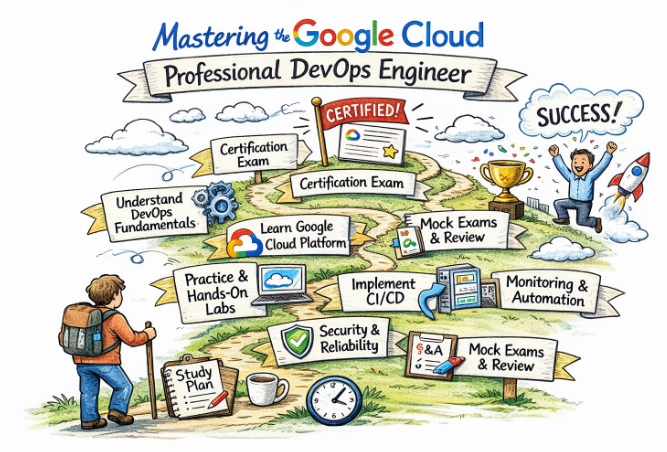
Throughout my career in technical operations and leadership, I have observed a major shift in how we build and maintain software. We are no longer in an era where developers simply write code and operators simply run it. Today, the most successful engineering teams are those that treat infrastructure as a core part of the product. Google Cloud Platform (GCP) has led this charge by sharing the internal methods they use to keep some of the world’s largest systems running perfectly.
For engineers in India and across the globe, the Google Cloud Professional Cloud DevOps Engineer certification is more than a test. It is a validation of your ability to manage high-stakes, modern systems. If you are looking to move into a senior role or lead a department as an engineering manager, this guide is your starting point for mastering the Google Cloud ecosystem.
The Landscape of Google Cloud Certifications
Before focusing on the DevOps path, it is important to understand where it sits within the larger GCP environment. Each track is designed to solve a specific business problem, and choosing the right order can significantly speed up your learning.
Master Certification Comparison Table
| Track | Level | Who it’s for | Prerequisites | Skills Covered | Recommended Order |
| Cloud DevOps | Professional | SREs, DevOps Engineers | 3+ years experience | CI/CD, SRE Culture, Monitoring | 3rd |
| Cloud Architect | Professional | Solutions Architects | 3+ years experience | Design, Infrastructure, Security | 2nd |
| Cloud Security | Professional | Security Engineers | 3+ years experience | IAM, Network Defense, Compliance | 4th |
| Data Engineer | Professional | Data Scientists | 3+ years experience | BigQuery, ML Pipelines, ETL | 3rd |
| Cloud Developer | Professional | Software Engineers | 3+ years experience | Application Profiling, APIs | 2nd |
| Cloud Network | Professional | Network Engineers | 3+ years experience | VPC, DNS, Hybrid Cloud | 4th |
| Cloud Database | Professional | Database Admins | 3+ years experience | Spanner, Cloud SQL, Migrations | 3rd |
Focus: Google Cloud Professional Cloud DevOps Engineer
This certification represents the intersection of software development and system reliability. It is built on the foundation of Site Reliability Engineering (SRE), a discipline that Google itself pioneered to manage its massive scale.
What it is
The Professional Cloud DevOps Engineer certification proves that you can build and manage a reliable delivery pipeline on GCP. It focuses on the technical skills needed to automate infrastructure and the cultural skills needed to manage system health. You are tested on your ability to set up monitoring, manage incidents, and ensure that every code release is safe and efficient.
Who should take it
This path is designed for Software Engineers who want to take full ownership of their applications in production. It is also perfect for Cloud Engineers and SREs who want to move beyond manual tasks and master the automation of the cloud. For Managers, it provides the technical language and framework needed to build a modern engineering culture.
Skills you’ll gain
Preparing for this certification changes your perspective on how systems should run. You move away from “hope” and toward “measurement.”
- SRE Fundamentals: You will learn how to set Service Level Objectives (SLOs) and Service Level Indicators (SLIs). You will understand the “Error Budget”—a tool that helps you decide when to push new features and when to stop and fix bugs.
- Automated Pipelines: You will master Cloud Build and Artifact Registry to create fully automated CI/CD flows. This ensures that your code is tested and deployed without human error.
- System Observability: You will learn to use the Cloud Operations suite (formerly Stackdriver) to monitor logs, traces, and metrics. This gives you deep visibility into how your app is behaving.
- Incident Management: You will learn how to act when things break. This includes setting up alerts and performing “blameless post-mortems” to learn from failures.
Real-world projects you should be able to do
After completing this path, you will be equipped to lead complex infrastructure projects.
- Advanced Deployments: You will be able to set up “Canary” or “Blue-Green” deployment strategies, allowing you to test new code on a small group of users before a full release.
- Self-Healing Infrastructure: Using Google Kubernetes Engine (GKE), you can build systems that automatically restart or replace failing parts without manual help.
- Infrastructure as Code: You will learn to use tools like Terraform to manage your entire cloud environment through scripts, making it easy to replicate or scale.
- Resource Optimization: You can design systems that automatically grow when traffic spikes and shrink when it is quiet, ensuring you only pay for what you use.
Preparation Plans: Choose Your Timeline
Different engineers have different schedules. Here are three ways to get ready for the exam.
7–14 Days: The Fast Track
- Target: Senior engineers who use Google Cloud daily.
- Focus: Reviewing the specific service names and the Google SRE philosophy.
- Method: Take 4-5 practice exams and read the official Google SRE book chapters on SLOs and Monitoring.
30 Days: The Balanced Path
- Target: Engineers with cloud experience (like AWS) who are new to GCP.
- Focus: Building a mental map of how Google services work together.
- Method: Spend 20 hours on hands-on labs and 20 hours on theory. Focus on Cloud Build, GKE, and Monitoring.
60 Days: The Foundation Path
- Target: Junior engineers or managers who want a complete understanding.
- Focus: Learning the fundamentals of DevOps and Cloud Architecture.
- Method: Spend one hour every day. Take a structured course from a school like DevOpsSchool. Build a small project from scratch to see the whole lifecycle.
Common Mistakes to Avoid
In my experience, many people fail not because they aren’t smart, but because they miss these key areas:
- Ignoring SRE Culture: This is not just a technical exam. If you don’t understand “Toil” or “Error Budgets,” you will struggle with the scenario questions.
- Skipping the Labs: You cannot pass this by just reading. You must use the console and see how the tools actually interact in real-time.
- Overthinking: Google usually prefers the most automated, “native” way to solve a problem. Avoid choosing complex third-party tools if a GCP tool can do the job.
Choose Your Path: 6 Specialized Learning Tracks
Once you have your DevOps foundation, you can move into these specialized areas of the industry:
- DevOps: Focused on the speed of delivery and the automation of the software lifecycle.
- DevSecOps: Integrating security checks into every part of the automated pipeline.
- SRE: The highest level of focus on reliability, scalability, and system performance.
- AIOps/MLOps: Using AI to manage systems and managing the lifecycle of machine learning models.
- DataOps: Streamlining the flow of data and ensuring data pipelines are as reliable as code.
- FinOps: Mastering the financial management of the cloud to ensure high performance at the lowest cost.
Role → Recommended Certifications
If you are looking for your next career move, follow this mapping based on your current or target job title:
- DevOps Engineer: Professional Cloud DevOps Engineer → Professional Cloud Architect.
- SRE: Professional Cloud DevOps Engineer → Professional Cloud Security Engineer.
- Platform Engineer: Professional Cloud Architect → Professional Cloud Developer.
- Cloud Engineer: Associate Cloud Engineer → Professional Cloud DevOps Engineer.
- Security Engineer: Professional Cloud Security Engineer → Professional Cloud DevOps Engineer.
- Data Engineer: Professional Data Engineer → Professional Cloud DevOps Engineer.
- FinOps Practitioner: Cloud Digital Leader → Professional Cloud Architect.
- Engineering Manager: Cloud Digital Leader → Professional Cloud DevOps Engineer.
Next Steps for Professional Growth
After you master the DevOps track, it is important to keep your skills sharp. Based on the latest data from GurukulGalaxy, here are three ways to move forward:
- Same Track (Security): The Professional Cloud Security Engineer is the perfect follow-up to ensure your pipelines are locked down.
- Cross-Track (Data): The Professional Data Engineer helps you understand how to handle the massive amounts of data that modern apps generate.
- Leadership (Growth): The Professional Cloud Architect is the best choice for those moving into high-level strategy or senior management.
Top Institutions for Training and Certification
Finding the right teacher can make your journey much easier. Here are the top institutions providing specialized training for the Google Cloud Professional Cloud DevOps Engineer (CDE):
- DevOpsSchool: A premier institution known for practical, job-ready workshops. They help you master both the technical tools and the SRE culture required for Google’s professional exams.
- Cotocus: This school offers high-level training focused on modern cloud architecture. They are great for professionals who need a structured and efficient way to learn complex topics.
- Scmgalaxy: A very popular community-driven platform. They provide an extensive library of guides, blogs, and tutorials that help engineers learn by doing.
- BestDevOps: They offer specialized coaching that is always updated with the latest industry standards, ensuring your skills stay relevant in the current market.
- devsecopsschool: The best choice for those who want to focus specifically on the intersection of security and DevOps automation.
- sreschool: Since the Google DevOps exam is so heavy on SRE, this institution provides the exact focus you need to master reliability and performance.
- aiopsschool: This school is perfect for those looking at the future of infrastructure, teaching you how to use AI to manage complex cloud systems.
- dataopsschool: They specialize in managing data pipelines, bridging the gap between data engineering and modern cloud operations.
- finopsschool: Essential for managers and leads who need to learn how to optimize cloud costs without losing performance.
FAQs: General Career Outcomes and Value
1. Is the DevOps exam harder than the Architect exam?
Many find it harder because it is much more technical and requires a deep understanding of the SRE philosophy.
2. How much time should I study every day?
If you are working, aim for one hour a day. Consistency is more important than long study sessions once a week.
3. Do I need to be a developer?
You don’t need to be a full-stack developer, but you should be comfortable with basic scripting and reading application logs.
4. What is the best starting point for a beginner?
The Associate Cloud Engineer is the best way to learn the basics of GCP before moving to the Professional tracks.
5. Is the salary high for certified DevOps Engineers?
Yes, DevOps and SRE are currently among the highest-paid roles in the global tech industry, especially for those with GCP expertise.
6. Does the certification expire?
Yes, it is valid for two years. Technology changes quickly, and Google wants to make sure your skills are current.
7. Can I take the exam from home?
Yes, Google offers remote proctoring so you can take the test from your home or office.
8. Is Google Cloud growing?
Yes, Google Cloud is the fastest-growing major cloud provider, and the demand for certified engineers is at an all-time high.
9. Are there any requirements to take the test?
There are no formal rules, but Google recommends having a few years of industry experience before trying the professional level.
10. What if I fail the exam?
You can retake it after a waiting period. Use the time to review the sections where you felt less confident.
11. Is this certification good for managers?
Absolutely. It gives managers the technical grounding they need to lead teams and make better infrastructure decisions.
12. Will this help me find a job abroad?
Yes, Google Cloud certifications are recognized worldwide and are a great asset if you are looking for an international career.
FAQs: Specifics for the Google Professional Cloud DevOps Engineer
1. What is the most important service to study?
Cloud Monitoring and Cloud Logging (part of the Cloud Operations suite) are the most critical for this exam.
2. How much Kubernetes is on the test?
A significant amount. You must understand GKE, pods, services, and how to scale clusters properly.
3. Why is SRE so important for this exam?
Google built their DevOps path around SRE. You must understand SLOs, SLIs, and Error Budgets to pass the scenario questions.
4. What tools should I focus on for CI/CD?
Focus on Cloud Build, Artifact Registry, and how they integrate with Git and deployment targets like GKE.
5. Are the questions mostly about theory?
No, they are scenario-based. They will give you a problem a company is facing and ask you for the best technical solution.
6. Do I need to know about security?
Yes, basic security like Identity and Access Management (IAM) and Binary Authorization are very important.
7. Is networking a big part of the exam?
You need to know how traffic moves through load balancers and how VPCs connect, but it is less focused on deep networking than the Architect exam.
8. Can I get a refund if I don’t pass?
No, the fee is for the attempt. It is better to over-prepare and pass the first time!
Conclusion
Embarking on the journey to become a Google Cloud Professional Cloud DevOps Engineer is one of the most impactful decisions you can make for your career. It represents a move from being someone who just manages technology to someone who masters the system of delivery itself. By focusing on the principles of Site Reliability Engineering and the power of automation on Google Cloud, you are preparing yourself to solve the complex problems that modern companies face every day. Whether you are an engineer looking to build more stable systems or a manager looking to build a higher-performing team, the skills you gain here will be the foundation of your success. The path requires hard work and a dedication to learning, but the rewards—ranging from career mobility to a deeper understanding of modern engineering—make it well worth the effort. Now is the perfect time to start building your future in the cloud.
