Limited Time Offer!
For Less Than the Cost of a Starbucks Coffee, Access All DevOpsSchool Videos on YouTube Unlimitedly.
Master DevOps, SRE, DevSecOps Skills!
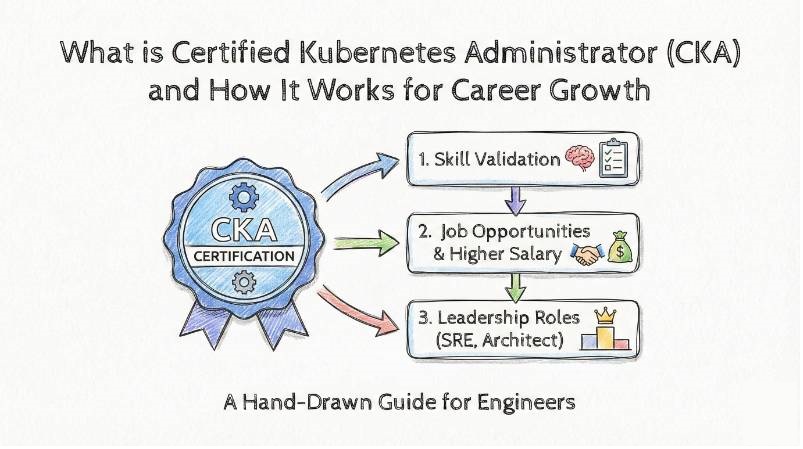
The landscape of cloud-native infrastructure has shifted dramatically, making container orchestration a non-negotiable skill for modern technical leadership. Having navigated the transition from monolithic architectures to microservices over the last two decades, I’ve seen how Kubernetes has emerged as the definitive operating system for the cloud.
The Certified Kubernetes Administrator (CKA) program is more than a credential; it is a validation of your ability to manage the very foundation of modern software. This guide provides a comprehensive roadmap for engineers and managers in India and globally to master this domain.
Global Certification Master Table
This table outlines the essential tracks for 2026, helping you plan your career progression from core administration to specialized leadership.
| Track | Level | Who it’s For | Prerequisites | Skills Covered | Recommended Order |
| Kubernetes | Administrator | DevOps & Cloud Engineers | Linux Basics, Containers | Cluster Setup, Networking, Storage | 1st (Foundation) |
| DevOps | Professional | Software Engineers | Git, Basic Coding | CI/CD, IaC, Automation | 2nd |
| DevSecOps | Specialist | Security Engineers | DevOps Basics | Security Auditing, Compliance | 3rd |
| SRE | Reliability | Operations Leads | DevOps Professional | SLOs, Error Budgets, Monitoring | 4th |
| AIOps | Advanced | Data & Ops Leads | Python, Statistics | AI/ML in Ops, Predictive Maintenance | 5th |
| FinOps | Management | Managers & Architects | Cloud Fundamentals | Cost Optimization, Budgeting | 6th |
Certified Kubernetes Administrator (CKA)
What it is
The CKA is a performance-based certification that validates your ability to install, configure, and manage production-grade Kubernetes clusters. Unlike traditional exams, it is held in a live command-line environment where you solve real infrastructure challenges.
Who should take it
- Software Engineers looking to master the platform where their code lives.
- System Administrators transitioning from traditional VMs to cloud-native stacks.
- DevOps Professionals responsible for infrastructure reliability.
- Engineering Managers who need technical depth to lead containerized teams.
Skills you’ll gain
- Cluster Architecture: Understanding control plane components and node communication.
- Installation & Configuration: Building clusters from scratch using
kubeadm. - Services & Networking: Implementing Pod connectivity and Ingress controllers.
- Storage Management: Configuring Persistent Volumes and Storage Classes.
- Advanced Troubleshooting: Diagnosing application and cluster failures at scale.
Real-world projects you can do after it
- Build a high-availability Kubernetes cluster for a global microservices app.
- Secure production workloads using Role-Based Access Control (RBAC).
- Automate cluster maintenance and zero-downtime upgrades.
- Implement complex network policies to isolate sensitive database traffic.
Preparation Plan
7–14 Days (The Sprint)
- Days 1-4: Intensive focus on Kubernetes Architecture and
kubectlimperative commands. - Days 5-9: Practice Cluster Installation (
kubeadm) and Maintenance (Backup/Restore). - Days 10-14: High-speed drills using mock exams like Killer.sh to build muscle memory.
30 Days (Standard Pace)
- Week 1: Master the basics—Pods, Deployments, and Services.
- Week 2: Deep dive into Networking (CNIs, Ingress) and Storage (PVCs).
- Week 3: Troubleshooting—learn to interpret logs and fix node/pod failures.
- Week 4: Practice speed and accuracy in the official exam simulator.
60 Days (The Deep Dive)
- Month 1: Theory and manual labs. Read official documentation and build clusters “the hard way.”
- Month 2: Focus on complex scenarios, security hardening, and refining your CLI speed for the exam.
Common Mistakes
- Context Switching: Forgetting to switch to the correct cluster context for each question.
- Writing YAML from Scratch: Wasting time manually typing YAML instead of using
--dry-run=client. - Poor Documentation Use: Not knowing exactly where to find example templates in the official k8s docs.
- Ignoring Partial Credit: Skipping hard questions entirely instead of completing the parts you know.
Best next certification after this
The Certified Kubernetes Security Specialist (CKS) is the natural progression to master cluster hardening and defense.
Choose Your Path: 6 Strategic Learning Tracks
To succeed in the current market, it is vital to specialize. Here are six tracks you can pursue after your CKA:
- DevOps Track: Focus on the flow—master CI/CD pipelines, GitOps, and high-speed delivery.
- DevSecOps Track: Prioritize safety—integrate security auditing and compliance directly into your pipelines.
- SRE Track: Focus on stability—learn the art of monitoring, SLO management, and incident response.
- AIOps/MLOps Track: Focus on the future—deploy and scale machine learning models using Kubernetes.
- DataOps Track: Focus on the data—manage complex data pipelines and stateful sets for enterprise databases.
- FinOps Track: Focus on efficiency—learn to balance performance with cloud cost optimization.
Role → Recommended Certifications Mapping
- DevOps Engineer: CKA + Certified DevOps Professional
- SRE: CKA + SRE Certified Professional
- Platform Engineer: CKA + Certified DevOps Architect
- Cloud Engineer: CKA + Cloud-Specific Professional (AWS/Azure)
- Security Engineer: CKA + DevSecOps Certified Professional
- Data Engineer: CKA + DataOps Certified Professional
- FinOps Practitioner: CKA + FinOps Certified Professional
- Engineering Manager: CKA + Certified DevOps Manager
Top Institutions for CKA Training
Choosing the right training partner is essential for gaining hands-on expertise.
- DevOpsSchool: A leader in mentor-led technical training. They focus on real-world projects and provide lifelong support for engineers looking to master the Kubernetes ecosystem through practical labs.
- Cotocus: Known for high-level consulting, their training is geared toward senior engineers who need to understand complex enterprise architectures and cloud-native strategies.
- Scmgalaxy: A community-driven powerhouse offering massive repositories of tutorials and troubleshooting guides, making it ideal for self-directed continuous learners.
- BestDevOps: Focuses on simplified, result-oriented modules that help working professionals gain mastery in the shortest possible time.
- devsecopsschool: The premier destination for security-first engineering, where Kubernetes is taught with a focus on hardening and compliance.
- sreschool: Dedicated to the discipline of Site Reliability Engineering, teaching professionals how to keep distributed systems up and running 24/7.
- aiopsschool: Focuses on the next wave of automation, teaching how to apply AI and intelligent agents to manage modern IT operations.
- dataopsschool: Specializes in the unique challenges of managing large-scale data lifecycles and pipelines within containerized environments.
- finopsschool: The go-to source for cloud financial management, teaching you how to optimize the “unit cost” of running infrastructure.
Next Certifications to Take
Based on current industry trends, I recommend three growth directions after your CKA:
- Same Track (Specialization): Certified Kubernetes Security Specialist (CKS) to harden your clusters.
- Cross-Track (Technical Depth): Hashicorp Certified Terraform Associate to master Infrastructure as Code (IaC).
- Leadership (Career Growth): Certified DevOps Manager (CDM) to lead larger organizational transformations.
Career & Strategy FAQs
1. How difficult is the CKA exam?
It is considered a 7/10 in difficulty. Because it is performance-based, you must actually know how to use the commands rather than just memorizing concepts.
2. How much preparation time do I need?
For most working professionals, 4 to 6 weeks of dedicated practice (1 hour a day) is the standard for success.
3. What are the prerequisites?
There are no formal requirements, but a strong comfort level with the Linux command line and basic networking is essential.
4. Should I take CKAD or CKA?
CKA is better for those building and managing infrastructure. CKAD is focused purely on deploying applications.
5. Is the CKA certification worth it?
Yes. In 2026, it remains the gold standard for cloud-native roles, often resulting in significant salary increases and better job stability.
6. Does it expire?
Yes, it is valid for 2 years. This ensures that you stay current with the frequent updates to the Kubernetes project.
7. Can I use the internet during the exam?
You are permitted to access official Kubernetes documentation in one browser tab. Knowing how to navigate these docs is a critical skill.
8. What is the passing score?
You need to score at least 66% to earn your certification.
9. Will this help me become an SRE?
Absolutely. CKA is a foundational requirement for most SRE roles today.
10. Do I need to know coding for CKA?
While you don’t need to be a developer, being comfortable with YAML and basic bash scripts is mandatory.
11. Is there a retake policy?
Yes, most exam purchases include one free retake if you don’t pass on your first attempt.
12. Can a manager benefit from this technical exam?
Yes. Understanding the “how” of Kubernetes allows a manager to lead with technical authority and set realistic team goals.
CKA Training FAQs
1. What makes DevOpsSchool’s CKA training unique?
The focus is on “muscle memory.” You spend the majority of your time in the terminal solving real problems under the guidance of mentors.
2. Are the labs provided accessible 24/7?
Yes, most of our top institutions provide cloud-based lab access so you can practice whenever you have free time.
3. Do I get help with the actual exam booking?
Yes, we guide you through the registration process and help you set up your exam environment to avoid technical issues.
4. Is there support if I get stuck on a lab?
Institutions like DevOpsSchool and Scmgalaxy provide dedicated community forums and mentor support to help you through difficult concepts.
5. Will I work on real-world projects?
Yes, the training is built around production scenarios, such as migrating applications and hardening cluster security.
6. Can I join if I only know basic Linux?
Yes, but we recommend taking a basic containerization (Docker) refresher first to get the most out of the course.
7. Is this training valid for international job markets?
Yes, the curriculum is aligned with the global CNCF standards, making your skills highly portable.
8. What happens after the training?
You will be fully prepared to sit for the CKA exam and move directly into advanced roles like Kubernetes Administrator or DevOps Engineer.
Conclusion
The path to becoming a Certified Kubernetes Administrator is a journey of transition—from managing servers to orchestrating entire ecosystems. In my experience, those who take the time to truly master these hands-on skills are the ones who find themselves leading the most impactful projects in our industry.
By choosing a structured learning path and a dedicated training partner, you are doing more than just passing an exam; you are positioning yourself at the forefront of the cloud-native revolution.
