Limited Time Offer!
For Less Than the Cost of a Starbucks Coffee, Access All DevOpsSchool Videos on YouTube Unlimitedly.
Master DevOps, SRE, DevSecOps Skills!
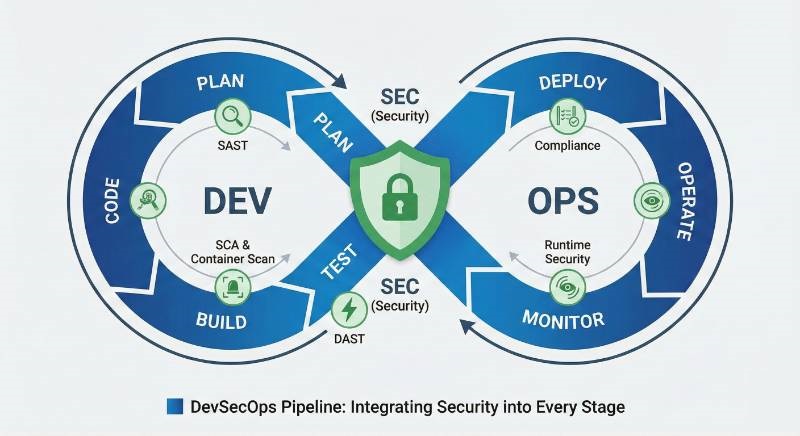
The era of “move fast and break things” is officially over. Consequently, in today’s landscape, if you break things, you might just leak customer data or crash a critical banking system. The new mandate is “move fast and be safe,” and this is precisely where the DevSecOps Certified Professional (DSOCP) comes in.
As someone who has navigated the shifting tides of IT for two decades—from the days of racking physical servers to managing ephemeral containers—I can tell you that security is no longer a separate department. On the contrary, it is a fundamental skillset. It is no longer enough to just build; therefore, you must build securely.
Furthermore, this guide is written for working engineers, managers, and technical leaders who are ready to stop being the bottleneck and start being the enabler. Here is your comprehensive roadmap to mastering the DevSecOps Certified Professional Online Training.
Master Certification Roadmap
Before diving deep into the DSOCP, it is critical to understand where it fits in the broader ecosystem. For instance, knowing your current track will help you identify the right next step. Below is a snapshot of the key certifications you should be aware of.
| Certification Name | Track | Level | Who it’s for | Prerequisites | Skills Covered | Order |
| Master in DevOps Engineering (MDE) | DevOps | Master | Architects, Leads | Linux, Cloud Basics | CI/CD, Ansible, Terraform, K8s | 1 |
| DevSecOps Certified Professional (DSOCP) | DevSecOps | Professional | Security Engineers, DevOps | CI/CD, Basic Scripting | SAST/DAST, Compliance, Vault | 2 |
| Site Reliability Engineering (SRECP) | SRE | Professional | Ops, SysAdmins | Linux, Monitoring | SLOs, Error Budgets, Grafana | 3 |
| AIOps Certified Professional (AIOCP) | AIOps | Advanced | Data/Ops Engineers | Python, DevOps | AI in Ops, Anomaly Detection | 4 |
| DataOps Certified Professional (DOCP) | DataOps | Professional | Data Engineers | SQL, ETL basics | Data Pipelines, Data Quality | 5 |
| FinOps Certified Architect | FinOps | Advanced | Managers, Cloud Architects | Cloud Billing | Cost Optimization, Forecasting | 6 |
Deep Dive: DevSecOps Certified Professional (DSOCP)
The DevSecOps Certified Professional is not just about learning tools; rather, it is about learning a workflow. Specifically, it teaches you how to embed security checks into every stage of the software lifecycle without slowing down the developers.
Provider: DevOpsSchool
What it is
Fundamentally, this certification is a comprehensive 72-hour program that bridges the gap between IT Operations, Development, and Security. Moreover, it focuses on “Shifting Left”—the practice of testing for security vulnerabilities early in the development process (at the code and build level) rather than waiting for a security audit before production.
Who should take it
- DevOps Engineers: Ideally those who want to stop being blocked by the security team and want to automate compliance.
- Security Professionals: Additionally, those who need to understand modern CI/CD pipelines and how to secure containers.
- Software Engineers: Engineers who want to write secure code and understand how their applications are attacked.
- Technical Managers: Finally, leaders who need to define security policies that do not kill productivity.
Skills you’ll gain
- Pipeline Security: How to integrate SAST (Static Application Security Testing) tools like SonarQube into Jenkins/GitLab.
- Dynamic Analysis: Running DAST checks using tools like OWASP ZAP on running applications.
- Container Hardening: For example, scanning Docker images for CVEs using Trivy or Clair before they ever reach the cluster.
- Secret Management: Implementing HashiCorp Vault so passwords are never stored in plain text.
- Compliance as Code: Automating checks for standards like GDPR or PCI-DSS using InSpec or OPA (Open Policy Agent).
- Cloud Security Posture: Simultaneously detecting misconfigurations in AWS/Azure (like open S3 buckets) automatically.
Real-world projects you should be able to do after it
- Design a “Zero-Trust” CI/CD Pipeline: Build a pipeline that automatically fails if code contains high-severity vulnerabilities or hardcoded secrets.
- Automated Audit Reporting: Subsequently, create a system that generates a PDF security report for auditors automatically after every release.
- Secure Kubernetes Deployment: Deploy an application to Kubernetes with Pod Security Policies (PSP) and Network Policies that restrict traffic.
- Supply Chain Security: Implement image signing to ensure only trusted code runs in your production environment.
Preparation Plan
Option 1: The 14-Day Sprint (For experienced DevOps Engineers)
- Days 1-3: Refresh on Docker and Jenkins. Then, set up a local lab.
- Days 4-7: Deep dive into SAST/DAST tools (SonarQube, OWASP ZAP). Next, integrate them into a dummy pipeline.
- Days 8-10: Focus on Container Security. Learn to break (hack) and fix a Dockerfile.
- Days 11-12: Secret Management. Install and configure Vault.
- Days 13-14: Finally, review Compliance as Code and take mock exams.
Option 2: The 30-Day Standard (For most working professionals)
- Week 1: Foundations of DevSecOps culture and setting up the “Golden Pipeline.”
- Week 2: Code Analysis (SAST) and Software Composition Analysis (SCA) for open-source libraries.
- Week 3: Infrastructure and Container Security. In addition, lock down the runtime environment.
- Week 4: Monitoring, Alerting, and the Capstone Project.
Option 3: The 60-Day Mastery (For beginners or career switchers)
- Weeks 1-2: Linux, Networking, and basic Cloud fundamentals.
- Weeks 3-4: CI/CD mastery. Initially, build pipelines without security.
- Weeks 5-6: Layering in Security tools one by one. Also, understand false positives.
- Weeks 7-8: Advanced topics: Kubernetes Security, Threat Modeling, and Final Project.
Common Mistakes
- “Alert Fatigue”: Turning on every single security rule on Day 1. As a result, this causes developers to ignore all alerts. Start small.
- Ignoring False Positives: Failing to tune your tools leads to broken builds for non-issues, which consequently destroys trust in the system.
- Focusing Only on Tools: Forgetting that DevSecOps is 50% culture. You cannot automate trust.
- Neglecting the IDE: Security should start in the developer’s editor, not just in the CI server.
Best next certification after this
- Certified DevSecOps Architect: If you want to design systems at an enterprise scale.
- Certified Kubernetes Security Specialist (CKS): Alternatively, if you want to specialize deeply in the orchestration layer.
Choose Your Path
The technology world is vast. While DevSecOps is critical, it is equally important to know which “Ops” suits your personality and career goals.
1. DevOps Path
The foundation of modern IT. Focus on this if you love automation, coding scripts, and connecting the dots between code and cloud. Ideally, it is the generalist track that opens the most doors initially.
2. DevSecOps Path
The guardian track. However, choose this only if you have a paranoid mindset (in a good way!). You care about integrity, trust, and protecting data. This is often higher paid than general DevOps due to the niche risk-management skill set.
3. SRE (Site Reliability Engineering) Path
The firefighter and architect. Choose this if you love solving hard problems, debugging complex systems, and care about “uptime” above all else. Therefore, it requires strong coding skills and a cool head under pressure.
4. AIOps / MLOps Path
The futurist track. For instance, choose AIOps if you want to use AI to solve operational problems (like predicting server crashes). Conversely, choose MLOps if you want to build the infrastructure that allows Data Scientists to train and deploy models reliably.
5. DataOps Path
The data steward. Choose this if you understand databases and want to bring “Agile” speed to data warehousing and analytics. In short, it is crucial for companies that are “data-driven.”
6. FinOps Path
The economist. Choose this if you are good with numbers and negotiation. Ultimately, it is about managing the variable cost of the cloud and ensuring the company isn’t wasting millions on unused servers.
Role → Recommended Certifications
Use this mapping to decide your next move based on where you are today.
| Current Role | Recommended Certification | Why? |
| DevOps Engineer | DevSecOps Certified Professional | To increase your value by adding “Security” to your resume. |
| SRE | Site Reliability Engineering (SRECP) | To formalize your knowledge of SLOs and error budgets. |
| Platform Engineer | Certified Kubernetes Administrator (CKA) | Because Kubernetes is the OS of the platform you build. |
| Cloud Engineer | Certified DevOps Architect (CDA) | To move from managing resources to designing systems. |
| Security Engineer | DevSecOps Certified Professional | To learn how to automate your job and work with developers. |
| Data Engineer | DataOps Certified Professional | To stop manually moving data and start automating pipelines. |
| FinOps Practitioner | Certified FinOps Architect | To gain authority in cost optimization discussions. |
| Engineering Manager | Certified DevOps Manager (CDM) | To understand how to lead high-performing teams. |
Top Institutions for Training & Certification
Finding the right mentor is as important as the curriculum. Therefore, here are the top institutions that provide help in training and certification for the DevSecOps Certified Professional (DSOCP).
- DevOpsSchool: Undoubtedly, this is the gold standard for this certification. They offer deep, instructor-led training with a focus on real-world scenarios and hands-on labs.
- Cotocus: In contrast, they are excellent for those looking for internship-based learning and practical exposure to software engineering environments.
- Scmgalaxy: A massive community-driven platform. Furthermore, it provides great tutorials, forums, and training resources for SCM and DevOps professionals.
- BestDevOps: Known for their consulting approach; consequently, they provide training that is very close to what you will face in enterprise consulting roles.
- devsecopsschool: Specifically, they are specialized in the security domain, offering deep-dive courses into security tools.
- sreschool: The go-to place if you want to pivot from DevSecOps to Site Reliability Engineering.
- aiopsschool: Similarly, this is focused on the cutting edge of AI in operations, great for future-proofing your skills.
- dataopsschool: The best resource for data engineers looking to adopt Ops practices.
- finopsschool: Finally, this is essential for learning the financial aspect of cloud operations.
Why Choose DevOpsSchool?
When you commit to a certification like the DSOCP, you aren’t just buying a course; instead, you are investing in your future. DevOpsSchool stands out for several reasons:
- Community-Centric: You join a network, not just a class.
- Expert Mentors: Moreover, trainers are working professionals who face these challenges daily.
- Lifetime Resources: Access to materials often extends well beyond the course dates.
- Practical Focus: Most importantly, the curriculum is designed to get you “job-ready,” not just “exam-ready.”
General Certification FAQs
1. Is DevSecOps difficult for a beginner?
It has a steep learning curve because it requires knowledge of three domains: Dev, Ops, and Sec. However, if you take a structured course like the DSOCP, it breaks it down into manageable chunks.
2. Do I need to know coding?
You don’t need to be a developer. Nevertheless, you must be able to read code (Python, Java, or YAML) to understand where the vulnerabilities are.
3. How much time does it take to prepare?
For a working professional, expect to spend 4-6 weeks (approx. 72 hours of study and practice) to be exam-ready.
4. What is the prerequisite for DSOCP?
Basic knowledge of Linux commands and an understanding of the software development life cycle (SDLC). Additionally, knowledge of Docker is a huge plus.
5. Which tools will I learn?
You will typically learn Jenkins (CI), Docker (Containers), Ansible (Config Mgmt), SonarQube (SAST), and OWASP ZAP (DAST).
6. Is this certification recognized globally?
Yes, the skills covered in the DSOCP are universal. Thus, the certification proves you have the practical ability to implement these skills.
7. Can I take this online?
Yes, the training and the exam are fully online, allowing you to learn at your own pace or in live virtual batches.
8. How does this help my career?
DevSecOps engineers are among the highest-paid professionals in IT. As a result, this certification validates your specialized skills, making you eligible for senior roles.
9. What is the difference between DevOps and DevSecOps?
DevOps focuses on speed and delivery. On the other hand, DevSecOps focuses on speed, delivery, and safety. It is an evolution of DevOps.
10. Will I get to do a live project?
Yes, the DSOCP training includes a mandatory real-world project where you must build a secure pipeline from scratch.
11. What if I fail the exam?
Most providers, including DevOpsSchool, offer support and retake options. However, check the specific policy when you enroll.
12. Is the content updated regularly?
Security moves fast. Therefore, good providers update their curriculum every few months to include new threats and new tools.
Next Certifications to Take
Once you have your DSOCP, where do you go next? Based on the industry landscape, here are your best three options:
- Same Track (Deepen Expertise):Certified DevSecOps Architect. This moves you from “implementing” to “designing.” Specifically, you will learn threat modeling at a system level and how to design security policies for thousands of developers.
- Cross-Track (Broaden Skills):Certified Kubernetes Administrator (CKA). Since most modern apps run on Kubernetes, knowing how to administer the cluster deeply will make you an unstoppable DevSecOps engineer.
- Leadership (Management):Certified DevOps Manager (CDM). Finally, if you are ready to trade your terminal for spreadsheets and strategy, this certification helps you understand how to manage teams, budgets, and cultural transformation.
FAQs: DevSecOps Certified Professional Online Training
1. Is prior coding experience mandatory? Although coding helps, you do not need to be a developer. Instead, you only need to understand basic scripts and read code to identify vulnerabilities.
2. What specific tools will I learn? Specifically, you will master the “Golden Pipeline” stack. For instance, the course covers Jenkins, Docker, SonarQube (SAST), and HashiCorp Vault.
3. How does this impact my salary? Undoubtedly, DevSecOps pays significantly more than standard DevOps roles. Consequently, the ROI is high because security skills are in short supply.
4. Is the exam theoretical or practical? Unlike traditional exams, this is heavily practical. Therefore, you must prove your skills by building secure pipelines, not just memorizing terms.
5. How long does it take to finish? Generally, most professionals complete it in 4-6 weeks. However, this assumes you dedicate about 5-7 hours per week to study.
6. Does the certification expire? Fortunately, it does not have a hard expiration date. Nevertheless, regular upskilling is recommended to stay current with new security threats.
7. Will I get help if I get stuck? Absolutely, top providers like DevOpsSchool offer mentor support. Additionally, you get access to community forums for troubleshooting assistance.
8. How is this different from CISSP? In contrast to CISSP, which focuses on policy and theory, DSOCP is for engineers. Thus, it is the better choice if you want to build automation.
Conclusion
The gap between “development” and “security” has existed for too long. Unfortunately, it has caused delays, arguments, and ultimately, insecure software. The DevSecOps Certified Professional (DSOCP) is your chance to close that gap.
It is not just about getting a certificate; rather, it is about becoming the engineer who knows how to deliver value safely. Whether you are looking for a salary bump, a new role, or just the confidence to deploy on Fridays without fear, this training is your next big step.
Don’t wait for the industry to mandate it. Instead, get ahead of the curve. Start your learning journey today.
