Skip to content
Menu
DevSecOps Now!!!
  • About
  • Certifications
  • Contact
  • Courses
  • DevSecOps Consulting
  • DevSecOps Tools
  • Training
  • Tutorials
DevSecOps Now!!!

Top API Security Practices

Posted on August 7, 2023

Limited Time Offer!

For Less Than the Cost of a Starbucks Coffee, Access All DevOpsSchool Videos on YouTube Unlimitedly.
Master DevOps, SRE, DevSecOps Skills!
Enroll Now

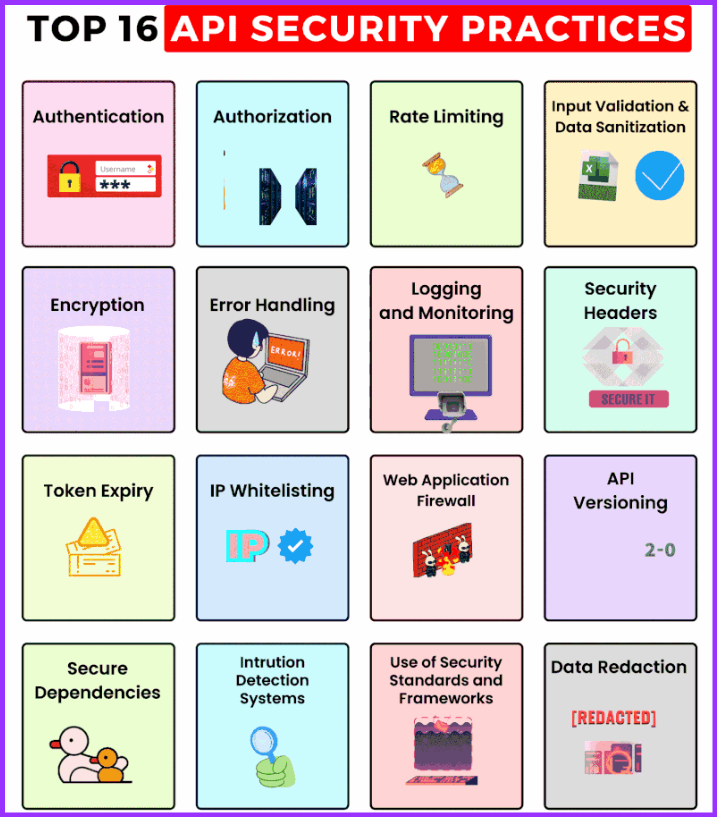
API security is of paramount importance to protect sensitive data and maintain the integrity of systems. Here are some top API security practices:

  1. Authentication and Authorization: Implement strong authentication mechanisms to ensure that only authorized users or applications can access your API. Use OAuth, API keys, or JWT (JSON Web Tokens) for secure authentication and authorization.
  2. Use HTTPS: Always use HTTPS (TLS/SSL) for transmitting data between clients and the API server. HTTPS encrypts data during transmission, preventing eavesdropping and man-in-the-middle attacks.
  3. Input Validation and Sanitization: Validate and sanitize all incoming data to prevent injection attacks (e.g., SQL injection, XSS). Use parameterized queries and avoid executing user-supplied data in commands.
  4. Output Encoding: Encode API responses correctly to prevent script injection attacks (XSS). Use content type negotiation to ensure the proper response format is returned.
  5. Rate Limiting and Throttling: Implement rate limiting and request throttling to prevent abuse and protect against DDoS attacks.
  6. Avoid Sensitive Data in URLs: Avoid passing sensitive data (e.g., passwords, tokens) in URLs, as they may get logged in various systems.
  7. JWT Best Practices: If using JWT for authentication, follow best practices such as setting a reasonable expiration time, not storing sensitive information in the token, and using strong cryptographic algorithms.
  8. Least Privilege Principle: Grant the least privilege required for users or applications accessing the API. Limit access to only the necessary resources and actions.
  9. Secure Error Handling: Avoid displaying sensitive information in error messages. Provide generic error messages to end-users and log detailed errors for debugging purposes.
  10. API Versioning: Use versioning to manage changes in the API and avoid breaking existing client applications.
  11. Audit and Monitor API Activity: Implement logging and monitoring mechanisms to track API usage and detect suspicious activities or anomalies.
  12. Regularly Update and Patch: Keep the API server, libraries, and dependencies up-to-date with the latest security patches to mitigate known vulnerabilities.
  13. Secure Data Transmission and Storage: Encrypt sensitive data both in transit and at rest. Use strong encryption algorithms and ensure proper key management.
  14. Implement Two-Factor Authentication (2FA): For highly sensitive APIs, consider adding an extra layer of security with two-factor authentication to ensure stronger user verification.
  15. Security Testing: Regularly conduct security assessments, penetration testing, and code reviews to identify and address potential security vulnerabilities.
  16. API Gateway: Consider using an API gateway to centralize security policies, handle authentication, and manage traffic to backend services.
  17. Security Headers: Set appropriate security headers in API responses to protect against common web vulnerabilities.
  18. Implement authentication and authorization. This is the most basic level of API security, and it ensures that only authorized users can access your APIs. There are a number of different authentication methods available, such as OAuth 2.0, API keys, and username/password.
  19. Use SSL/TLS encryption. This encrypts all traffic between your APIs and clients, making it much more difficult for attackers to intercept and steal data.
  20. Implement rate limiting. This limits the number of requests that a client can make to your APIs in a given period of time. This can help to protect your APIs from denial-of-service attacks.
  21. Use auditing and logging. This helps you to track all API activity, so that you can identify any suspicious or malicious behavior.
  22. Restrict access to sensitive data. Only allow authorized users to access sensitive data, such as passwords, credit card numbers, and social security numbers.
  23. Use a security gateway. A security gateway can help to protect your APIs from a variety of threats, such as cross-site scripting (XSS) attacks, SQL injection attacks, and denial-of-service attacks.
  24. Keep your APIs up to date. Software updates often include security patches, so it’s important to keep your APIs up to date to protect them from known vulnerabilities.

In addition to these general practices, there are a number of specific security measures that you can take to protect your APIs, depending on the specific type of API you are developing. For example, if you are developing a REST API, you should consider using the following security measures:

Use JSON Web Tokens (JWTs) for authentication and authorization. JWTs are a secure way to transmit authentication and authorization information between your APIs and clients.

Use HTTPS for all API requests and responses. This ensures that all traffic between your APIs and clients is encrypted.

Validate all API input data. This helps to protect your APIs from malicious input that could be used to exploit vulnerabilities.

Use API versioning. This helps to protect your APIs from breaking changes that could be introduced in new versions.

Post Views: 2,999
Subscribe
Login
Notify of
guest
guest
0 Comments
Oldest
Newest Most Voted
Inline Feedbacks
View all comments
  • Linux Server Diagnostic Commands: Complete Guide for Performance, Network & System Troubleshooting
  • The Ultimate Guide to CDOM – Certified DataOps Manager Certification
  • The Practical Path to AI Reliability: A Guide to the Certified MLOps Manager
  • Master the Machine Learning Lifecycle:Guide to Becoming a Certified MLOps Architect
  • How to Build a Project-Level AI Memory System That Works Across Codex, Claude, and Other AI Coding Tools
  • Certified MLOps Professional: A Deep Dive into the Certified MLOps Professional Certification
  • Certified MLOps Engineer : The Comprehensive Guide to Mastering Machine Learning Operations
  • Codex vs Claude: A Complete Practical Guide for Modern Developers (2026)
  • Certified AIOps Professional Program A Guide to Career Growth
  • Keycloak Multi-Client Architecture with Project-Based Email Validation (Student, Trainer, Company, Consulting)
  • Incorrect definition of table mysql.column_stats
  • Mautic and PHP 8.3 Compatibility Guide (2026)
  • Certified AIOps Engineer: The Complete Career Path and Certification Guide
  • How to Rename Apache Virtual Host Files Safely (Step-by-Step Guide for Linux)
  • AIOps Foundation Certification: Everything You Need to Know to Get Certified
  • DevOps to Certified Site Reliability Professional: A Senior Mentor’s Guide
  • Certified Site Reliability Manager Training, Preparation, and Career Mapping
  • Certified Site Reliability Architect: The Complete Career Guide
  • What Is a VPN? A Complete Beginner-to-Advanced Tutorial
  • How to Install, Secure, and Tune MySQL 8.4 on Ubuntu 24.04 for Apache Event MPM and PHP-FPM
  • Complete Guide to Certified Site Reliability Engineer Career
  • Certified DevSecOps Professional Step by Step
  • Certified DevSecOps Manager: Complete Career Guide
  • Certified DevSecOps Engineer: Skills, Career Path and Certification Guide
  • Step-by-Step: Become a Certified DevSecOps Architect
  • Tuning PHP 8.3 for Apache Event MPM and PHP-FPM on Ubuntu: A Complete Step-by-Step Production Guide
  • Complete Step-by-Step Guide to Configure Apache Event MPM, Create index.php, Set Up VirtualHost, and Fix Ubuntu Default Page
  • Convert XAMPP Apache to Event MPM + System PHP-FPM
  • The Gateway to System Observability Engineering (MOE)
  • How to Finetune Apache and Prove It Works: A Real-World Guide to Testing Performance, Concurrency, HTTP/2, Memory, CPU, and Security

Recent Comments

  1. emmy day on SQLSTATE[42S22]: Column not found: 1054 Unknown column ‘provider’ in ‘field list’
  2. digital banking on Complete Tutorial: Setting Up Laravel Telescope Correctly (Windows + XAMPP + Custom Domain)
  3. SAHIL DHINGRA on How to Uninstall Xampp from your machine when it is not visible in Control panel programs & Feature ?
  4. Abhishek on MySQL: List of Comprehensive List of approach to secure MySQL servers.
  5. Kristina on Best practices to followed in .httacess to avoid DDOS attack?

Archives

  • April 2026
  • March 2026
  • February 2026
  • January 2026
  • December 2025
  • November 2025
  • October 2025
  • September 2025
  • August 2025
  • July 2025
  • June 2025
  • May 2025
  • April 2025
  • March 2025
  • February 2025
  • January 2025
  • December 2024
  • November 2024
  • October 2024
  • September 2024
  • August 2024
  • July 2024
  • June 2024
  • May 2024
  • April 2024
  • March 2024
  • February 2024
  • January 2024
  • December 2023
  • November 2023
  • October 2023
  • September 2023
  • August 2023
  • July 2023
  • May 2023
  • April 2023
  • March 2023
  • February 2023
  • January 2023
  • December 2022

Categories

  • Ai
  • AI Blogging
  • AiOps
  • ajax
  • Android Studio
  • Antimalware
  • Antivirus
  • Apache
  • Api
  • API Security
  • Api Testing
  • APK
  • Aws
  • Bike Rental Services
  • ChatGPT
  • Code Linting
  • Composer
  • cPanel
  • Cyber Threat Intelligence
  • Cybersecurity
  • Data Loss Prevention
  • Database
  • dataops
  • Deception Technology
  • DeepSeek
  • Devops
  • DevSecOps
  • DevTools
  • Digital Asset Management
  • Digital Certificates
  • Docker
  • Drupal
  • emulator
  • Encryption Tools
  • Endpoint Security Tools
  • Error
  • facebook
  • Firewalls
  • Flutter
  • git
  • GITHUB
  • Google Antigravity
  • Google play console
  • Google reCAPTCHA
  • Gradle
  • Guest posting
  • health and fitness
  • IDE
  • Identity and Access Management
  • Incident Response
  • Instagram
  • Intrusion Detection and Prevention Systems
  • jobs
  • Joomla
  • Keycloak
  • Laravel
  • Law News
  • Lawyer Discussion
  • Legal Advice
  • Linkedin
  • Linkedin Api
  • Linux
  • Livewire
  • Mautic
  • Medical Tourism
  • MlOps
  • MobaXterm
  • Mobile Device Management
  • Multi-Factor Authentication
  • MySql
  • Network Traffic Analysis tools
  • Paytm
  • Penetration Testing
  • php
  • PHPMyAdmin
  • Pinterest Api
  • Quora
  • SAST
  • SecOps
  • Secure File Transfer Protocol
  • Security Analytics Tools
  • Security Auditing Tools
  • Security Information and Event Management
  • Seo
  • Server Management Tools
  • Single Sign-On
  • Site Reliability Engineering
  • soft 404
  • software
  • SuiteCRM
  • SysOps
  • Threat Model
  • Twitter
  • Twitter Api
  • ubuntu
  • Uncategorized
  • Virtual Host
  • Virtual Private Networks
  • VPNs
  • Vulnerability Assessment Tools
  • Web Application Firewalls
  • Windows Processor
  • Wordpress
  • WSL (Windows Subsystem for Linux)
  • X.com
  • Xampp
  • Youtube
©2026 DevSecOps Now!!! | WordPress Theme: EcoCoded
wpDiscuz