Limited Time Offer!
For Less Than the Cost of a Starbucks Coffee, Access All DevOpsSchool Videos on YouTube Unlimitedly.
Master DevOps, SRE, DevSecOps Skills!
Introduction
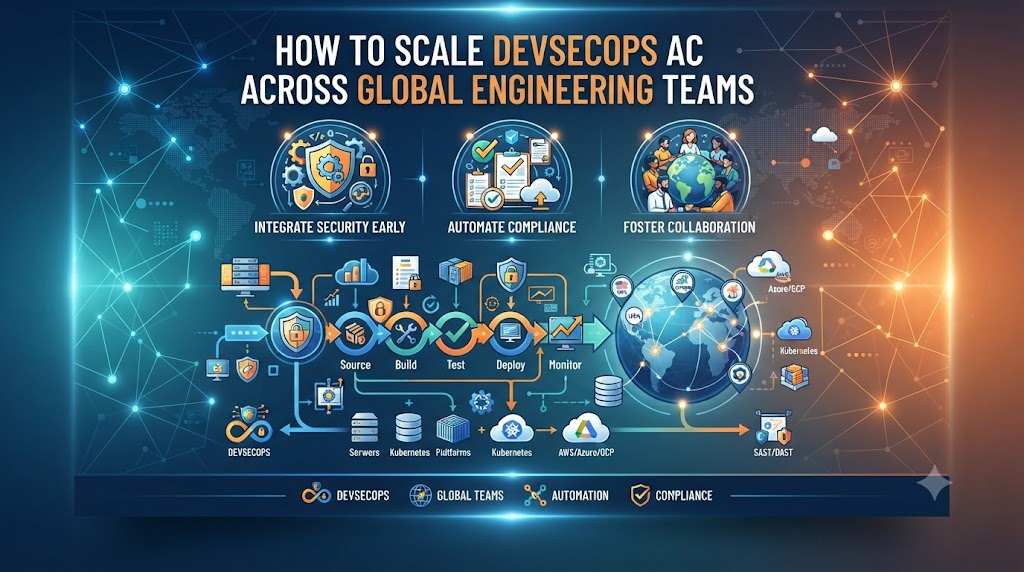
Scaling DevSecOps across a global enterprise requires balancing enterprise risk management with engineering velocity, moving far beyond rigid manual controls to embrace a scalable operating model that supports multiple regions, cloud environments, and technology stacks while leveraging guidance from specialized organizations like DevOpsSchool. Ultimately, achieving this successfully is never about forcing every team into one rigid, bureaucratic process; rather, it combines common security principles, clear governance, reusable platforms, secure defaults, team ownership, and continuous improvement so that organizations can standardize the outcomes, provide secure defaults, enable teams, automate where useful, measure effectively, and continuously improve.
What Does Scaling DevSecOps Mean?
Scaling DevSecOps does not mean imposing a single, monolithic security gate on every piece of code written across the enterprise. Instead, scaling means enabling many engineering teams to consistently adopt secure engineering practices while maintaining appropriate operational autonomy.
Effective scaling rests upon five fundamental pillars:
- Common Principles: Clear, agreed-upon security objectives that apply across the entire enterprise.
- Reusable Platforms: Shared services, golden paths, and automated pipelines built by platform engineering teams.
- Guardrails: Automated checks and policy-as-code validations that prevent critical risks without blocking delivery.
- Team Enablement: Empowering engineers with training, clear documentation, and accessible security support.
- Measurement: Data-driven visibility into security posture, vulnerability trends, and engineering friction.
Scaling successfully means centralizing what requires consistency while decentralizing execution so that individual teams can move fast without sacrificing safety.
Why DevSecOps Is Difficult to Scale Globally
Attempting to scale security across a global enterprise introduces friction points that do not exist in localized environments. Understanding these challenges is the first step toward building a resilient program.
Key Organizational and Technical Friction Points
- Team diversity: Varying skill sets, local team cultures, and communication styles affect how security guidance is interpreted and applied.
- Tool diversity: Organic tool adoption often leaves different business units using incompatible security scanners, ticketing systems, and artifact repositories.
- Technology diversity: Supporting everything from serverless functions to mainframe applications requires flexible security patterns rather than a one-size-fits-all scanner.
- Regional regulations: Data sovereignty laws and local privacy mandates restrict how security logs and vulnerability data can be aggregated across borders.
- Cloud differences: Disparate cloud provider configurations, permission models, and native security tooling create inconsistent visibility.
- Legacy systems: Older applications often lack automated testing hooks, making traditional security integration impractical without major re-architecting.
- Organizational silos: Historical barriers between security, development, and operations teams can lead to finger-pointing during security incidents.
- Time-zone differences: Global follow-the-sun operations require asynchronous communication channels and well-documented escalation paths.
Solutions designed for a single high-performing team will invariably break when applied blindly across hundreds of distributed squads.
Centralized vs Federated DevSecOps Operating Model
Organizations must choose an operating model that aligns with their culture, regulatory obligations, and structural maturity.
| Centralized Model | Federated Model |
| Central security team controls most activities | Central team provides standards and platforms |
| Strong consistency | Balanced consistency and autonomy |
| Easier governance | Better team flexibility |
| Risk of bottlenecks | Requires stronger coordination |
| Slower local decision-making | Faster team-level decisions |
Selecting the Right Approach
A purely centralized model creates severe delivery bottlenecks, turning the security team into a gatekeeper for every minor code change. A purely decentralized model results in tool sprawl, inconsistent risk postures, and regulatory blind spots.
For most large enterprises, a balanced model is the most effective path forward:
$$\text{Central Governance} + \text{Shared Platforms} + \text{Embedded Security} + \text{Team Ownership}$$
The central organization defines the boundaries and provides the tools, while local engineering teams retain ownership of their applications and daily remediation workflows.
Establish a Global DevSecOps Strategy
A sustainable global strategy defines outcomes and boundaries rather than prescribing every technical implementation detail. Leadership must establish clear pillars for the security program:
- Security principles: Core tenets such as defense-in-depth, least privilege, and shift-left validation.
- Risk appetite: Clear definitions of acceptable risk thresholds for different classes of applications.
- Required controls: Non-negotiable security expectations that apply to all production environments.
- Engineering standards: Guidelines for secure coding, infrastructure design, and data handling.
- Platform strategy: Investment in shared tooling and self-service security capabilities.
- Ownership model: Clear demarcation of responsibilities between central security, platform engineering, and product squads.
- Metrics: Key performance indicators focused on risk reduction and developer velocity.
- Exception process: A structured mechanism for handling valid business justifications that bypass standard controls.
- Review process: Regular cadence for evaluating strategy effectiveness against emerging threat landscapes.
Define Non-Negotiable Security Controls
Global consistency is essential for high-risk domains, but teams must understand the distinction between a mandatory control and an implementation choice.
[Mandatory Control Objective] (e.g., All production data must be encrypted at rest)
       │
       ├──> Approved Implementation Option A (Cloud-managed KMS)
       ├──> Approved Implementation Option B (External Key Manager)
       └──> Approved Implementation Option C (Hardware Security Module)
Areas Requiring Global Consistency
- Identity protection: Mandatory multi-factor authentication and secure session management.
- Secrets management: Prohibition of hardcoded credentials and enforcement of centralized secret stores.
- Critical vulnerability handling: Defined Service Level Agreements (SLAs) for addressing high and critical flaws.
- Security logging: Standardized audit trail generation and secure log shipping.
- Access control: Strict enforcement of the principle of least privilege across all environments.
- Artifact integrity: Cryptographic verification of software dependencies and container images.
- Production protection: Segregation of duties between development, staging, and production environments.
Standardize What Should Be Standardized
Over-standardization stifles innovation, while under-standardization creates chaos. Organizations should apply standards where they protect the enterprise without restricting engineering creativity.
High-Value Standardization Areas
- Security policies: Clear, accessible documents outlining corporate expectations.
- Control objectives: What must be achieved rather than how it must be built.
- Identity patterns: Unified federation and authentication protocols.
- Logging requirements: Consistent log formats for security event monitoring.
- Vulnerability severity definitions: Enterprise-wide alignment on Common Vulnerability Scoring System (CVSS) thresholds.
- Security evidence: Standardized reporting formats for compliance audits.
- Minimum secure configuration: Baseline hardening guides for operating systems and cloud services.
Create Reusable DevSecOps Platforms
Platform engineering acts as the force multiplier for global security. By embedding security into shared platforms, organizations can protect hundreds of teams simultaneously.
$$\text{Build Once} \longrightarrow \text{Secure Once} \longrightarrow \text{Reuse Across Teams}$$
Core Platform Capabilities
- Secure CI/CD templates: Pre-configured pipeline components with built-in security scans.
- Infrastructure modules: Pre-vetted Terraform or OpenTofu modules enforcing secure defaults.
- Security scanning services: Centralized scanning engines accessible via self-service APIs.
- Secrets integration: Native sidecars or SDKs connecting applications to secure vaults.
- Identity patterns: Reusable authentication middleware and token validation libraries.
- Policy enforcement: Automated policy-as-code gates integrated into deployment workflows.
Build Secure CI/CD at Global Scale
Pipelines are the backbone of software delivery. A scalable pipeline model ensures security checks occur continuously without creating manual hurdles.
Source ──> Code Validation ──> Security Checks ──> Build ──> Artifact Security ──> Deployment Validation ──> Environment Deployment ──> Runtime Monitoring
Centralized pipeline templates ensure that security scans run consistently across all repositories. However, platform teams must allow parameterization so teams can adjust non-security build steps to fit their unique language runtimes.
Scale Application Security Across Teams
Application security (AppSec) cannot scale if security engineers manually review every pull request. Transitioning to a scalable model requires shifting security testing left and empowering developers.
- Secure coding standards: Published guidelines integrated directly into IDEs via linters.
- Code review: Peer reviews augmented by automated static analysis tools (SAST).
- Dependency scanning: Automated checking of open-source libraries for known vulnerabilities (SCA).
- API security: Automated contract testing and schema validation.
- Dynamic testing (DAST): Automated security testing embedded in staging pipeline runs.
- Threat modeling: Lightweight design reviews focused on high-risk features and architectural changes.
Scale Vulnerability Management
Managing thousands of vulnerabilities across a global asset inventory requires a structured, automated workflow.
Detection ──> Normalization ──> Risk Assessment ──> Prioritization ──> Ownership ──> Remediation ──> Verification ──> Reporting
Central visibility tools collect findings from multiple scanners, but remediation ownership must remain with the engineering team closest to the codebase.
Global Vulnerability Prioritization Framework
Relying strictly on CVSS base scores leads to alert fatigue. Global teams must prioritize vulnerabilities based on contextual risk factors:
- Exploitability: Is there public exploit code available in the wild?
- Internet exposure: Is the vulnerable asset directly accessible from the public internet?
- Asset criticality: Does the service handle core business logic or sensitive data?
- Business impact: What is the financial or operational cost of a potential breach?
- Data sensitivity: Does the application process regulated data types?
- Active exploitation: Are threat actors actively targeting this flaw globally?
- Compensating controls: Are web application firewalls or network isolation mitigating the risk?
Scale Secrets Management
Hardcoded secrets are a primary vector for enterprise breaches. Global organizations must enforce strict secrets lifecycle management.
- Central standards: Clear policies prohibiting plaintext storage of credentials.
- Approved patterns: Mandating the use of enterprise secret stores (e.g., HashiCorp Vault, cloud native key vaults).
- Rotation: Automated rotation schedules for service accounts, database passwords, and API keys.
- Access control: Strict scoping ensuring applications only access secrets required for their specific function.
- Auditing: Comprehensive logging of all secret retrieval events.
- Regional requirements: Ensuring secret storage complies with local data residency laws where applicable.
Scale Infrastructure as Code Security
Infrastructure as Code (IaC) defines modern cloud environments. Securing IaC prevents cloud misconfigurations before deployment.
$$\text{Reusable Module} \longrightarrow \text{Policy Validation} \longrightarrow \text{Review} \longrightarrow \text{Deployment} \longrightarrow \text{Monitoring}$$
- Secure modules: Distributing pre-approved infrastructure templates.
- Policy as Code: Using automated tools (e.g., OPA/Rego, Checkov) to validate configurations against security baselines.
- Static analysis: Scanning IaC files during the pull request phase.
- State protection: Encrypting and restricting access to Terraform state files.
- Drift detection: Continuously monitoring cloud environments for unauthorized manual changes.
Scale Container Security
Containers form the execution unit for modern microservices. Common container security standards protect runtime environments across clusters.
- Approved base-image strategy: Maintaining a curated repository of hardened base images.
- Image scanning: Automated vulnerability and malware checks during the build phase.
- Registry controls: Restricting production clusters to pull only from trusted, scanned enterprise registries.
- Non-root execution: Enforcing container execution under non-privileged user accounts.
- Runtime controls: Monitoring container behavior for anomalous system calls.
Scale Kubernetes Security
Kubernetes environments require robust multi-tenancy and cluster hardening practices.
- Cluster standards: Enforcing consistent hardening baselines across all Kubernetes deployments.
- RBAC: Implementing strict role-based access control with regular permission audits.
- Namespace isolation: Logically separating workloads by team, environment, and sensitivity.
- Network policies: Restricting pod-to-pod communication using default-deny models.
- Admission controls: Using validating webhooks to block non-compliant resource definitions.
Scale Cloud Security Across Regions
Managing cloud security across multiple regions and accounts requires centralized visibility paired with localized governance.
- IAM: Centralized identity federation with regional resource scoping.
- Network architecture: Standardized Virtual Private Cloud (VPC) peering, transit gateways, and secure edge filtering.
- Encryption: Mandatory encryption of data in transit and at rest using enterprise-managed keys.
- Logging: Centralized aggregation of cloud audit logs while respecting data residency boundaries.
- Posture management: Automated cloud security posture management (CSPM) tools monitoring misconfigurations.
Global Identity and Access Management
Identity is the modern security perimeter. Enterprise scale demands rigorous identity lifecycle management.
- Workforce identities: Secure single sign-on (SSO) integrated with enterprise directory services.
- Service identities: Secure workload identity federation replacing long-lived credentials.
- Privileged access: Just-in-time access provisioning for administrative tasks.
- Role design: Standardized role definitions enforcing separation of duties.
- Access reviews: Regular automated attestation campaigns verifying user entitlements.
Managing Regional Compliance Requirements
Global organizations must navigate complex legal landscapes without fracturing their security programs.
[Global Policy] ──> [Control Objective] ──> [Approved Pattern] ──> [Regional Adaptation] ──> [Team Implementation] ──> [Evidence]
By separating high-level control objectives from regional implementation details, organizations can satisfy local data protection laws (such as GDPR or regional financial regulations) without maintaining entirely separate security workflows for every country.
DevSecOps Champions Program
Security cannot scale through a central team alone. A security champions network embeds security culture directly within engineering squads.
- Champion selection: Passionate engineers nominated by their peers and supported by leadership.
- Training: Advanced security education, threat modeling workshops, and secure coding labs.
- Community meetings: Regular global syncs to share lessons learned and new tooling updates.
- Security office hours: Dedicated channels for champions to consult with application security specialists.
- Feedback loops: Champions acting as the voice of the developer community, helping central security refine policies.
Security Enablement and Developer Experience
Security controls that introduce excessive friction are routinely bypassed. Sustainable DevSecOps focuses on developer experience (DevEx).
$$\text{Secure by Default} + \text{Easy to Use} + \text{Fast Feedback}$$
When security tools provide clear, actionable remediation guidance directly within the developer’s native workflow, adoption increases organically.
Scaling Security Training Globally
Education must be tailored to specific professional roles rather than delivered as a generic annual compliance module.
- Developer training: Practical labs focused on OWASP Top Ten vulnerabilities and secure coding practices.
- DevOps training: Guidance on pipeline security, secret management, and artifact integrity.
- Security training: Advanced threat intelligence, incident response, and cloud forensics.
- Manager awareness: Training focused on risk management, metric interpretation, and supporting security initiatives.
Tool Standardization and Tool Sprawl
Tool sprawl occurs when different teams adopt disconnected security scanners, creating massive licensing waste and inconsistent reporting.
- Approved tools: A curated catalog of enterprise-supported security utilities.
- Shared services: Centralizing scanner infrastructure so individual teams do not have to manage tool licenses.
- Reference architectures: Documented patterns showing how approved tools integrate into pipelines.
- Exceptions: A clear governance path for teams requesting specialized tooling for unique technology stacks.
Global DevSecOps Governance
Governance should act as an enabler rather than a bureaucratic checkpoint.
- Standards maintenance: Living security policies updated in collaboration with engineering leaders.
- Architecture reviews: Collaborative security design sessions during the early phases of project planning.
- Metrics tracking: Continuous evaluation of security health across business units.
- Continuous improvement: Using post-incident reviews and audit findings to refine enterprise guardrails.
DevSecOps Exception Management at Scale
Business realities sometimes require temporary deviations from standard security controls.
Exception Request ──> Risk Assessment ──> Compensating Control ──> Approval ──> Expiration ──> Review
Exceptions must never be open-ended. Every approved exception requires a documented risk acceptance, defined compensating controls, a strict expiration date, and executive sign-off.
Scaling Incident Response Across Global Teams
Security incidents require coordinated global execution across different time zones.
- Incident ownership: Clear playbooks defining who leads containment and recovery efforts.
- Escalation paths: Transparent routing rules connecting local teams with central incident commanders.
- Follow-the-sun support: Handoff protocols ensuring continuous monitoring and response coverage across global centers.
- Post-incident reviews: Blameless retrospectives focused on systemic improvements and preventive controls.
Global DevSecOps Observability and Metrics
Leadership needs accurate data to evaluate security program health without turning metrics into punitive weapons against engineering teams.
Core Metrics to Track
- Vulnerability aging: Average time required to remediate critical and high findings.
- Security test coverage: Percentage of repositories incorporating automated SAST and SCA scans.
- Security exceptions: Number of active, expired, and pending exception requests.
- Incident response time: Mean time to detect (MTTD) and mean time to resolve (MTTR) security events.
- Policy compliance: Percentage of cloud resources adhering to baseline security configurations.
- Pipeline security coverage: Adoption rate of standardized secure CI/CD templates.
DevSecOps Maturity Across Global Teams
Organizations progress through distinct maturity stages as they scale their security capabilities:
- Level 1 – Fragmented: Teams use inconsistent, ad-hoc security practices with heavy reliance on manual reviews.
- Level 2 – Defined: Common security policies and baseline standards are documented and introduced to engineering groups.
- Level 3 – Standardized: Reusable security controls, golden templates, and automated scanning platforms are established.
- Level 4 – Scaled: Most engineering squads successfully utilize common secure engineering patterns within automated pipelines.
- Level 5 – Optimized: Security, engineering, platform, and reliability practices continuously improve using automated telemetry and measurable feedback loops.
Different business units within a global enterprise will naturally sit at different maturity levels.
How to Handle Teams at Different Maturity Teams
$$\text{Assess} \longrightarrow \text{Segment} \longrightarrow \text{Prioritize} \longrightarrow \text{Enable} \longrightarrow \text{Measure} \longrightarrow \text{Improve}$$
Organizations must tailor their enablement strategies based on team maturity:
- New teams: Provide fully managed secure templates and golden paths right from project inception.
- Mature cloud-native teams: Grant autonomy to integrate advanced security controls while maintaining compliance reporting.
- Legacy application teams: Focus on perimeter protection, dependency patching, and incremental refactoring rather than full pipeline rewrites.
- High-risk applications: Apply rigorous threat modeling, penetration testing, and continuous runtime monitoring.
Legacy Application DevSecOps at Global Scale
Legacy systems present unique scaling challenges due to brittle architectures, older runtimes, and manual deployment procedures.
Organizations should avoid forcing legacy applications into modern CI/CD pipelines before they are ready. Instead, implement compensating controls such as network segmentation, virtual patching, egress filtering, and enhanced runtime monitoring while gradual modernization plans are put in place.
DevSecOps for Mergers, Acquisitions, and New Engineering Teams
Integrating newly acquired companies or newly formed engineering centers requires a structured onboarding framework to align security posture without crushing innovation.
Assess ──> Map ──> Identify Gaps ──> Prioritize ──> Integrate ──> Monitor
The central security team should assess the acquired estate, map existing controls to enterprise baselines, prioritize high-risk gaps, and integrate the new teams into the shared platform ecosystem progressively.
Common Mistakes When Scaling DevSecOps Globally
- Centralizing every decision and turning the security team into a delivery bottleneck.
- Treating every engineering team identically regardless of technology stack or maturity.
- Adopting a tool-first implementation strategy without defining processes or operating models.
- Inserting excessive, manual security gates that destroy developer velocity.
- Failing to invest in platform engineering and reusable security templates.
- Operating without a transparent, time-bound exception management process.
- Measuring teams solely on compliance checkboxes rather than actual risk reduction.
Real-World Global Enterprise Scenario
Consider a multinational enterprise operating with 200+ engineering squads distributed across North America, Europe, and Asia. The organization maintains multi-cloud footprints (AWS and Azure) alongside legacy on-premises data centers, resulting in tool sprawl and inconsistent security baselines.
Current State ──> Assessment ──> Global Standards ──> Reusable Platform ──> Team Enablement ──> Security Champions ──> Metrics ──> Continuous Improvement
By moving away from fragmented local practices and establishing a federated operating model supported by a central platform team, the organization introduces golden pipeline templates, deploys a global security champions network, and achieves enterprise-wide visibility while preserving local engineering autonomy.
Global DevSecOps Operating Model
Central Security Team
- Responsible for security strategy, enterprise standards, risk frameworks, security architecture, threat intelligence, and overall governance.
Platform Team
- Responsible for secure developer platforms, CI/CD capabilities, shared infrastructure modules, reusable controls, and self-service automation.
Engineering Teams
- Responsible for secure application delivery, vulnerability remediation, secure configuration, incident participation, and application risk ownership.
Security Champions
- Responsible for local enablement, security awareness, peer communication, and feedback loops between squads and central security.
DevSecOps Global Scaling Framework
- Layer 1 – Strategy: Define clear enterprise security objectives and risk appetite.
- Layer 2 – Governance: Define non-negotiable control objectives and baseline policies.
- Layer 3 – Platform: Provide reusable capabilities, golden modules, and secure CI/CD templates.
- Layer 4 – Enablement: Help teams adopt secure practices through training, documentation, and champions.
- Layer 5 – Measurement: Track adoption rates, vulnerability aging, and operational outcomes.
- Layer 6 – Improvement: Use metrics and post-incident reviews to refine enterprise guardrails.
30-60-90 Day DevSecOps Global Scaling Roadmap
First 30 Days
- Assess existing engineering teams and map current security tools.
- Identify critical security gaps and high-risk application portfolios.
- Define initial non-negotiable security standards and establish executive sponsorship.
Days 31–60
- Build reusable security patterns and secure CI/CD pipeline templates.
- Launch the global security champion network and establish communication channels.
- Establish core metrics dashboards and create structured exception workflows.
- Begin pilot implementations with select engineering teams.
Days 61–90
- Expand adoption across additional business units and cloud environments.
- Enhance platform capabilities based on pilot feedback and automated policy checks.
- Address adoption barriers and establish a continuous governance cadence.
Practical Global DevSecOps Scaling Checklist
- Global DevSecOps strategy exists
- Security ownership is defined
- Required controls are documented
- Team autonomy boundaries are clear
- Reusable secure patterns exist
- CI/CD security is standardized where appropriate
- Vulnerability management is centralized for visibility
- Remediation ownership remains with engineering teams
- Secrets management standards exist
- IaC security controls exist
- Container security standards exist
- Kubernetes security standards exist
- Cloud security controls exist
- IAM standards exist
- Regional compliance requirements are mapped
- Security champions program exists
- Developer enablement exists
- Security exceptions are documented
- Incident response is coordinated globally
- Metrics are defined
- Team maturity is measured
- Legacy applications have improvement plans
- Playbooks are reviewed regularly
- Continuous improvement is established
Frequently Asked Questions
What does scaling DevSecOps across global teams mean?
Scaling DevSecOps means enabling hundreds of distributed engineering squads to consistently build and deploy secure software without sacrificing delivery speed or operational autonomy.
Should every engineering team use the same security tools?
No. While organizations should standardize core categories to prevent tool sprawl, teams working with distinct technology stacks should be allowed to use approved alternative tools that meet the same security objectives.
How can DevSecOps be standardized without reducing team autonomy?
Organizations can standardize high-level outcomes, control objectives, and reusable platform templates while allowing individual teams to choose how they implement local workflows within those guardrails.
What should a central DevSecOps team own?
The central team should own enterprise security strategy, baseline policies, governance frameworks, threat intelligence, and core platform security capabilities.
What should individual engineering teams own?
Engineering teams should own their application architecture, secure configuration, daily vulnerability remediation, and the risk posture of their specific deliverables.
How can security be integrated into global CI/CD pipelines?
By providing centralized, pre-configured pipeline templates that automatically execute static analysis, dependency scanning, and policy checks without requiring manual intervention from developers.
How can organizations manage vulnerabilities across hundreds of teams?
Organizations should use centralized visibility tools to aggregate vulnerability data while ensuring remediation ownership remains firmly with the engineering squads responsible for the affected applications.
How can DevSecOps work across different cloud environments?
By defining cloud-agnostic security policies and utilizing modular Infrastructure as Code frameworks that enforce consistent security baselines across multi-cloud deployments.
How should organizations handle regional compliance requirements?
By establishing a layered model where global control objectives are adapted locally through approved patterns that satisfy regional data residency and privacy mandates.
What is the role of DevSecOps security champions?
Security champions act as embedded advocates within development squads, bridging the gap between central security and engineering teams by promoting best practices and facilitating feedback.
How can organizations measure global DevSecOps maturity?
By tracking quantitative indicators such as vulnerability aging, pipeline security coverage, exception volumes, and incident response times alongside qualitative maturity assessments.
What are the biggest mistakes when scaling DevSecOps?
Common mistakes include centralizing all decision-making, treating every team identically, relying purely on tool adoption without process changes, and creating excessive manual security gates.
Final Thoughts
Scaling DevSecOps across global engineering teams is not about forcing every team into one rigid, bureaucratic process. Successful scaling combines common security principles, clear governance, reusable platforms, secure defaults, team ownership, and continuous enablement.
