Limited Time Offer!
For Less Than the Cost of a Starbucks Coffee, Access All DevOpsSchool Videos on YouTube Unlimitedly.
Master DevOps, SRE, DevSecOps Skills!
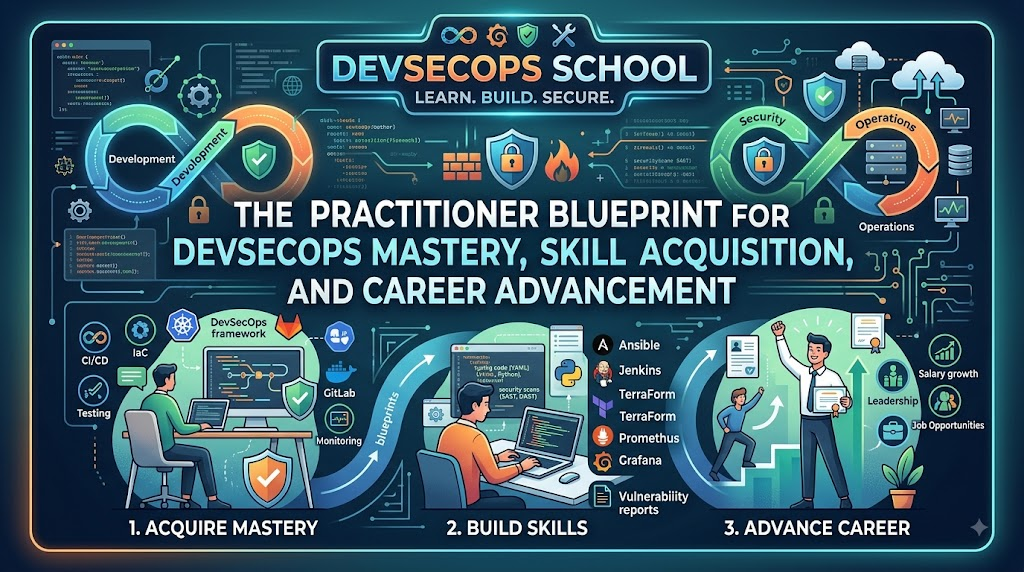
Modern software delivery operates at remarkable velocity. Cloud platforms, microservice ecosystems, and automated deployment engines enable engineering squads to ship incremental updates to live environments throughout the day. However, this acceleration exposes a severe operational friction point: legacy security methods designed for slow, staged release cycles cannot keep up with rapid code iteration. When security reviews remain isolated at the end of a project, deployment pipelines stall, vulnerabilities reach production environments, and engineering teams face disruptive emergency patches.
To overcome this structural barrier, technical organizations are adopting DevSecOps. This operating model integrates automated policy enforcement, continuous testing, and shared defensive ownership directly into the software development lifecycle. For software engineers, infrastructure specialists, and security practitioners, building competency in this discipline requires a balanced mastery of pipeline engineering, cloud-native architecture, and automated threat mitigation.
This guide provides a comprehensive breakdown of continuous security principles, essential technical proficiencies, structured educational paths, professional certification strategies, and practical career frameworks for modern cloud environments.
What Is DevSecOps?
DevSecOps represents the pragmatic union of software creation, defensive engineering, and system operations into a unified workflow. Rather than treating security as an external compliance checkpoint evaluated at the conclusion of a project, DevSecOps transforms system protection into an automated, continuous capability embedded throughout software manufacturing.
In legacy environments, technical departments operated in strict isolation. Developers focused on feature output, operations engineers managed platform availability, and security analysts conducted periodic assessments just prior to production release. When severe defects were uncovered during these late-stage evaluations, organizations faced a painful choice between missing release targets or deploying vulnerable software.
DevSecOps eliminates this friction through Shift-Left Security. By introducing automated tests, syntax linters, and configuration checks into early coding stages, engineers receive immediate feedback on their work. This proactive posture enables developers to correct logic flaws and configuration errors during regular development, significantly reducing remediation effort and operational overhead.
Why DevSecOps Matters in Modern Software Development
Modern application architectures rely heavily on third-party libraries, containerized workloads, declarative cloud definitions, and automated deployment tooling. While these advancements provide unprecedented agility, they also expand the organizational attack surface.
- Upstream Supply Chain Risk: Modern applications are built from complex webs of open-source packages. Without continuous composition analysis, vulnerable components can enter production workloads undetected.
- Declarative Infrastructure Misconfigurations: Minor errors in infrastructure automation scripts—such as open database ports or unencrypted storage volumes—can expose enterprise assets within moments of deployment.
- Continuous Delivery Alignment: Traditional security audits cannot match the cadence of pipelines deploying multiple times daily. Automated validation ensures that security guardrails scale effortlessly alongside build frequency.
- Streamlined Audit Readiness: Highly regulated sectors require continuous verification of access controls, configuration baselines, and vulnerability remediation across all active environments.
Automating these protective checks within everyday engineering workflows allows organizations to sustain high deployment velocity without compromising system integrity.
Essential DevSecOps Skills
Achieving proficiency in this discipline requires building practical capabilities across several interconnected technical domains:
Linux and Networking Fundamentals
A strong command of Linux operating system internals, process isolation, filesystem permissions, and shell automation forms the foundation of platform defense. Engineers must also master core networking concepts—including TLS configuration, DNS resolution, subnet routing, and packet filtering—to maintain secure communication across distributed systems.
Git and CI/CD Pipeline Security
Source control systems serve as the single source of truth for modern software operations. Practitioners must master branch governance rules, multi-stage pipeline configuration, and build environment isolation. Securing the pipeline infrastructure itself involves protecting build runners, rotating integration tokens, and preventing unauthorized tampering with deployment definitions.
Cloud Security
Navigating major public cloud platforms requires deep familiarity with Identity and Access Management (IAM) role boundaries, network security groups, object storage access policies, and encrypted data stores. Enforcing least-privilege permissions across machine-to-machine integrations is a critical component of platform resilience.
Containers and Kubernetes
Containerized environments introduce distinct isolation boundaries. Engineers must understand how to construct minimal container configurations, enforce non-privileged execution contexts, audit parent base layers, implement cluster role-based access controls, and define granular traffic policies across microservices.
Security Testing
Automated security testing provides immediate feedback within the CI/CD pipeline:
- Static Application Security Testing (SAST): Analyzes raw source code for structural weaknesses such as unvalidated inputs, insecure parsing, and code injection vulnerabilities.
- Software Composition Analysis (SCA): Catalogs open-source dependencies and package trees to highlight documented Common Vulnerabilities and Exposures (CVEs) and licensing non-compliance.
- Secrets Detection: Scans repositories and commit history to prevent credentials, API keys, and private tokens from leaking into code repositories.
- Dynamic Application Security Testing (DAST): Probes running applications in staging environments against common attack patterns.
Infrastructure as Code Security
As teams manage infrastructure through declarative templates like Terraform, OpenTofu, Ansible, or CloudFormation, DevSecOps engineers must scan these templates for misconfigurations before resources are provisioned. This includes catching unencrypted storage buckets, public database endpoints, and open administrative ports.
How to Build a DevSecOps Learning Path
Developing well-rounded DevSecOps expertise is an incremental process. Following a structured progression helps learners build practical competence:
- Establish Core Technical Foundations: Ensure a solid grasp of basic scripting in Python, Bash, or Go, system administration utilities, and foundational networking.
- Master CI/CD and Version Control: Learn how source code is built, tested, packaged, and deployed automatically through continuous delivery pipelines.
- Adopt Container Engineering: Practice authoring optimized Dockerfiles, managing multi-stage compilation, and minimizing runtime attack surfaces.
- Integrate Shift-Left Security Scanners: Add automated vulnerability scanners and secrets checkers into personal pipeline projects to analyze feedback loops.
- Study Cloud-Native and Kubernetes Security: Progress into container orchestration security, network policy configuration, and cloud access management.
- Focus on Runtime Defense and Monitoring: Explore security logging, audit trails, and runtime threat detection to understand how production systems report incidents.
What to Look for in DevSecOps Training
Selecting the right educational program accelerates technical development. When evaluating a DevSecOps Course or comprehensive curriculum, prioritize programs that emphasize practical application over purely theoretical lectures.
Key elements of quality programs include:
- Lab-Driven Curriculum: Theoretical concepts should immediately be followed by hands-on exercises in real environments.
- End-to-End Pipeline Workflows: The training should walk through building and securing complete pipelines rather than examining tools in isolation.
- Focus on Security Automation: Instruction should cover how to set up automated gates, handle scan outputs, and establish manageable threshold levels to prevent alert fatigue.
- Cloud and Container Depth: The coursework should address cloud-native architectures, containerization risks, and modern orchestration platforms.
- Instructor Experience: Look for programs led by active practitioners who understand enterprise workflows, legacy-to-cloud transitions, and practical engineering trade-offs.
Platforms like DevSecOps School provide structured training roadmaps that cover these foundational and advanced domains through guided, practical lab environments.
Online DevSecOps Training vs Corporate DevSecOps Training
Depending on whether you are an individual engineer or an engineering manager upskilling a department, training delivery methods vary in design and outcome.
DevSecOps Online Training
DevSecOps Online Training provides flexibility for working professionals. It enables learners to practice in dedicated virtual labs, revisit recorded sessions, and experiment with pipelines across diverse tools without geographic constraints. It is well-suited for professionals looking to transition from traditional QA, systems administration, or software development into security engineering.
Corporate DevSecOps Training
Corporate DevSecOps Training is designed for organizations looking to establish a unified security culture. Rather than training individuals in isolation, enterprise programs focus on breaking down operational silos between internal developers, DevOps teams, and security analysts. This format allows companies to align training directly with their production toolchains, compliance standards, and architectural blueprints.
Understanding DevSecOps Certification
A DevSecOps Certification validates that an engineer understands how to bridge development workflows with security requirements. Certification programs generally assess a candidate’s grasp of secure coding concepts, automated testing integration, cloud posture management, and container security.
It is important to maintain a balanced perspective on certifications:
- What Certification Offers: It provides a structured study framework, demonstrates professional initiative, and serves as formal verification of domain knowledge during hiring assessments.
- What Certification Does Not Replace: A credential alone does not substitute for hands-on problem-solving, architectural debugging, or practical troubleshooting experience.
Earning credentials such as a DevSecOps Engineer Certification or becoming a Certified DevSecOps Professional helps validate competencies, provided the candidate reinforces their study with real-world lab execution.
How to Prepare for a DevSecOps Certification
Preparing for a DevSecOps Certification Training examination requires disciplined theoretical study combined with scenario-based practice:
- Review the Exam Blueprint: Map every topic on the syllabus to a concrete hands-on exercise.
- Build a Personal Test Environment: Set up a sandbox repository, configure a pipeline using a CI tool, and integrate open-source SAST, SCA, and IaC linters.
- Practice Analyzing Vulnerability Reports: Learn how to read security scan logs, identify false positives, and apply appropriate remediation in source code or configurations.
- Understand Pipeline Fail Conditions: Learn how to configure security tools to block builds on critical findings while allowing low-severity warnings to proceed.
- Take Timed Practical Assessments: Solve scenario-based challenges to build confidence in configuring tools, debugging broken pipelines, and securing infrastructure configs under time constraints.
Career Path for a DevSecOps Engineer
The demand for professionals who understand both software velocity and defensive security continues to grow across finance, healthcare, enterprise cloud, and e-commerce sectors.
Common entry paths include:
- Software Developers moving into security by mastering pipeline automation, threat modeling, and defensive coding.
- DevOps/Site Reliability Engineers (SREs) expanding their skill sets into access management, compliance automation, and container security.
- Security Analysts and Pen Testers learning programming, CI/CD automation, and cloud platforms to shift from periodic auditing to continuous engineering.
Typical daily responsibilities involve configuring automated security scanners, defining IaC policies, reviewing security alerts with development squads, hardening Kubernetes clusters, and building automated compliance checks into deployment workflows.
Importance of Kubernetes Security Training
Because Kubernetes has become the standard orchestrator for containerized workloads, targeted Kubernetes Security Training is an increasingly critical component of modern security education.
Orchestrating microservices at scale introduces several critical layers that require systematic hardening:
- Control Plane Hardening: Securing the Kubernetes API server, enabling encryption at rest for the cluster datastore, and restricting administrative access.
- Workload and Pod Security: Implementing Pod Security Standards to restrict privileged containers, ensure immutable root filesystems, and block unnecessary Linux capabilities.
- Granular Access Control: Configuring role-based access policies (RBAC) based on the principle of least privilege for both human operators and automated service accounts.
- Network Segmentation: Implementing Kubernetes Network Policies to restrict pod-to-pod and egress traffic, preventing lateral movement during a security incident.
- Admission Controllers: Leveraging validating and mutating admission controllers to automatically reject workloads that do not meet organizational security baselines.
Why Hands-On DevSecOps Projects Matter
Hands-on projects are the most effective way to turn theoretical knowledge into operational capability. Below are practical, defensive projects you can build in a personal sandbox:
- Project 1: Secure CI/CD Pipeline from ScratchBuild a complete pipeline that automatically builds a sample web application, runs unit tests, executes SAST analysis, runs dependency scanning for vulnerable packages, checks for hardcoded credentials, and generates a structured build report.
- Project 2: Infrastructure as Code Security BaselineWrite Terraform templates for a standard cloud VPC and compute instance. Add automated linting and security scanning checks into a Git hook or pipeline to flag open security groups, unencrypted disks, or missing log configurations prior to deployment.
- Project 3: Hardened Container Build PipelineConstruct a multi-stage Dockerfile that builds an application binary, copies it to a minimal base image, runs as a non-privileged user, and scans the final image for vulnerabilities before publishing to a registry.
- Project 4: Kubernetes Admission and Policy EnforcementSet up a local test cluster and configure policy enforcement to automatically block pods configured to run as root, require resource limits, and mandate specific security labels.
Common Challenges When Learning DevSecOps
Navigating DevSecOps education can present several hurdles for learners and engineering teams:
- Tooling Overload: The cloud-native security landscape includes hundreds of specialized tools. Approach this by focusing on core principles and categories rather than attempting to learn every tool simultaneously.
- High Alert Volume: Introducing automated scanners without tuning often results in false positives that overwhelm teams. Approach this by learning how to filter scan severities and setting baseline exception rules.
- Bridging the Cultural Divide: Developers and security professionals often use different vocabularies and prioritize competing metrics. Approach this by learning how security risks translate into operational impacts and delivering clear remediation guidance.
- Complex Local Setup: Setting up full cloud environments locally can be resource-intensive. Approach this by utilizing lightweight local tools like Kind or Minikube alongside low-cost cloud sandboxes.
Best Practices for Learning DevSecOps
To maximize your learning efficiency and technical depth:
- Prioritize Fundamentals Over Syntax: Tools change rapidly, but foundational concepts like access control, network routing, process isolation, and cryptography remain consistent.
- Automate Incrementally: Start by integrating one security check into a pipeline. Once stable, add dependency auditing, static code analysis, and container scanning.
- Practice Defensive Thinking: When writing or reviewing code, actively consider what assumptions the application makes about input data, user permissions, and network availability.
- Emphasize Remediation, Not Just Detection: Finding a vulnerability is only half the job. Focus on understanding why the vulnerability occurred and how to refactor code or configurations safely.
- Engage with Technical Communities: Follow open-source security projects, participate in technical workshops, and collaborate with peer communities to stay updated on emerging defensive techniques.
Comparison Table
The following comparison outlines the primary characteristics of different learning and upskilling approaches:
| Learning Approach | Best For | Main Advantage | Key Consideration |
| Online Training | Remote learners, working professionals | Flexible access, self-paced review | Requires consistent personal study habits |
| Corporate Training | Enterprise engineering squads, platform teams | Organization-focused, unified standards | Requires departmental alignment and scheduling |
| Self-Directed Study | Highly independent engineers | Complete freedom over curriculum and pacing | Requires strong discipline and independent troubleshooting |
| Instructor-Led Bootcamps | Structured learners seeking direct mentorship | Real-time feedback, guided lab walkthroughs | Requires adherence to fixed schedule sessions |
Future Trends in DevSecOps
As infrastructure and software architectures evolve, DevSecOps continues to mature:
- Software Bill of Materials (SBOM): Organizations increasingly generate and track machine-readable inventories of every software component, library, and dependency included in production applications to quickly respond to zero-day vulnerabilities.
- AI-Assisted Security and Remediation: Machine learning models are being integrated into developer workflows to automatically suggest contextual security fixes, draft IaC policies, and reduce false-positive rates in code reviews.
- Platform Engineering with Built-In Guardrails: Internal Developer Platforms (IDPs) are incorporating security templates directly into standard deployment workflows, providing developers with pre-approved, compliant infrastructure by default.
- Continuous Cloud Compliance and Runtime Observability: Shift-left security is increasingly paired with real-time runtime detection, ensuring security visibility spans from code commit to running cluster processes.
Frequently Asked Questions
How does shift-left security change the responsibilities of software developers?
Shift-left security provides software developers with automated tools and real-time feedback during coding and pull-request creation. Instead of waiting for pre-production security assessments, developers identify and fix syntax vulnerabilities, outdated libraries, and misconfigurations as part of their routine development workflow.
Why is static analysis alone insufficient for securing modern applications?
Static Application Security Testing (SAST) analyzes uncompiled source code for programmatic errors, but it cannot observe how an application executes in a live environment. Comprehensive defense requires pairing static analysis with dependency scanning, container inspection, infrastructure verification, and runtime behavioral monitoring.
What technical skills are most critical when transitioning from DevOps to DevSecOps?
DevOps engineers already possess strong automation and deployment skills. To transition into DevSecOps, they must develop expertise in Identity and Access Management (IAM), container isolation policies, automated vulnerability triaging, secrets management, and declarative infrastructure compliance.
How does secret detection prevent cloud breaches?
Secret detection tools continuously inspect Git commits, pull requests, and build logs for exposed credentials, API keys, and cryptographic certificates. Catching exposed secrets before code is committed prevents attackers from harvesting credentials from public or shared repositories.
What is the role of admission controllers in container cluster defense?
Admission controllers act as automated interceptors within the container orchestrator’s API. They validate deployment manifests against defined security baselines and automatically reject configurations that attempt to run privileged containers or violate cluster security standards.
Where can technical professionals access comprehensive DevSecOps training in India?
Engineers seeking structured DevSecOps Training in India or through remote channels can explore curriculum pathways offered by DevSecOps School, which provides hands-on sandbox environments, practical pipeline projects, and instructor-guided courses covering modern cloud and container defense.
Conclusion
DevSecOps is not an isolated tool or a momentary trend; it is a fundamental shift in how resilient, modern software is engineered, deployed, and protected. As organizations accelerate release cadences and expand cloud-native infrastructure, the ability to build automated, secure software delivery pipelines has become an indispensable engineering skill.
Whether you are an individual engineer looking to expand your technical capabilities or an enterprise team modernizing your security operations, developing structured skills across version control, CI/CD security, cloud IAM, and container orchestration is essential. By focusing on practical labs, mastering core defensive principles, and pursuing structured learning paths, you can successfully navigate and excel in the evolving landscape of cloud and application security.
