Limited Time Offer!
For Less Than the Cost of a Starbucks Coffee, Access All DevOpsSchool Videos on YouTube Unlimitedly.
Master DevOps, SRE, DevSecOps Skills!
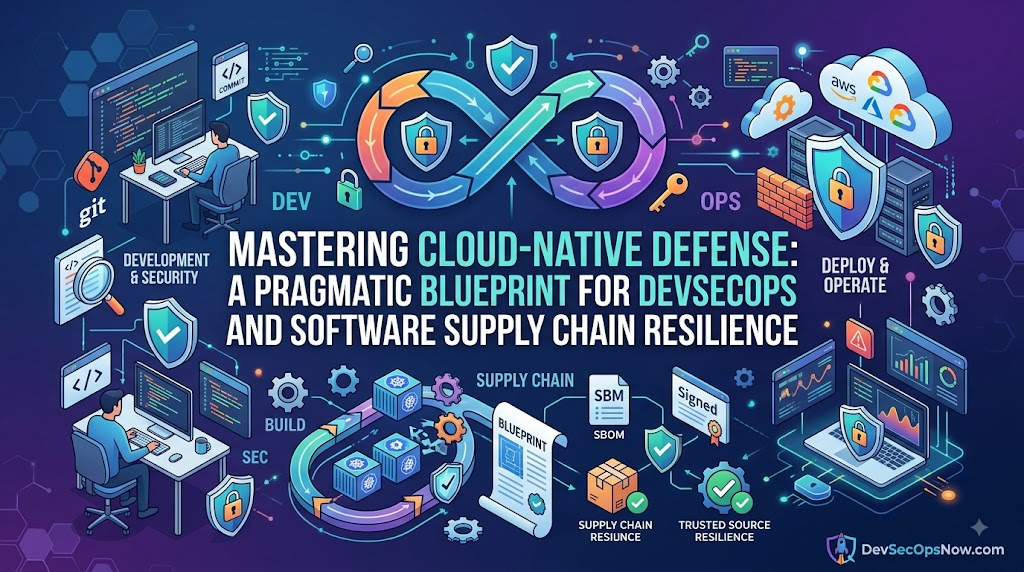
In today’s fast-paced digital landscape, the widespread adoption of microservices, serverless patterns, container orchestrators, and automated delivery pipelines has fundamentally shifted how software gets built and deployed. While this modern delivery pipeline grants unprecedented feature velocity, it significantly alters an organization’s risk profile. Contemporary software systems rarely start from a blank canvas; instead, they are assembled from external open-source packages, third-party code libraries, public container bases, and automated CI/CD runners. Consequently, an unaddressed flaw in an upstream package or a single cloud misconfiguration can turn into an open doorway for malicious actors.
Safeguarding these interconnected ecosystems requires moving away from the old model of manual, post-development security gates. Instead, security controls, policy automation, and threat mitigation must be seamlessly woven throughout every phase of the engineering lifecycle. By shifting security left and maintaining continuous visibility across production systems, tech organizations can safeguard critical data without sacrificing developer speed. This comprehensive guide details actionable approaches to protecting the software supply chain, hardening cloud-native infrastructure, leveraging expert operational support, and cultivating an engineering culture centered on proactive defense.
Deconstructing Software Supply Chain and Cloud-Native Security
Software supply chain security focuses on verifying and protecting every element, source, tool, and automation script involved in crafting and shipping digital products. This includes internal source code repositories, open-source dependencies, CI/CD runner agents, artifact registries, and target hosting platforms.
In modern engineering pipelines, application artifacts move through an automated execution path. Code moves from a local developer environment into version control, where continuous integration engines compile, scan, package, and push container images to orchestrators like Kubernetes.
Achieving complete visibility across this delivery path demands clear oversight across four distinct zones:
- Source Code and Ingestion: Authenticating contributor identities, auditing code commits, and vetting external software libraries before merging.
- Build Systems and Packaging: Isolating pipeline execution nodes, safeguarding build scripts, and cryptographically signing generated build artifacts.
- Infrastructure Configuration: Enforcing strict declarative policies across multi-cloud environments, database instances, and network boundaries.
- Runtime Operations: Monitoring deployed microservices continuously to detect anomalous execution patterns, illegal system calls, or drift from established baselines.
Establishing a dependable posture requires active, cross-functional collaboration among software developers, platform engineers, site reliability engineers (SREs), and dedicated security analysts.
The Strategic Importance of Continuous DevSecOps Integration
In traditional engineering models, security reviews were treated as a final sign-off right before release. Security engineers conducted manual audits or penetration tests right at the deployment threshold, frequently discovering fundamental architectural flaws that forced costly delays or rework. This dynamic created natural friction between product teams pushing to hit deadlines and security teams tasked with managing risk.
Shifting security left resolves this operational disconnect. By embedding lightweight, automated security validations into daily pull requests and build steps, engineering teams detect and fix flaws when they are simplest and cheapest to address.
Core organizational advantages include:
- Reduced Exposure Windows: Early detection of hardcoded keys, logic bugs, and template errors limits vulnerability exposure in live environments.
- Automated Compliance: Continuous policy enforcement simplifies regulatory reporting for standards such as SOC 2, ISO 27001, PCI-DSS, and HIPAA.
- Uninterrupted Velocity: Security transforms from an external blocker into an integrated quality control check.
- Enhanced System Resilience: Real-time visibility combined with automated policy enforcement minimizes the blast radius of operational security events.
Core Pillars of modern DevSecOps Infrastructure
Building a durable security framework requires establishing defensive measures across every operational layer of the software delivery lifecycle.
Pipeline Security and Build Isolation
Because continuous integration servers hold high-level credentials to deploy into target environments, they are primary targets for attackers. Pipeline security involves scanning code with Static Application Security Testing (SAST), detecting hardcoded credentials, running build tasks in isolated containers, and verifying artifact provenance.
Vulnerability Management and Contextual Triage
Effective vulnerability management requires more than generating long lists of potential bugs. It demands a centralized workflow that aggregates scanner output, filters out false positives, evaluates business context, and routes actionable tasks directly to developer backlogs.
Infrastructure and Cloud Governance
Managing infrastructure via Infrastructure as Code (IaC) allows teams to evaluate environment configurations before resources are provisioned. Automated static analysis of templates (such as Terraform, CloudFormation, or Bicep) identifies overly broad firewall rules or unencrypted storage buckets prior to deployment.
Container Hardening and Kubernetes Security
Container security begins by auditing base images for known vulnerabilities, using minimal container distributions, and enforcing non-root user permissions. At the orchestration level, Kubernetes security focuses on implementing Role-Based Access Control (RBAC), configuring network isolation policies, auditing API servers, and observing runtime behavior.
Supply Chain Visibility and Artifact Provenance
Managing open-source software risks relies on creating an accurate Software Bill of Materials (SBOM) for every release build. SBOMs track direct and transitive dependencies, giving technical teams immediate visibility when zero-day vulnerabilities emerge in external components.
Real-World Implementations of Security Automation
Engineering teams implement automated security practices to solve pressing operational challenges across their technology stacks:
- Automated Open-Source Auditing: A software engineering team integrates automated dependency scanning into developer pull requests. If a proposed change introduces an open-source library containing a critical vulnerability, the build engine flags the issue and suggests a patched release before merging.
- Verifiable Container Deployment: A cloud application vendor automates container image signing during CI/CD steps. Their Kubernetes clusters deploy admission controllers to block any container image lacking a valid cryptographic signature from their build pipeline.
- Enforcing Cloud Guardrails: An enterprise organization applies static analysis to IaC files stored in git repositories. Developers receive immediate, inline feedback regarding open security groups or missing encryption flags prior to updating live infrastructure.
Overcoming Common Security Implementation Hurdles
Adopting security practices across high-velocity development cycles introduces distinct operational challenges:
| Operational Challenge | Root Cause | Practical Mitigation Strategy |
| Alert Fatigue | Automated scanners generate overwhelming noise with varying severity levels. | Implement contextual risk scoring to highlight critical, highly exploitable threats. |
| Tool Fragmentation | Disparate utilities for code, containers, and cloud assets create visibility silos. | Consolidate security findings into unified dashboards integrated into developer tools. |
| Developer Friction | Heavy security checks that slow down local builds trigger resistance. | Provide lightweight IDE plugins, explicit remediation guidance, and fast scan engines. |
| Kubernetes Complexity | Highly configurable clusters lead to accidental permission sprawl. | Deploy policy-as-code engines to enforce cluster guardrails automatically. |
| Supply Chain Blind Spots | Transitive open-source dependencies change dynamically across builds. | Implement continuous SBOM generation and real-time dependency tracking across repositories. |
The Value of Specialized DevSecOps Expertise
While automated software tools form the bedrock of cloud security, many technical organizations seek external guidance to architect, scale, and mature their security operations. Working alongside experienced advisors helps engineering teams navigate complex technical decisions while avoiding costly execution mistakes.
Specialized professional services frequently cover:
- DevSecOps Consulting Services: Formulating strategic roadmaps, evaluating tooling choices, defining target architectures, and establishing policy frameworks aligned with business targets.
- DevSecOps Implementation Services: Integrating static code scanners, dynamic testing tools, secrets management vaults, and policy engines directly into active deployment pipelines.
- DevSecOps Managed Services: Delivering continuous monitoring, vulnerability triage, policy maintenance, and operational management for teams seeking ongoing operational support.
- Cloud Security Consulting Services: Reviewing cloud account structures, identity management configurations, network boundaries, and resource access policies.
- Kubernetes Security Consulting Services: Hardening cluster configurations, establishing network isolation policies, auditing API security, and enforcing container runtime protections.
- Software Supply Chain Security Services: Implementing automated SBOM generation, verifying code signatures, securing build runners, and auditing third-party code risks.
Industry-focused advisory platforms, such as DevSecOps Now, provide strategic technical guidance and practical execution paths that align security controls with continuous software delivery objectives.
Cultivating Team Capability Through DevSecOps Training
Security tools are only as effective as the professionals managing them. Building a security-conscious organization requires ongoing skill development across development, platform, and security functions.
DevSecOps Training
Software engineers benefit from tailored learning paths covering secure coding principles, threat modeling methodologies, pipeline security integrations, and dependency risk management.
Corporate DevSecOps Training
For enterprise organizations, corporate training programs align development, security, and operations teams around consistent terminology, shared responsibilities, and unified risk management goals.
Practical Hands-On Learning
Effective educational initiatives emphasize practical application. Interactive lab environments allow technical staff to practice identifying code defects, configuring container security rules, fixing IaC misconfigurations, and validating fixes in simulated environments.
How DevSecOps Security Assessments Work
Evaluating an organization’s overall security posture requires a structured review of technical architecture, automation pipelines, and operational habits. Engaging professional DevSecOps Assessment Services provides a clear methodology for identifying operational gaps:
+------------------+     +-------------------+     +--------------------+     +---------------------+
| 1. Discovery &   | --> | 2. Pipeline &     | --> | 3. Infrastructure  | --> | 4. Risk Triage &    |
| Mapping          |     | Code Audit        |     | Review             |     | Context Scoring     |
+------------------+     +-------------------+     +--------------------+     +---------------------+
                                                                                     |
                                                                                     v
                                                                          +---------------------+
                                                                          | 5. Actionable       |
                                                                          | Improvement Plan    |
                                                                          +---------------------+
- Discovery and Mapping: Documenting repositories, CI/CD tools, cloud platforms, container registries, and deployment workflows.
- Pipeline and Code Audit: Evaluating automated scanning tools, secrets management practices, pipeline isolation, and authorization controls.
- Infrastructure Review: Assessing cloud account settings, container orchestrator rules, access permissions, and network boundaries.
- Risk Triage and Context Scoring: Categorizing technical risks by business impact, ease of exploitation, and system exposure.
- Actionable Improvement Plan: Delivering a clear roadmap to remediate vulnerabilities and systematically raise security maturity.
Leveraging Penetration Testing in Modern Lifecycles
Automated scanners excel at catching known syntax errors, outdated dependencies, and simple misconfigurations. However, automated systems cannot easily spot complex logic flaws or multi-stage exploit vectors.
Specialized Penetration Testing Services complement automated pipeline checks by simulating realistic adversary tactics within authorized, controlled environments.
Key benefits include:
- Exploitability Verification: Testing whether discovered vulnerabilities pose actual operational risks within the application’s real environment.
- Business Logic Evaluation: Identifying flaws in multi-tenant boundaries, custom authentication flows, or privilege structures that scanners miss.
- Controlled Execution: Conducting targeted security evaluations against specific staging systems or APIs under formal authorization to ensure operational safety.
- Feedback Loop Enhancement: Turning manual assessment findings into automated regression tests inside the CI pipeline to prevent bugs from re-emerging.
Essential Best Practices for Secure Delivery
Building a resilient cloud security program rests on executing core engineering principles consistently:
- Shift Checks Left: Run static analysis and credentials scanning directly inside developer IDEs and pre-commit hooks.
- Enforce Strict Least Privilege: Restrict user accounts, CI execution nodes, and service roles to the minimum access levels required for their tasks.
- Deploy Policy-as-Code: Use automated policy engines to evaluate infrastructure templates, container rules, and pipeline configs automatically.
- Track Dependencies Continuously: Maintain real-time SBOMs and continuously evaluate open-source components for newly disclosed vulnerabilities.
- Centralize Secrets Management: Remove hardcoded credentials, API keys, and certificates from repositories by utilizing dedicated dynamic secrets vaults.
- Isolate Build Environments: Lock down CI runner nodes, restrict outbound network access during build steps, and cryptographically sign artifacts.
- Prioritize Based on Context: Focus remediation efforts on flaws that pose genuine business exposure rather than relying purely on default severity scores.
Technical Comparison: Defensive Testing Methods
Choosing the right security methodology for different stages of the development cycle helps teams maintain a balanced defensive posture.
| Testing Approach | Target Area | Pipeline Phase | Core Advantage | Main Consideration |
| Static Analysis (SAST) | Application source code | Local IDE & PR creation | Finds coding bugs early in development | Requires custom rule tuning to reduce noise |
| Dependency Auditing (SCA) | Open-source libraries & SBOM | Component ingestion & build | Uncovers known library flaws and license risks | Relies on accurate, updated vulnerability feeds |
| Dynamic Analysis (DAST) | Live application endpoints | Staging / Test environments | Identifies runtime and environment issues | Requires running environments; longer execution times |
| IaC Template Scanning | Cloud configuration files | Pre-deployment pipeline | Catches cloud misconfigurations before live deployment | Needs coverage across platform-specific templates |
| Penetration Testing | Full application ecosystem | Periodic scheduled reviews | Uncovers complex logic bugs and chained exploits | Requires experienced human testers and clear scope |
Key Trends Shaping Modern DevSecOps
Cloud-native security continues to adapt alongside evolving development frameworks and platform architectures:
- AI-Driven Security Automation: Machine learning algorithms are increasingly assisting with alert triage, identifying complex code anomalies, and drafting contextual code fixes for review.
- Mandatory SBOM Integration: Regulatory standards and supply chain requirements are driving broad adoption of verifiable SBOMs to maintain software provenance across global supply chains.
- Security in Platform Engineering: Internal Developer Platforms (IDPs) are increasingly embedding security guardrails directly into default paths, allowing developers to deploy secure applications by default.
- Zero-Trust CI/CD Pipelines: Organizations are applying zero-trust architectures to deployment systems, continuously authenticating every user, runner node, and API call inside the delivery process.
Frequently Asked Questions
What sets DevSecOps apart from conventional IT security models?
DevSecOps embeds security validations directly into daily development and deployment automation, whereas conventional models relied on manual testing performed at the end of a project release.
Why is software supply chain security critical for cloud applications?
Modern software is composed largely of external open-source packages and dependencies. If an attacker compromises an upstream library, every downstream application inheriting that package becomes vulnerable.
What is the core difference between static scanning and dynamic security testing?
Static testing analyzes uncompiled code files for syntax flaws and insecure patterns without running the application. Dynamic testing evaluates a live, running application to find operational flaws, improper access controls, and runtime errors.
What key areas are evaluated during a Kubernetes security audit?
A Kubernetes audit evaluates API server access permissions, Role-Based Access Control (RBAC) settings, pod security standards, namespace network policies, secret storage mechanisms, and runtime cluster activity.
What is a Software Bill of Materials (SBOM)?
An SBOM is a structured, machine-readable inventory of all code modules, third-party libraries, and components integrated into a software product, enabling fast risk assessments when new bugs are disclosed.
How can teams eliminate security tool alert fatigue?
Engineering organizations can reduce noise by scoring scanner findings based on real-world exploitability, asset exposure, and environmental context rather than fixing every low-impact finding blindly.
Conclusion
Securing modern cloud-native systems requires a comprehensive approach encompassing source code, automated delivery pipelines, cloud resources, container environments, and third-party dependencies. By embedding automated guardrails, maintaining clear visibility into application components, conducting regular technical evaluations, and fostering a collaborative security culture, technical teams can systematically reduce risk. Ultimately, integrating security into day-to-day engineering workflows allows organizations to ship features quickly while maintaining strong resilience against evolving cyber threats.
