Limited Time Offer!
For Less Than the Cost of a Starbucks Coffee, Access All DevOpsSchool Videos on YouTube Unlimitedly.
Master DevOps, SRE, DevSecOps Skills!
Introduction
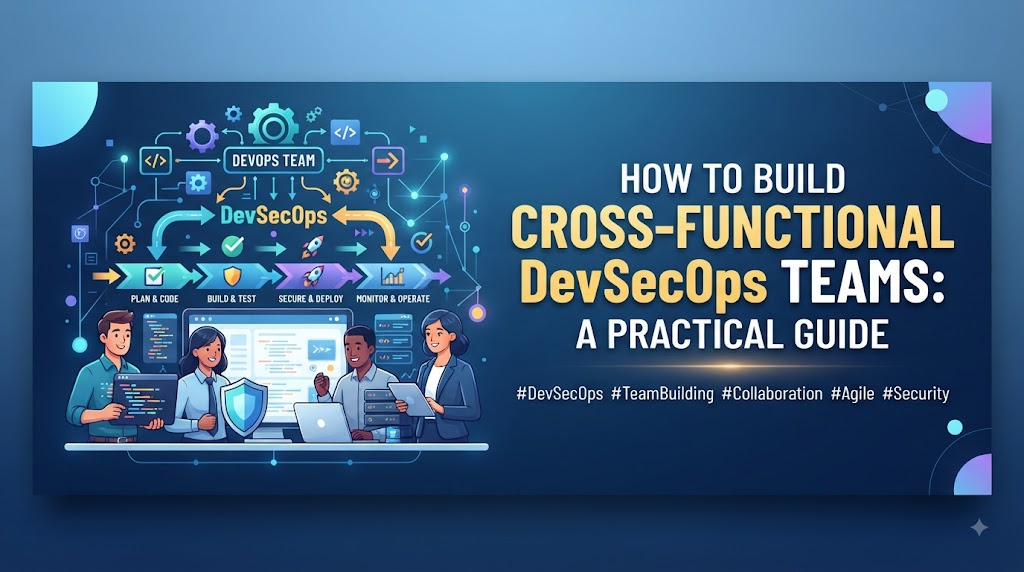
Modern software delivery requires development, operations, platform, and security teams to work together closely. Software cannot be built quickly by developers and then handed over to operations to run and security to inspect at the very end. That traditional method creates friction, delays releases, and leaves vulnerabilities hidden until production. Cross-functional DevSecOps teams bring different engineering capabilities into a shared delivery model while keeping clear ownership across the board.
Simply adding a few automated security scans to an existing continuous integration and continuous deployment pipeline is not enough to create an effective DevSecOps operating model. Tools alone cannot fix structural silos between departments. True security integration requires changing how people communicate, how responsibilities are shared, and how engineering workflows are designed from the ground up.
Organizations looking to establish this collaborative culture often seek guidance from established training providers such as DevOpsSchool to help bridge the knowledge gap between development, operations, and security personnel. When engineering teams share common goals and understand each other’s challenges, software delivery becomes both faster and inherently more secure.
What Is a Cross-Functional DevSecOps Team?
A cross-functional DevSecOps team is a single, cohesive unit that brings together multiple engineering disciplines to design, build, secure, test, deploy, and operate software. Instead of separating people by their specialized titles into different departments, this model places developers, operations engineers, security professionals, reliability engineers, and testers onto the same product or platform team.
These teams share common goals around delivery speed, system reliability, and application security. Every member holds a shared responsibility for the end-to-end lifecycle of the software. Security ownership is distributed across the group rather than being pushed off to a separate security department that reviews code only after it is finished.
Automation plays a central role by handling repetitive checks and compliance verifications inside the pipeline, allowing engineers to focus on complex problem-solving. Continuous feedback loops ensure that errors, vulnerabilities, and performance issues are identified and fixed early. This contrasts sharply with traditional teams that work independently in silos and hand work across departmental boundaries with little visibility into downstream impacts.
Why Cross-Functional DevSecOps Teams Matter
Organizational structure directly affects software security and delivery speed. When teams work in isolated silos, communication breaks down and handoffs multiply. Every handoff introduces the risk of lost context, delayed feedback, and finger-pointing when incidents occur in production.
Cross-functional DevSecOps teams reduce these silos by bringing diverse perspectives into daily engineering discussions. Security concerns are addressed during the design and coding phases rather than right before release day. This early involvement significantly lowers the cost and effort required to fix vulnerabilities.
Incident response also improves because the people who wrote the code and configured the infrastructure work together to diagnose failures and restore service. Shared accountability encourages better engineering decisions, reduces unnecessary bureaucracy, and improves overall delivery quality. When everyone understands the business value and the risk profile of the application, the team moves forward with greater alignment and confidence.
Core Roles in a Cross-Functional DevSecOps Team
In smaller organizations, a single engineer may perform multiple roles, while enterprise teams often have dedicated individuals for each function. The table below outlines how different roles contribute to a cross-functional DevSecOps team.
| Role | Primary Responsibility | DevSecOps Contribution |
| Software Developer | Writing application features and business logic | Implementing secure coding practices and unit testing |
| DevOps Engineer | Managing CI/CD pipelines and deployment automation | Integrating security checks into automated workflows |
| Security Engineer | Defining security policies and threat modeling | Providing security guidance, tooling, and vulnerability analysis |
| Cloud Engineer | Provisioning and managing cloud infrastructure | Ensuring secure cloud configurations and resource isolation |
| SRE | Maintaining system reliability, uptime, and performance | Monitoring runtime behavior and leading incident response |
| Platform Engineer | Building internal developer platforms and standards | Embedding security guardrails into shared platform templates |
| QA Engineer | Testing software functionality and quality | Integrating automated security and regression tests |
| Product Manager | Defining product roadmap, features, and priorities | Balancing feature delivery speed with risk mitigation |
| Engineering Manager | Managing team performance, resources, and culture | Fostering a collaborative culture of shared security ownership |
Shared Responsibility Model for DevSecOps
Security should never be treated as a final approval gate owned exclusively by a security department. A shared responsibility model clarifies who leads an activity and who supports it across the engineering lifecycle.
| Activity | Development | DevOps/Platform | Security | SRE |
| Secure Coding | Primary | Supporting | Consulting | Supporting |
| Dependency Management | Primary | Supporting | Consulting | None |
| CI/CD Security | Supporting | Primary | Consulting | None |
| Infrastructure Security | None | Primary | Consulting | Supporting |
| Secrets Management | Supporting | Primary | Consulting | None |
| Monitoring | Supporting | Supporting | Supporting | Primary |
| Incident Response | Supporting | Supporting | Consulting | Primary |
| Compliance | Supporting | Supporting | Primary | Supporting |
Clear ownership and accountability prevent tasks from falling through the cracks without creating unnecessary bureaucracy. When everyone knows their specific contribution to security, collaboration flows naturally.
How to Design a Cross-Functional DevSecOps Team
Designing an effective team requires a structured approach tailored to organizational needs. Follow these practical steps to build your operating model:
Step 1: Define Business and Engineering Goals
Establish clear objectives regarding deployment frequency, lead time, vulnerability remediation speed, and system uptime. Align these goals with overall business priorities.
Step 2: Map Existing Responsibilities
Document how code flows from development to production today. Identify where handoffs cause delays and where security reviews create bottlenecks.
Step 3: Identify Skill Gaps
Assess the current technical capabilities of your engineering staff. Determine whether you need to upskill existing members or hire specialists in cloud security and platform engineering.
Step 4: Define Team Boundaries
Form balanced teams around specific products, services, or platforms rather than functional departments. Ensure each team has access to development, operations, and security expertise.
Step 5: Establish Security Ownership
Use a shared responsibility matrix to clarify who owns secure coding, dependency management, and infrastructure hardening within the team.
Step 6: Define Engineering Workflows
Standardize how code is written, reviewed, tested, scanned, and deployed. Ensure workflows include automated quality and security checks.
Step 7: Automate Repetitive Controls
Implement automated static analysis, dependency scanning, and infrastructure validation to reduce manual toil and human error.
Step 8: Establish Feedback Loops
Create rapid feedback mechanisms so developers receive immediate notifications about failing tests, vulnerabilities, or performance bottlenecks.
Step 9: Define Metrics
Track meaningful metrics covering delivery performance, operational reliability, and security posture without creating perverse incentives.
Step 10: Review and Improve
Hold regular retrospectives to evaluate team performance, identify friction points, and continuously refine processes and tooling.
Team Structure Models for DevSecOps
Organizations vary in size, architecture, and regulatory requirements. Therefore, several team structure models exist to support different operational contexts.
Embedded Security Model
Security engineers work directly within product development teams. This model maximizes collaboration and ensures security is considered from day one, but it requires a high number of security professionals.
Central Security Model
A centralized security team provides organization-wide standards, tooling, and governance. While efficient for compliance, this model can slow down delivery if teams must wait for manual reviews.
Platform Security Model
Security capabilities are built directly into shared developer platforms and golden paths. Developers inherit secure defaults automatically when provisioning infrastructure or deploying applications.
Hybrid Model
Combines centralized governance with embedded security expertise. Central teams maintain policies and platform guardrails, while embedded engineers help product teams apply them locally.
| Model | Strength | Limitation | Suitable For |
| Embedded Security | High collaboration and context | Requires many security engineers | High-risk or fast-moving product teams |
| Central Security | Consistent standards and compliance | Can create approval bottlenecks | Heavily regulated enterprises |
| Platform Security | Scalable security defaults | Requires strong platform engineering | Modern cloud-native organizations |
| Hybrid Model | Balances governance and speed | Complex organizational structure | Large enterprises with diverse portfolios |
DevSecOps Team Communication
Effective communication forms the foundation of any successful cross-functional team. Teams should avoid relying on ad-hoc meetings and instead build communication around engineering workflows.
Shared documentation must be maintained in accessible repositories so that architecture decisions, runbooks, and security guidelines are clear to everyone. Using common terminology prevents misunderstandings between developers and security engineers who might otherwise speak different professional dialects.
Architecture discussions, security reviews, and technical design sessions should occur early in the planning phase. Chat channels should be organized by project or service rather than department, allowing developers, operators, and security staff to troubleshoot issues together in real time. Regular retrospectives provide a safe environment to discuss process friction and improve team collaboration continuously.
Building Security Ownership Across the Team
Distributing security responsibilities requires clear guidance across all technical domains. Teams must understand how security applies to each layer of the technology stack:
- Secure Coding: Developers write code following secure programming principles, avoiding common vulnerabilities such as injection flaws or improper input handling.
- Dependency Management: Teams regularly audit third-party libraries and packages to ensure known vulnerabilities are patched promptly.
- Secrets: Credentials, API keys, and connection strings are never hardcoded and are managed securely using dedicated vault services.
- IAM: Cloud and container access follows the principle of least privilege, ensuring users and services have only the permissions they require.
- Infrastructure: Infrastructure as Code is scanned for misconfigurations before provisioning cloud resources.
- Containers: Base images are minimized, scanned for vulnerabilities, and updated regularly.
- APIs: Endpoints are authenticated, authorized, and rate-limited to protect backend services from unauthorized access.
- Security Testing: Automated tests run within the pipeline to catch security regressions early.
- Incident Response: Development, operations, and security teams collaborate during security incidents to contain threats and remediate root causes.
Integrating Security Into the Software Lifecycle
Security is not a single phase; it spans the entire software delivery lifecycle.
Plan
↓
Design
↓
Code
↓
Build
↓
Test
↓
Secure
↓
Deploy
↓
Operate
↓
Monitor
↓
Improve
During planning and design, teams conduct threat modeling and define security requirements. In the coding and building phases, developers write unit tests and perform peer reviews. Automated pipelines execute static analysis, dependency scanning, and container verification before deployment. Once in production, operations and SRE teams monitor system behavior, while security teams analyze audit logs for anomalous activity. Insights from operations feed back into planning, completing the continuous improvement cycle.
DevSecOps Workflow Example
A practical CI/CD workflow demonstrates how shared ownership operates in daily practice:
Developer Creates Feature
↓
Pull Request
↓
Code Review
↓
Automated Tests
↓
Security Checks
↓
Build Artifact
↓
Container Scan
↓
Infrastructure Validation
↓
Deployment
↓
Monitoring
↓
Security and Reliability Feedback
When a developer submits a pull request, automated code reviews and unit tests run. Static application security testing and dependency scans execute in parallel. Once the build artifact is created, container images and infrastructure templates are validated against security policies. If all checks pass, the deployment proceeds automatically. Post-deployment monitoring feeds performance and security data back to the team for continuous refinement.
Cross-Functional DevSecOps and CI/CD
Integrating security into CI/CD requires balancing thoroughness with speed. Automated checks should be fast and reliable to maintain developer trust.
Static Application Security Testing scans source code for vulnerabilities without executing it. Dependency scanning checks open-source libraries against known vulnerability databases. Secrets scanning prevents credentials from being committed to version control. Container scanning inspects images for vulnerable OS packages and application dependencies. Infrastructure as Code scanning evaluates Terraform or Kubernetes manifests for security misconfigurations.
Deployment controls and security policies should act as automated guardrails rather than manual speed bumps, ensuring that compliant code moves smoothly to production.
Cross-Functional DevSecOps and Cloud Security
Cloud environments require tight coordination between application, platform, and security engineering functions.
Identity and Access Management policies must be configured with strict least-privilege principles. Network security groups, firewalls, and virtual private cloud configurations must isolate workloads effectively. Cloud resource configurations should be continuously audited to prevent accidental exposure of storage buckets or databases. Encryption must be enforced both in transit and at rest. Comprehensive logging and monitoring ensure that unauthorized access attempts are detected and investigated immediately.
Cross-Functional DevSecOps and Kubernetes
Kubernetes clusters combine infrastructure, application runtime, and network policies, requiring deep collaboration between platform, security, and application teams.
Cluster security involves hardening control plane components and keeping worker nodes updated. Workload security ensures containers run with non-root users and restricted capabilities. Role-Based Access Control governs who can interact with the cluster API. Network policies restrict pod-to-pod communication. Secrets management ensures sensitive data is injected securely into pods. Admission controllers enforce compliance policies at the API level before objects are created in the cluster. Runtime monitoring detects suspicious behavior inside running containers.
Cross-Functional DevSecOps and SRE
Site Reliability Engineering and DevSecOps share a common philosophy centered on automation, observability, and resilience.
SREs contribute expertise in system reliability, observability, incident response, Service Level Objectives, error budgets, and capacity planning. Security incidents and reliability incidents share similar operational workflows, including detection, containment, eradication, recovery, and post-incident learning. By aligning operational practices, teams can respond to security breaches with the same structured discipline applied to infrastructure outages.
Handling Security vs. Delivery Conflicts
Conflicts often arise when development wants speed, security wants stronger controls, and operations wants stability. Resolving these tensions requires objective frameworks rather than emotional arguments.
Teams should rely on risk assessments, verifiable evidence, and automated compensating controls. If a security scan flags a low-risk vulnerability, the team can establish a time-bound exception process rather than blocking the entire release. Clear ownership ensures that disputes are resolved based on data and risk tolerance. Security should act as an enabler that helps the business manage risk intelligently rather than a rigid blocker that stops all progress.
DevSecOps Governance Without Excessive Bureaucracy
Governance in a DevSecOps environment should be embedded directly into engineering platforms and pipelines rather than enforced through manual paperwork.
Security policies and engineering standards are codified into automated guardrails and templates. When developers use approved platform modules, they inherit compliance automatically. Risk-based approvals ensure that high-risk changes receive appropriate scrutiny while low-risk changes flow rapidly through the pipeline. Audit evidence is generated automatically by CI/CD systems, making compliance reporting straightforward and transparent.
DevSecOps Metrics for Cross-Functional Teams
Effective metrics measure delivery performance, operational stability, and security posture holistically.
| Metric | What It Tells You |
| Deployment Frequency | How often code is successfully deployed to production |
| Lead Time | How long it takes code to go from commit to production |
| Change Failure Rate | Percentage of deployments that cause a production failure |
| Mean Time to Recovery | How long it takes to restore service after an incident |
| Vulnerability Remediation Time | How quickly identified security flaws are fixed |
| Security Defect Rate | Number of security issues found per release |
| Critical Vulnerabilities | Count of severe unpatched security exposures |
| Pipeline Failure Rate | Frequency of automated build or test failures |
| Security Scan Coverage | Percentage of codebases and infrastructure covered by scans |
| Mean Time to Detect | How quickly security anomalies or incidents are identified |
Teams should avoid optimizing a single metric in isolation, as doing so often compromises overall security or system reliability.
DevSecOps Team Maturity Model
Organizations evolve through distinct stages as they build cross-functional capabilities.
- Level 1: Siloed: Security, development, and operations work in separate departments. Security reviews happen at the end of the project, causing major delays and friction.
- Level 2: Collaborative: Teams communicate more frequently and share basic information. Security begins reviewing designs earlier, but testing and remediation remain largely manual.
- Level 3: Integrated: Security controls, automated scans, and shared responsibilities are embedded directly into CI/CD workflows and platform templates.
- Level 4: Continuous: Security, reliability, delivery, and improvement are continuously measured, automated, and refined across fully cross-functional product teams.
| Maturity Level | Collaboration | Automation | Security Integration |
| Level 1: Siloed | Low / Departmental | Minimal | End-of-cycle gate |
| Level 2: Collaborative | Moderate / Ad-hoc | Partial | Early design reviews |
| Level 3: Integrated | High / Shared | Extensive | Embedded in CI/CD |
| Level 4: Continuous | Cultural / Seamless | Complete | Continuous validation |
Common Problems in Cross-Functional DevSecOps Teams
Building cross-functional teams comes with common organizational challenges. Here are practical solutions to address them:
- Unclear Ownership: When no one knows who owns a security task, it gets ignored. Solution: Use a shared responsibility matrix to define clear ownership for every phase of the lifecycle.
- Security as a Gatekeeper: Security teams acting solely as approvers create bottlenecks. Solution: Shift security left and empower developers with automated guardrails and self-service tools.
- Tool Overload: Teams adopt too many disjointed security tools that generate excessive alerts. Solution: Consolidate tools around a unified platform and tune scanners to reduce false positives.
- Skill Gaps: Engineers may lack foundational security knowledge. Solution: Invest in targeted training and pair security engineers with developers during feature design.
- Conflicting Priorities: Product delivery competes directly with security remediation. Solution: Integrate security debt into the regular product backlog alongside feature work.
How to Build Trust Between Development and Security
Security teams are far more effective when developers see them as engineering partners rather than release blockers.
Involve security professionals early during the architectural design phase rather than presenting them with finished code. Establish shared goals where security and development are measured on safe, fast delivery. Provide practical, developer-friendly guidance and tooling that integrates smoothly into existing workflows.
Define clear vulnerability severity ratings so teams know which issues require immediate action. Conduct blameless incident reviews that focus on systemic improvements rather than personal blame.
Training and Skill Development
Cross-functional teams do not require every member to be a security expert, but everyone needs foundational literacy across key domains.
| Skill | Developer | DevOps | Security | SRE |
| Git | High | High | Moderate | High |
| CI/CD | Moderate | High | Moderate | Moderate |
| Cloud | Moderate | High | High | High |
| Containers | Moderate | High | High | Moderate |
| IaC | Low | High | Moderate | Moderate |
| Secure Coding | High | Low | High | Low |
| Threat Modeling | Moderate | Low | High | Low |
| Monitoring | Moderate | High | Moderate | High |
| Incident Response | Low | Moderate | High | High |
Teams build collaborative capability by cross-training members on adjacent skills, ensuring that security and operational principles are understood by all engineers.
Cross-Functional DevSecOps Project Example
Consider an organization building a cloud-native customer portal. The cross-functional team collaborates throughout the project lifecycle:
- Product Manager: Defines feature requirements and balances feature velocity with security compliance milestones.
- Security Engineer: Leads threat modeling during design, defining authentication standards and data encryption requirements.
- Cloud Engineer: Provisions AWS infrastructure using Terraform modules that incorporate organizational security baselines.
- Platform Engineer: Configures CI/CD pipelines with automated SAST, dependency, and container scanning checks.
- Software Developer: Writes application code, implements secure input validation, and fixes vulnerabilities flagged by automated scans.
- QA Engineer: Integrates automated security regression tests into the test suite.
- SRE: Sets up monitoring dashboards, error budgets, and incident alerting rules.
The team works together from initial design to production deployment, ensuring security and reliability are built into every release.
Practical DevSecOps Team Checklist
- Shared engineering goals established across all functions
- Clear security ownership defined for every team member
- Defined team responsibilities documented in a shared matrix
- Secure coding practices adopted and communicated
- CI/CD security automated within pipelines
- Secrets management centralized and secured
- Cloud security guardrails implemented
- Container security scanning enforced
- IaC security validation integrated before provisioning
- Monitoring and observability configured for all services
- Incident response procedures documented and tested
- Security training provided to all engineering roles
- Documentation maintained and easily accessible
- Security metrics tracked alongside delivery metrics
- Reliability metrics monitored continuously
- Regular retrospectives held to improve team workflows
- Automated controls replacing manual gates
- Risk-based governance established for exceptions
DevSecOps Tools by Capability
| Capability | Example Tools | Purpose |
| Source Control | Git | Code versioning and collaboration |
| CI/CD | Jenkins / GitLab CI / GitHub Actions | Pipeline automation and orchestration |
| SAST | SonarQube / equivalent | Static code analysis |
| Dependency Scanning | Dependency scanning tools | Third-party vulnerability detection |
| Container Security | Trivy / equivalent | Container image vulnerability analysis |
| IaC Security | Checkov / equivalent | Infrastructure configuration scanning |
| Secrets Detection | Gitleaks / equivalent | Preventing credential leaks |
| Monitoring | Prometheus / Grafana / equivalent | System telemetry and observability |
| Cloud Security | Cloud-native security services | Cloud posture management |
| SIEM | Security monitoring platforms | Log analysis and threat detection |
Tool choices should always fit the organization’s specific architecture, technical stack, and maturity level.
Career Value of Cross-Functional DevSecOps Skills
Developing cross-functional skills significantly enhances career growth for engineering professionals at all levels.
| Role | Cross-Functional Skills to Develop |
| DevSecOps Engineer | Systems architecture, threat modeling, platform engineering |
| DevOps Engineer | Cloud security, compliance automation, reliability engineering |
| Security Engineer | CI/CD pipelines, infrastructure as code, application development |
| SRE | Security incident response, cloud architecture, automated testing |
| Platform Engineer | Security guardrails, developer experience, compliance frameworks |
| Cloud Engineer | Container security, IAM governance, automation pipelines |
| Engineering Manager | Systems thinking, cross-functional leadership, risk management |
Communication and systems thinking become increasingly important at senior levels, enabling engineers to design resilient, secure software at enterprise scale.
DevSecOps Learning Roadmap
Linux & Networking
↓
Git
↓
DevOps Fundamentals
↓
CI/CD
↓
Cloud
↓
Containers
↓
Infrastructure as Code
↓
Security Fundamentals
↓
Security Automation
↓
Cloud Security
↓
Container & Kubernetes Security
↓
Monitoring & Observability
↓
Incident Response
↓
Cross-Functional Projects
Beginning with foundational operating systems, version control, and DevOps basics, engineers progress through cloud technologies, containerization, and infrastructure automation. Once technical fundamentals are established, learners explore security principles, security automation, cloud security, and monitoring before applying their skills in real-world cross-functional projects.
Frequently Asked Questions
What is a cross-functional DevSecOps team?
A cross-functional DevSecOps team is a single product or platform team that includes development, operations, security, and reliability engineers working together with shared delivery goals and distributed security ownership.
Which roles should be part of a DevSecOps team?
Teams typically include software developers, DevOps engineers, security engineers, cloud engineers, SREs, platform engineers, QA engineers, product managers, and engineering managers.
Who owns security in DevSecOps?
Security is a shared responsibility across the entire team. Developers own secure coding and dependencies, platform engineers own infrastructure and pipeline security, and security specialists provide guidance, governance, and advanced threat analysis.
Should security engineers be embedded with development teams?
Embedding security engineers directly within product teams improves collaboration and ensures security is considered early in the design phase, though hybrid models also work well depending on organizational size.
How do DevOps and security teams collaborate?
DevOps and security collaborate by automating security checks inside CI/CD pipelines, establishing shared guardrails, participating in joint threat modeling, and resolving incidents together.
What skills should a DevSecOps engineer have?
DevSecOps engineers need a mix of software development, CI/CD pipeline management, cloud architecture, container security, infrastructure as code, and security testing capabilities.
How can teams avoid security becoming a release blocker?
Teams prevent bottlenecks by shifting security left, automating security checks in the pipeline, establishing risk-based exception processes, and providing developers with self-service guardrails.
What metrics should cross-functional DevSecOps teams track?
Teams should track a balanced set of metrics covering delivery performance such as deployment frequency and lead time, stability such as change failure rate, and security posture such as vulnerability remediation time.
How does DevSecOps work with SRE?
DevSecOps and SRE share a focus on automation, observability, and resilience, aligning operational response practices for both security incidents and infrastructure outages.
How important is automation in cross-functional DevSecOps?
Automation is essential. It eliminates manual toil, ensures consistent application of security policies, and allows teams to deliver software rapidly without sacrificing security or quality.
What are common DevSecOps team problems?
Common challenges include unclear security ownership, security acting as a gatekeeper, tool overload, skill gaps, and conflicting priorities between speed and risk mitigation.
How can an organization start building a cross-functional DevSecOps team?
Organizations can start by defining business goals, mapping existing workflows, identifying skill gaps, forming pilot cross-functional teams, and embedding automated security checks into their CI/CD pipelines.
Final Thoughts
Successful cross-functional DevSecOps teams are built around shared ownership, clear responsibilities, strong communication, automation, security awareness, and continuous improvement. The goal is not to make every engineer a security specialist. The goal is to make security a natural part of normal engineering work while ensuring specialists provide deeper expertise where needed. When engineering leaders foster a culture of collaboration and trust, software delivery becomes fast, secure, and sustainable over the long term.
