Limited Time Offer!
For Less Than the Cost of a Starbucks Coffee, Access All DevOpsSchool Videos on YouTube Unlimitedly.
Master DevOps, SRE, DevSecOps Skills!
Introduction
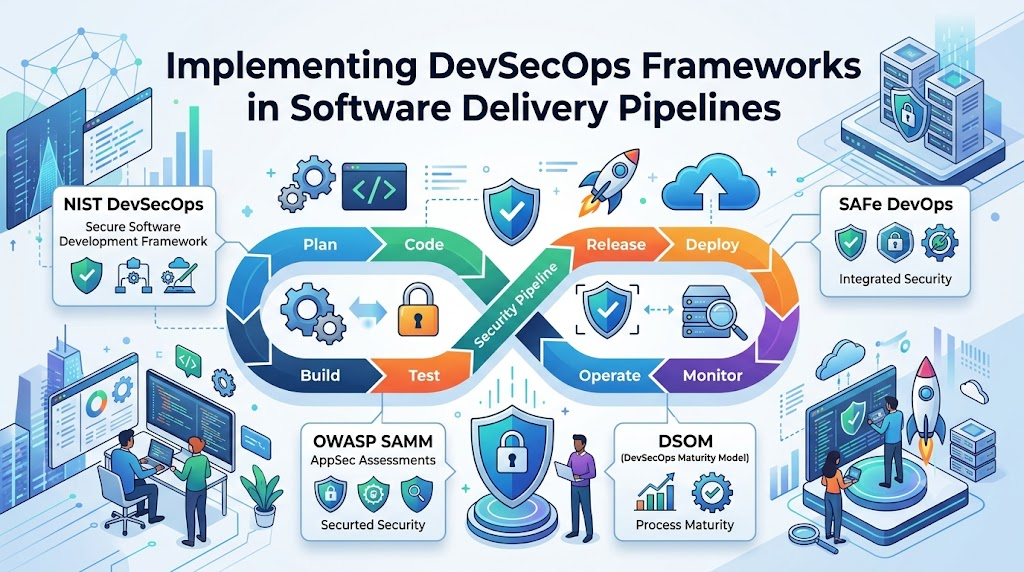
In modern software engineering, the pressure to deliver features rapidly has fundamentally transformed how development teams operate, yet speed often introduces critical security risks. Traditional security models, reliant on manual audits and end-of-cycle gatekeeping, simply cannot keep pace with continuous deployment pipelines, creating massive bottlenecks and costly remediation delays. This reality has driven the adoption of DevSecOps, a practice that embeds security directly into daily development and operations workflows rather than treating it as an afterthought. However, transitioning toward this model can feel overwhelming, which is why structured approaches are essential. By utilizing established DevSecOps frameworks, organizations and individual practitioners can establish a clear roadmap for integrating security without sacrificing velocity. A well-designed DevSecOps implementation framework provides the structure needed to align people, processes, and technology around shared security goals, helping teams balance speed, quality, and security effectively through platforms like DevOpsSchool.
What Are DevSecOps Frameworks?
A DevSecOps framework is a structured set of guidelines, practices, models, and workflows designed to help organizations integrate security into every phase of the software development lifecycle. It acts as a blueprint that guides teams on how to blend development, security, and operations seamlessly.
It is important to distinguish between a framework and a tool. A tool is a specific piece of software—such as a static code analyzer, a container scanner, or a vulnerability management platform. A framework, on the other hand, is the strategic blueprint that dictates how those tools should be deployed, who should use them, and at what stage of the pipeline they should execute.
DevSecOps frameworks guide three core pillars:
- People: Cultivating a culture of shared responsibility where developers, security specialists, and operations engineers collaborate closely.
- Processes: Establishing repeatable, automated workflows for code review, testing, compliance verification, and risk mitigation.
- Technology: Selecting and integrating the right security automation tools into the CI/CD pipeline.
For beginners, a framework prevents the common pitfall of buying expensive security tools without a clear strategy. It provides a step-by-step path from basic awareness to mature, automated security governance.
Why Organizations Need DevSecOps Frameworks
As software systems grow more complex and threats become more sophisticated, ad-hoc security measures are no longer sufficient. Organizations across industries face mounting pressure to protect sensitive data while maintaining rapid release cycles. Here is why structured frameworks are critical for modern engineering teams:
Increasing Security Risks
Modern applications rely on thousands of open-source libraries and third-party dependencies. A single vulnerable dependency can expose an entire system to attackers. Frameworks help organizations establish proactive dependency management and vulnerability tracking.
Faster Software Delivery Requirements
Traditional security reviews often take weeks or months. Frameworks enable security automation, allowing tests to run automatically during code commits and builds so that security checks match the speed of modern deployment pipelines.
Cloud Complexity
Moving workloads to cloud environments introduces new misconfiguration risks, identity management challenges, and data exposure threats. Cloud security frameworks provide specific guardrails to keep infrastructure secure.
Compliance Needs
Regulatory standards such as GDPR, HIPAA, and PCI-DSS require strict data protection and audit trails. Frameworks incorporate compliance checks directly into development pipelines, ensuring that regulatory requirements are met continuously rather than audited manually once a year.
Shared Security Responsibility
In a traditional model, security was exclusively the job of the security team. DevSecOps frameworks distribute this responsibility, ensuring that developers write secure code, operations teams maintain secure infrastructure, and security specialists focus on advanced threat modeling and policy definition.
Core Components of a DevSecOps Framework
| Component | Purpose | Business Benefit |
| Security Culture | Fostering shared responsibility between development, security, and operations. | Eliminates silos and accelerates cross-functional problem solving. |
| Automation | Embedding security checks directly into the CI/CD pipeline without manual intervention. | Reduces human error and speeds up release cycles. |
| Secure CI/CD | Validating code, dependencies, and configurations at every build stage. | Catches vulnerabilities early when they are inexpensive to fix. |
| Risk Management | Identifying, prioritizing, and remediating vulnerabilities based on actual business impact. | Protects critical assets and minimizes potential breach exposure. |
| Compliance | Continuously auditing infrastructure and code against regulatory standards. | Reduces audit preparation effort and avoids regulatory penalties. |
| Monitoring | Tracking runtime security, logs, and system behavior in production environments. | Enables rapid incident detection and response. |
| Continuous Improvement | Regularly reviewing metrics, incidents, and feedback to refine security practices. | Enhances overall security posture over time. |
Framework 1: OWASP DevSecOps Framework
The Open Worldwide Application Security Project (OWASP) provides guidance to help organizations build secure software. The OWASP DevSecOps approach focuses on integrating security into the software development lifecycle with an emphasis on developer-friendly practices.
Key Focus Areas
- Threat Modeling: Identifying potential design flaws and attack vectors before writing code.
- Secure Coding Standards: Training developers on common pitfalls such as the OWASP Top 10 vulnerabilities (e.g., injection flaws, broken authentication).
- Vulnerability Testing: Utilizing Static Application Security Testing (SAST) and Dynamic Application Security Testing (DAST) within the workflow.
- Security Automation: Running automated scans on every pull request.
This framework is ideal for beginners because it focuses heavily on educating developers, making security an approachable daily habit rather than an intimidating gatekeeping process.
Framework 2: NIST Secure Software Development Framework (SSDF)
The National Institute of Standards and Technology (NIST) Special Publication 800-218 outlines the Secure Software Development Framework (SSDF). This framework provides a core set of high-level secure software development practices derived from established security standards.
Key Focus Areas
- Preparing the Organization: Ensuring that internal people, processes, and technology are equipped to secure software development.
- Protecting Software: Ensuring that all components of the software and its build environment are protected against tampering and unauthorized access.
- Producing Well-Secured Software: Designing, writing, and testing code with security built-in from the ground up.
- Responding to Vulnerabilities: Establishing clear processes for identifying, analyzing, and fixing vulnerabilities found after release.
Enterprise engineering teams frequently adopt the NIST SSDF because it provides a rigorous, standardized approach that satisfies government and enterprise compliance requirements.
Framework 3: DevSecOps CALMS Extension
The CALMS model—originally created for DevOps—stands for Culture, Automation, Lean, Measurement, and Sharing. When extended for DevSecOps, every pillar is viewed through a security lens.
Key Focus Areas
- Culture: Shifting from “security as a blocker” to “security as everyone’s responsibility.”
- Automation: Automating security tests, compliance checks, and infrastructure provisioning to eliminate manual bottlenecks.
- Lean: Minimizing waste by addressing security vulnerabilities early, reducing the time spent fixing critical bugs in production.
- Measurement: Tracking meaningful security metrics, such as time-to-remediate vulnerabilities and scan failure rates.
- Sharing: Fostering knowledge exchange between security experts and development teams through workshops, retrospectives, and shared documentation.
Framework 4: Secure CI/CD Pipeline Framework
A secure CI/CD pipeline framework focuses on embedding automated security gates directly into the software delivery pipeline. This ensures that code undergoes rigorous security validation before it ever reaches production.
Key Workflow Example
- Code Commit: A developer pushes code to a Git repository.
- SAST Scan: Automated static analysis scans the source code for security flaws.
- Dependency Check: Software Composition Analysis (SCA) checks third-party libraries for known vulnerabilities.
- Container Build: The application is packaged into a container image, which is then scanned for OS-level vulnerabilities.
- DAST / Integration Testing: The built application is deployed to a staging environment and tested dynamically.
- Deployment: If all security gates pass, the deployment proceeds to production.
Framework 5: Cloud Security DevSecOps Framework
Cloud-native applications require specialized security practices due to the dynamic and distributed nature of cloud infrastructure. This framework focuses on protecting cloud environments from misconfigurations and unauthorized access.
Key Focus Areas
- Cloud Configuration Security: Using Infrastructure as Code (IaC) scanning tools (such as Checkov or TFLint) to catch cloud misconfigurations before deployment.
- Secrets Management: Preventing hardcoded credentials, API keys, and passwords in source code by utilizing dedicated vault services.
- Compliance Automation: Continuously verifying that cloud resources adhere to organizational and regulatory security policies.
Framework 6: Container and Kubernetes Security Framework
As containers and Kubernetes become the standard for modern application deployment, securing the container lifecycle is vital. This framework addresses security across the entire container ecosystem.
Key Focus Areas
- Image Scanning: Inspecting base images and application containers for known vulnerabilities and outdated packages before deployment.
- Runtime Security: Monitoring container behavior in production to detect anomalous processes, unauthorized network connections, or file system modifications.
- Access Control: Implementing strict Role-Based Access Control (RBAC) within Kubernetes clusters.
- Network Policies: Restricting pod-to-pod communication to enforce the principle of least privilege.
Framework 7: GitOps Security Framework
GitOps uses Git repositories as the single source of truth for declarative infrastructure and application deployments. A GitOps security framework ensures that the version-controlled workflow itself remains secure.
Key Focus Areas
- Secure Repositories: Enforcing multi-factor authentication, branch protection rules, and mandatory peer reviews for all pull requests.
- Configuration Validation: Automatically checking infrastructure manifests (such as Kubernetes YAML files or Helm charts) against security policies prior to synchronization.
- Deployment Security: Ensuring that agents syncing the cluster have restricted permissions and cannot be manipulated externally.
Framework 8: DevSecOps Maturity Model
Measuring progress is essential for successful DevSecOps adoption. A maturity model helps organizations assess their current capabilities and plan gradual improvements.
| Level | Description | Security Capability |
| Level 1: Initial | Security is reactive; manual reviews happen only before release. | Ad-hoc checks, frequent security bottlenecks. |
| Level 2: Developing | Basic security tools are introduced; initial automation in pipelines. | SAST and dependency scanning added to CI/CD. |
| Level 3: Defined | Standardized security frameworks are adopted across multiple teams. | Automated vulnerability management, threat modeling. |
| Level 4: Advanced | Security is fully integrated across all stages; metrics are actively tracked. | Continuous compliance, automated container scanning. |
| Level 5: Optimized | Proactive security posture with continuous feedback and advanced threat intelligence. | Self-healing pipelines, zero trust architecture. |
DevSecOps Framework Comparison
| Framework | Best For | Main Focus | Beginner Friendly |
| OWASP DevSecOps | Beginners and developers | Secure coding and threat awareness | High |
| NIST SSDF | Enterprises and government agencies | Comprehensive development lifecycle risk management | Moderate |
| CALMS Extension | Culture transformation | People, process, and measurement alignment | High |
| CI/CD Security Framework | DevOps and engineering teams | Automated pipeline security gates | High |
| Cloud Security Framework | Cloud-native organizations | Infrastructure configuration and secrets management | Moderate |
| Kubernetes Security Framework | SRE and platform engineers | Container and cluster hardening | Moderate |
| DevSecOps Maturity Model | Engineering leaders | Progress tracking and strategic roadmap planning | High |
How to Choose the Right DevSecOps Framework
Selecting the right framework depends on several key organizational factors:
- Organization Size: Startups and smaller teams benefit most from lightweight frameworks like OWASP or basic CI/CD security pipelines. Large enterprises typically require comprehensive standards like NIST SSDF.
- Security Maturity: If your organization has no existing security automation, start at Level 1 of a maturity model and introduce basic SAST tools before attempting advanced cloud or Kubernetes security frameworks.
- Technology Stack: If your applications run heavily in Kubernetes, prioritize container and Kubernetes security frameworks. If you operate primarily in serverless cloud environments, focus on cloud configuration security.
- Compliance Requirements: Highly regulated industries (finance, healthcare) must select frameworks that align closely with statutory auditing and data protection standards.
- Team Skills: Choose frameworks that match your team’s current technical proficiency and gradually introduce advanced concepts through structured training.
Real-World DevSecOps Framework Implementation Example
Consider a mid-sized financial technology company looking to accelerate deployments while meeting security compliance standards.
- Assessment: The team evaluates their current process and realizes that security reviews take two weeks per release, causing massive deployment delays.
- Framework Selection: They choose a combination of the OWASP DevSecOps framework for developer training and a Secure CI/CD Pipeline framework for automation.
- Tool Integration: They integrate static code analysis into the GitHub repository and add automated software composition analysis to check open-source packages during every build.
- Automation: Pull requests are automatically blocked if high-severity vulnerabilities are detected, preventing insecure code from merging.
- Monitoring and Improvement: The team tracks security metrics monthly, gradually reducing vulnerability remediation time and advancing their maturity level over twelve months.
DevSecOps Tools Supporting Framework Implementation
| Category | Tools | Purpose |
| Source Code Security | SonarQube, Semgrep, Checkmarx | Performing static code analysis to find bugs and vulnerabilities. |
| CI/CD Security | GitHub Advanced Security, GitLab CI/CD Security, Jenkins plugins | Orchestrating automated security checks within pipelines. |
| Container Security | Trivy, Grype, Aqua Security | Scanning container images and base OS layers for vulnerabilities. |
| Cloud Security | Checkov, TFSec, Prisma Cloud | Scanning Infrastructure as Code for misconfigurations. |
| Monitoring | Prometheus, Grafana, Datadog | Tracking runtime application behavior and system logs. |
| Compliance | Open Policy Agent (OPA), InSpec | Enforcing policy-as-code and automated compliance audits. |
Benefits of Using DevSecOps Frameworks
- Faster Secure Releases: Automating security checks eliminates manual bottlenecks, allowing teams to release software rapidly and securely.
- Reduced Vulnerabilities: Catching security flaws during the coding and build phases prevents costly exploits in production.
- Better Collaboration: Frameworks bridge the gap between development, operations, and security teams, fostering shared ownership.
- Improved Compliance: Continuous auditing ensures that regulatory requirements are consistently met without scrambling before audit season.
- Automated Security Processes: Reducing manual intervention minimizes human error and standardizes security checks across all projects.
- Better Risk Visibility: Engineering leaders gain clear insights into vulnerability trends, remediation times, and overall system security posture.
Common Challenges While Implementing DevSecOps Frameworks
- Cultural Resistance: Developers may view security tools as annoying hurdles that slow them down. Solution: Involve developers early, provide clear training, and ensure security feedback is constructive rather than punitive.
- Lack of Security Skills: Teams may struggle to interpret vulnerability reports or write secure code. Solution: Invest in continuous learning programs and practical training.
- Tool Complexity: Adopting too many tools at once can overwhelm engineers with false positives. Solution: Start small with one or two essential scanners and tune them carefully before expanding.
- Legacy Systems: Older monolithic applications can be difficult to integrate into modern CI/CD security pipelines. Solution: Apply risk-based prioritization and focus on perimeter and dependency checks first.
Best Practices for Starting DevSecOps Today
- Begin with security awareness training for all developers and engineers.
- Automate small security checks, such as basic dependency scanning, before introducing complex tools.
- Integrate security early in the development lifecycle rather than waiting for testing phases.
- Measure improvements regularly using clear, actionable metrics.
- Train teams continuously on evolving security threats and defensive practices.
DevSecOps Skills Required for Engineers
- DevOps Knowledge: Proficiency in CI/CD pipelines, version control, and infrastructure automation.
- Security Fundamentals: Understanding common attack vectors, authentication protocols, and encryption standards.
- Cloud Security: Knowing how to secure cloud resources, identity management systems, and IAM policies.
- Automation Skills: Ability to write scripts and integrate security tools into automated workflows.
- Container Security: Familiarity with Docker, Kubernetes security hardening, and image scanning principles.
- Monitoring: Skill in analyzing logs, tracking metrics, and responding to runtime anomalies.
Career Opportunities After Learning DevSecOps Frameworks
Mastering DevSecOps frameworks opens up rewarding career paths across modern technology organizations:
- DevSecOps Engineer: Bridges development and security, implementing automated security checks in CI/CD pipelines.
- Cloud Security Engineer: Focuses on protecting cloud infrastructure, identity management, and compliance automation.
- Security Automation Engineer: Specializes in building custom security scripts, policy engines, and automated remediation workflows.
- DevOps Security Consultant: Advises enterprises on adopting secure software delivery frameworks and transforming engineering culture.
- Platform Security Engineer: Secures internal developer platforms, container orchestrators, and infrastructure-as-code pipelines.
Industry demand for these roles continues to grow rapidly as organizations prioritize secure cloud transformation.
Certifications and Learning Paths
Structured learning is essential for mastering DevSecOps frameworks and building practical competence. Platforms like DevOpsSchool provide comprehensive learning ecosystems designed to take engineers from foundational DevOps concepts to advanced security automation.
| Certification Type | Suitable For | Skill Level | Focus Area |
| DevOps & Security Fundamentals | Beginners and developers | Beginner | Pipeline basics and secure coding |
| Cloud Security Professional | Cloud and platform engineers | Intermediate | Cloud configuration and IAM security |
| Kubernetes Security Specialist | SRE and DevOps engineers | Advanced | Container hardening and cluster defense |
| DevSecOps Architect | Tech leads and managers | Expert | Enterprise framework adoption and strategy |
Beginner Roadmap to Learn DevSecOps Frameworks
- Stage 1: Learn DevOps Fundamentals: Master version control, Linux, CI/CD pipelines, and basic automation concepts.
- Stage 2: Understand Security Basics: Study common vulnerabilities, threat modeling, and secure coding principles.
- Stage 3: Practice Secure CI/CD: Integrate basic SAST and dependency scanning tools into your personal or team projects.
- Stage 4: Learn Cloud and Container Security: Explore Docker, Kubernetes, and Infrastructure as Code security scanning.
- Stage 5: Implement Complete DevSecOps Workflows: Build end-to-end pipelines that incorporate automated testing, compliance, and runtime monitoring.
Future of DevSecOps Frameworks
- AI-Powered Security Automation: Artificial intelligence will assist in automatically triaging vulnerabilities, generating secure code patches, and predicting potential attack paths.
- Software Supply Chain Security: Increased focus on cryptographic software bills of materials (SBOMs) and artifact signing to verify software integrity.
- Zero Trust Security: Integrating Zero Trust principles directly into CI/CD pipelines and runtime environments to verify every request continuously.
- Cloud-Native Security: Frameworks will continue to evolve around ephemeral, serverless, and multi-cloud architectures.
- Platform Engineering Security: Security guardrails will be embedded directly into internal developer platforms as self-service capabilities.
FAQs
What are DevSecOps frameworks?
DevSecOps frameworks are structured sets of guidelines, practices, and models that help organizations integrate security into every phase of the software development lifecycle.
Why are DevSecOps frameworks important?
They provide a clear blueprint for balancing development speed with robust security, ensuring risks are identified and mitigated early without creating bottlenecks.
Which DevSecOps framework should beginners start with?
Beginners should start with the OWASP DevSecOps framework or basic CI/CD security integration, as they focus heavily on developer-friendly practices and fundamental security awareness.
Is the OWASP DevSecOps framework useful?
Yes, it is highly practical and helps teams understand secure coding, threat modeling, and vulnerability testing in an approachable manner.
What is NIST SSDF?
The NIST Secure Software Development Framework (SSDF) is a set of high-level secure software development practices designed to reduce vulnerabilities in software products.
How does DevSecOps improve security?
By embedding automated security checks throughout the pipeline, DevSecOps catches vulnerabilities early when they are quick and inexpensive to fix.
Are DevSecOps frameworks tools?
No, frameworks are strategic blueprints and methodologies, whereas tools are specific software applications used to execute security tests.
What skills are needed to learn DevSecOps?
A combination of DevOps pipeline knowledge, security fundamentals, cloud infrastructure understanding, and automation skills is required.
How do I choose the right framework?
Consider your organization’s size, security maturity, technology stack, and compliance requirements to select a framework that aligns with your current capabilities.
Can DevSecOps frameworks be customized?
Yes, organizations can adapt frameworks to fit their specific engineering workflows, technology stacks, and risk tolerance levels.
What is the role of automation in DevSecOps frameworks?
Automation ensures that security checks run consistently on every code commit without relying on manual intervention.
How does DevSecOps impact company culture?
It shifts security from a separate gatekeeping department to a shared responsibility across development, operations, and security teams.
What is the difference between DevOps and DevSecOps?
DevOps focuses on collaboration and speed between development and operations, while DevSecOps explicitly integrates security practices into that collaborative workflow.
How do maturity models help in DevSecOps adoption?
Maturity models allow organizations to assess their current security capabilities and plan gradual, structured improvements over time.
Where can I learn more about DevSecOps frameworks?
Structured learning platforms like DevOpsSchool offer professional courses and resources to help engineers master secure software delivery practices.
Final Thoughts
Adopting DevSecOps is not about buying every security tool on the market or slowing down development to conduct endless manual reviews. True security transformation comes from structured adoption, thoughtful automation, and a culture of shared responsibility.
By starting with proven frameworks—whether it is OWASP for secure coding, NIST for enterprise governance, or a secure CI/CD pipeline framework for automation—engineering teams can build secure software faster and with greater confidence. Approach adoption as an iterative journey: start small, automate what you can, measure your progress, and continuously improve your security posture over time.
