Limited Time Offer!
For Less Than the Cost of a Starbucks Coffee, Access All DevOpsSchool Videos on YouTube Unlimitedly.
Master DevOps, SRE, DevSecOps Skills!
Introduction
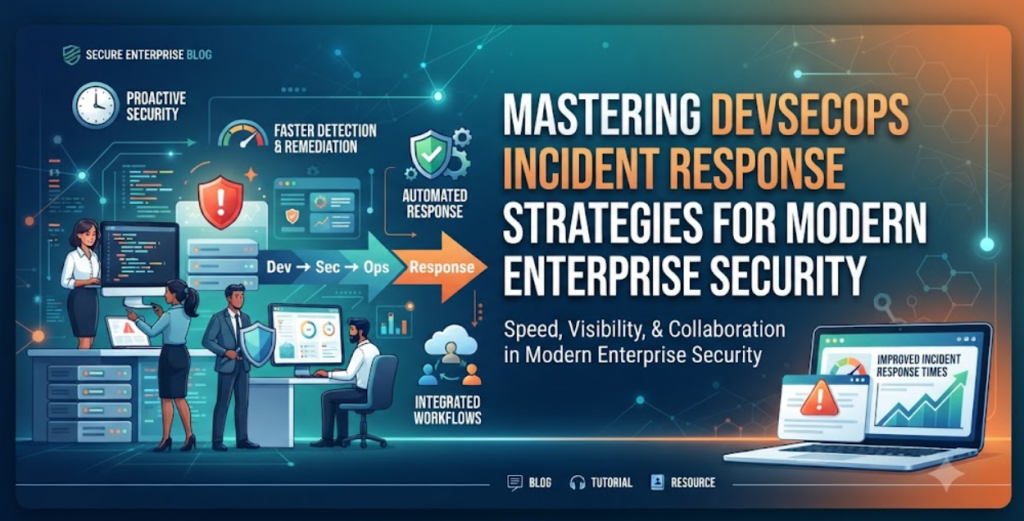
In modern digital ecosystems, traditional security models often struggle to keep pace with rapid application development, leaving organizations vulnerable to slow incident discovery and containment. To counter these challenges, organizations must shift from reactive security postures to proactive defense strategies through DevSecOps. By integrating security into every phase of the software delivery lifecycle, DevSecOps bridges the gap between development, operations, and security teams. Through continuous monitoring, automated threat detection, and seamless feedback loops, this methodology transforms incident response from a chaotic scramble into a streamlined, predictable, and rapid operational capability, helping teams minimize disruption and foster a resilient engineering culture supported by comprehensive training programs at DevOpsSchool.
What Is Incident Response in DevSecOps?
Incident response in DevSecOps refers to the coordinated, automated, and continuous process of identifying, analyzing, containing, and remediating security events within a software delivery and infrastructure lifecycle. Unlike traditional security models that treat incident response as an isolated post-breach activity handled exclusively by a Security Operations Center (SOC), DevSecOps integrates incident response into the daily responsibilities of developers, operations engineers, and security specialists.
The Incident Lifecycle in DevSecOps
The DevSecOps incident lifecycle is tightly coupled with the continuous integration and continuous deployment pipeline, consisting of the following continuous phases:
- Preparation: Establishing automated guardrails, threat models, monitoring baselines, and incident response playbooks.
- Detection: Leveraging continuous monitoring, anomaly detection, and automated security scans to identify unexpected behavior instantly.
- Analysis and Validation: Correlating alerts with application logs, infrastructure traces, and threat intelligence to rule out false positives.
- Containment: Automatically or semi-automatically isolating compromised containers, revoking leaked API keys, or blocking malicious traffic at the edge.
- Remediation and Recovery: Deploying patched code through the standard CI/CD pipeline and restoring services to a known good state.
- Post-Incident Review: Conducting automated root cause analysis and updating pipeline guardrails to prevent recurrence.
Collaboration Across Teams
In a DevSecOps model, responsibility for security is shared. Developers write secure code and participate in triage; operations engineers maintain immutable infrastructure and robust telemetry; and security engineers design detection rules and compliance policies. This cross-functional alignment ensures that when an incident strikes, all stakeholders share a unified understanding of the system architecture and response protocols.
Why Fast Incident Response Matters
In enterprise environments, the speed of incident response directly correlates with business survival and success. Minimizing the window of exposure during a security event yields profound operational and financial benefits.
Reducing Business Downtime
Every minute an application is compromised or offline results in lost revenue, frustrated customers, and wasted internal resources. Rapid detection and automated containment limit the blast radius of an incident, ensuring high availability and business continuity.
Protecting Sensitive Data
Data breaches involving customer personally identifiable information or intellectual property can incur severe regulatory penalties and legal liabilities. Fast incident response stops data exfiltration before malicious actors can transfer sensitive assets out of the network.
Maintaining Customer Trust
Customers expect reliable and secure digital experiences. Organizations that detect and resolve security incidents swiftly demonstrate competence and accountability, preserving brand reputation and customer loyalty.
Meeting Compliance Requirements
Regulatory frameworks such as PCI-DSS, HIPAA, and GDPR mandate strict timelines for incident detection, reporting, and containment. DevSecOps automation provides the audit trails and rapid response capabilities required to demonstrate compliance effortlessly.
Traditional Incident Response vs DevSecOps Incident Response
| Traditional Security | DevSecOps Approach | Business Benefit |
| Detection | Periodic audits, manual vulnerability scans, and retrospective reviews. | Continuous monitoring, real-time log analysis, and automated pipeline security checks. |
| Alerting | High volume of siloed alerts sent to a dedicated SOC, often causing alert fatigue. | Context-rich alerts routed directly to the responsible team via collaboration platforms. |
| Investigation | Manual log gathering across disparate, unstandardized systems. | Centralized observability platforms with distributed tracing and pre-built dashboards. |
| Response | Manual coordination, lengthy approval chains, and emergency change tickets. | Automated playbooks, canary deployments, and automated rollbacks via CI/CD. |
| Automation | Minimal automation; heavy reliance on human intervention for every step. | Deep integration of security orchestration and automated remediation workflows. |
| Collaboration | Siloed teams passing tickets back and forth with friction and finger-pointing. | Shared ownership, transparent communication, and integrated feedback loops. |
| Continuous Improvement | Rare post-mortems that seldom update development practices. | Automated feedback loops that update guardrails, tests, and code templates instantly. |
How DevSecOps Improves Incident Response Times
DevSecOps fundamentally changes how organizations handle security events by embedding speed, automation, and visibility directly into the engineering workflow.
Continuous Monitoring
By tracking system metrics, application logs, and network traffic in real time, teams establish a reliable baseline of normal behavior. Any deviation from this baseline is flagged immediately, cutting down the time required to notice an anomaly.
Automated Threat Detection
Modern cloud environments utilize machine learning and behavioral analysis tools to detect unusual patterns, such as unexpected outbound data transfers or privilege escalation attempts, without requiring human analysts to stare at dashboards constantly.
Security Automation
Automation eliminates human latency. When an alert fires, automated scripts can instantly quarantine an infected virtual machine, revoke compromised AWS IAM credentials, or block malicious IP addresses via web application firewalls.
Shift-Left Security
By catching security flaws during the coding and testing phases, DevSecOps prevents vulnerable code from ever reaching production. Fewer inherent vulnerabilities in production mean fewer security incidents to respond to overall.
Continuous Feedback
Every incident serves as a learning opportunity. DevSecOps feeds lessons learned back into the development pipeline, automatically updating static analysis rules and unit tests to ensure the same vulnerability never happens twice.
Key Metrics That Measure Incident Response Security
| Metric | Why It Matters | Improvement Strategy |
| Mean Time to Detect (MTTD) | Measures how quickly an organization becomes aware of a security incident or anomaly. | Implement continuous monitoring, automated anomaly detection, and centralized log aggregation. |
| Mean Time to Respond (MTTR) | Measures the duration from incident detection to successful containment and mitigation. | Utilize SOAR playbooks, automated remediation scripts, and cross-functional response training. |
| Mean Time to Recover (MTTRec) | Measures the time required to restore systems to full operational capacity after an incident. | Maintain immutable infrastructure, automated backup verification, and rapid CI/CD rollback mechanisms. |
| False Positive Rate | Quantifies the percentage of security alerts that are incorrect or do not represent real threats. | Tune detection rules, add contextual enrichment to alerts, and leverage machine learning filters. |
| Incident Resolution Time | Tracks the complete lifecycle duration of an incident from start to final post-mortem closure. | Improve documentation, standardize runbooks, and foster seamless collaboration between teams. |
| Security Coverage | Measures the percentage of infrastructure, code repositories, and cloud services monitored by security tools. | Enforce policy-as-code and automated asset discovery across all environments. |
Continuous Monitoring and Observability
Observability is the bedrock of rapid incident response. Without deep visibility into how applications and infrastructure behave in real time, identifying the root cause of an incident is nearly impossible.
Metrics, Logs, and Distributed Tracing
Effective monitoring relies on the three pillars of observability:
- Metrics: Numerical data points that indicate CPU utilization, memory leaks, error rates, and request latency.
- Logs: Detailed, timestamped text records of application events, authentication attempts, and system transactions.
- Distributed Tracing: Tracking requests as they flow across microservices, helping engineers pinpoint exactly which service or dependency failed.
Tooling Ecosystem
Enterprise observability typically relies on industry-standard tools:
- Prometheus and Grafana: For collecting time-series metrics and visualizing operational health through customized dashboards.
- ELK Stack / OpenSearch: For centralized log collection, parsing, indexing, and full-text search capabilities.
- SIEM Platforms: For aggregating security events and correlating logs across multi-cloud environments.
[Applications & Cloud Infrastructure]
               │
               ▼
[Telemetry Collectors (Prometheus / Logstash)]
               │
               ▼
[Centralized Observability & SIEM (OpenSearch)]
               │
               ▼
[Automated Alerting & Dashboards (Grafana)]
               │
               ▼
[On-Call Engineers & SOAR Playbooks]
Security Automation in DevSecOps
Manual security processes are slow and prone to human error. Security automation ensures that defensive measures execute at machine speed.
Automated Vulnerability Scanning
Security scans are integrated directly into the CI/CD pipeline. Software Composition Analysis (SCA) checks open-source libraries, Static Application Security Testing (SAST) analyzes source code, and Dynamic Application Security Testing (DAST) evaluates running applications.
Secret Detection
Accidentally committing API keys, database passwords, or private SSH keys to public or internal code repositories is a common cause of security incidents. Automated secret scanners block commits containing sensitive credentials before they leave the developer’s workstation.
Compliance Checks and Automated Remediation
Policy-as-code tools continuously audit cloud configurations against compliance frameworks like CIS benchmarks. If a storage bucket is accidentally made public, automated scripts reapply secure permissions instantly without waiting for human intervention.
Cloud-Native Incident Response
Cloud environments introduce unique security dynamics characterized by ephemerality, scalability, and distributed architectures. Incident response in AWS, Azure, and Google Cloud requires specialized approaches.
Cloud Logging and Identity Monitoring
Cloud-native incident response relies heavily on immutable audit logs, such as AWS CloudTrail or Azure Activity Logs. Monitoring identity and access management (IAM) events helps security teams immediately detect unauthorized privilege escalation or suspicious cross-account API calls.
Threat Detection Services
Managed cloud security services—such as Amazon GuardDuty, Microsoft Defender for Cloud, and Google Cloud Security Command Center—use threat intelligence and machine learning to identify suspicious behavior, compromised instances, and unauthorized data access across cloud resources.
Automated Incident Handling
Cloud environments make automated containment straightforward. When an anomaly is detected, serverless functions (like AWS Lambda) can automatically isolate a compromised EC2 instance from the Virtual Private Cloud (VPC), take a forensic snapshot of the disk, and alert the security team.
Security Orchestration, Automation, and Response (SOAR)
Security Orchestration, Automation, and Response (SOAR) platforms act as the central nervous system for modern incident response operations.
What Is SOAR?
SOAR combines security incident management, automated workflow orchestration, and threat intelligence into a single cohesive platform. It connects disparate security tools—such as firewalls, endpoint protection, SIEMs, and ticketing systems—allowing them to work together seamlessly.
Benefits and Playbooks
- Automated Playbooks: Pre-defined workflows that execute standard response steps automatically, such as enriching an alert with threat intelligence data, checking if an IP address is malicious, and notifying the appropriate team.
- Incident Prioritization: Automatically scoring and ranking incidents based on severity, asset criticality, and business impact so engineers tackle the most urgent threats first.
- Faster Response: Eliminating manual swivel-chair investigations where analysts have to log into ten different consoles to understand a single incident.
Root Cause Analysis After Security Incidents
Containment and recovery are only half the battle. To prevent incidents from recurring, organizations must conduct rigorous Root Cause Analysis (RCA).
Structured Framework for Post-Incident Review
- Establish the Timeline: Construct an accurate chronological sequence of events leading up to, during, and after the incident using system logs and audit trails.
- Conduct a Blameless Post-Mortem: Focus on systemic failures, broken processes, and tool gaps rather than pointing fingers at individuals.
- Identify Root Causes: Determine the fundamental underlying weakness that allowed the incident to occur.
- Formulate Action Items: Create concrete engineering tickets to patch vulnerabilities, improve monitoring coverage, update runbooks, or refine code review policies.
- Implement Preventative Measures: Push the resulting improvements back into the CI/CD pipeline and automated test suites.
DevSecOps Incident Response Workflow
A standardized incident response workflow ensures that every security event is handled consistently and efficiently across the organization.
[1. Threat Detection] ➔ [2. Alert Generation] ➔ [3. Automated Validation]
                                                           │
[8. Post-Incident Review] ⬅ [7. Recovery] ⬅ [6. Remediation] ⬅ [4. Investigation]
                                                           │
                                                [5. Containment]
Step-by-Step Enterprise Example
- Threat Detection: An anomaly detection system notices unusual database query volumes originating from a web application container.
- Alert Generation: A high-severity alert is automatically dispatched to the security channel and the on-call SRE.
- Automated Validation: A SOAR playbook queries threat intelligence feeds and inspects container metadata to confirm the activity is malicious.
- Investigation: The engineer reviews centralized logs to trace the entry point of the attack.
- Containment: Automated scripts terminate the compromised container and redirect traffic to a safe secondary instance.
- Remediation: Developers patch the SQL injection vulnerability, and the updated code passes through CI/CD security gates.
- Recovery: The service is scaled back up to full capacity and verified via automated health checks.
- Post-Incident Review: The team documents lessons learned and updates automated testing rules to catch similar patterns earlier.
Common Incident Response Challenges
Organizations transitioning to DevSecOps often encounter several operational hurdles:
- Alert Fatigue: Flooding engineers with low-fidelity alerts until important warnings are ignored.
- Manual Investigations: Relying on ad-hoc shell scripts and manual log digging instead of centralized observability.
- Poor Monitoring: Gaps in telemetry that leave blind spots in containerized or serverless environments.
- Weak Collaboration: Cultural friction between development and security teams leading to delayed communication during crises.
- Missing Documentation: Outdated or non-existent incident response playbooks that leave teams guessing during high-pressure events.
- Delayed Remediation: Slow patch deployment cycles that leave known vulnerabilities exposed in production.
Improvement Checklist
- Tune detection rules regularly to reduce false positives.
- Implement centralized, searchable log management systems.
- Establish clear, cross-functional incident ownership and escalation paths.
- Document and test incident response playbooks quarterly.
- Automate repetitive containment and evidence-collection tasks.
Best Practices for Faster Incident Response
Implementing these enterprise best practices ensures your incident response capability remains robust, agile, and effective:
- Automate Monitoring: Ensure every application, container, and cloud resource emits telemetry collected in real time.
- Integrate Security into CI/CD: Shift security checks left to catch and fix vulnerabilities before code reaches production.
- Use Infrastructure as Code (IaC): Maintain reproducible, version-controlled infrastructure that can be destroyed and recreated safely during an incident.
- Centralize Logging: Aggregate logs from all cloud accounts, clusters, and services into a single unified analysis platform.
- Conduct Regular Incident Simulations: Run tabletop exercises and game days to test team readiness under simulated attack conditions.
- Maintain Response Playbooks: Keep living documentation of step-by-step procedures for common incident scenarios.
- Review Metrics Continuously: Track MTTD, MTTR, and false positive rates to identify bottlenecks in your response workflow.
Enterprise Implementation Roadmap
| Phase | Objectives | Expected Outcome |
| 1. Assessment | Evaluate current security posture, toolchains, monitoring coverage, and incident response workflows. | Comprehensive gap analysis and baseline metric establishment. |
| 2. Security Integration | Embed SAST, DAST, SCA, and secret scanning into existing CI/CD pipelines. | Early vulnerability detection and reduced introduction of insecure code. |
| 3. Automation | Deploy centralized observability, SIEM platforms, and automated containment playbooks. | Drastic reduction in MTTD and elimination of manual response friction. |
| 4. Optimization | Conduct regular tabletop exercises, refine response playbooks, and analyze incident metrics continuously. | Mature, self-improving DevSecOps security operations culture. |
Career Opportunities
The fusion of DevOps, security, and incident response has created high demand for specialized professionals. Organizations worldwide actively seek talent capable of bridging these domains.
DevSecOps Engineer
Focuses on embedding security tooling, automated testing, and compliance checks into CI/CD pipelines while collaborating with developers to remediate vulnerabilities.
Security Operations Engineer
Specializes in monitoring security telemetry, tuning detection rules, and managing SIEM and SOAR platforms to neutralize active threats.
Cloud Security Engineer
Designs secure cloud architectures, enforces identity and access management policies, and secures multi-cloud workloads against unauthorized access.
Site Reliability Engineer (SRE)
Ensures system availability and resilience, building automation for rapid recovery, failover, and disaster recovery execution.
Security Architect
Designs enterprise-wide security strategies, governance frameworks, and zero-trust architectures for modern software delivery.
Incident Response Specialist
Leads threat hunting investigations, coordinates containment efforts during active breaches, and conducts thorough post-incident root cause analyses.
Certifications and Learning Roadmap
| Certification | Best For | Skill Level | Focus Area |
| DevSecOps Professional | Developers and DevOps engineers transitioning into security. | Intermediate | CI/CD security integration, vulnerability management, and pipeline hardening. |
| Certified Cloud Security Professional | Cloud architects and enterprise security consultants. | Advanced | Multi-cloud security design, data protection, and governance. |
| Kubernetes Security Specialist | Platform engineers and SREs managing containerized environments. | Intermediate to Advanced | Cluster hardening, container isolation, and runtime security monitoring. |
| AWS / Azure / GCP Security | Cloud-native engineers working within specific provider ecosystems. | Intermediate | Cloud IAM, threat detection services, and secure infrastructure deployment. |
| Certified Incident Handler | SOC analysts and incident response specialists. | Intermediate | Threat analysis, forensic investigation, and containment strategies. |
For structured, hands-on training across these disciplines, professionals frequently explore specialized programs offered by DevOpsSchool to accelerate their technical mastery.
Future of DevSecOps Incident Response
As enterprise technology continues to evolve, incident response in DevSecOps is being shaped by transformative technological trends:
- AI-Powered Threat Detection: Utilizing machine learning models to identify novel, zero-day attack patterns that signature-based tools miss.
- Autonomous Security Operations: Moving toward self-healing systems that detect, isolate, and patch vulnerabilities automatically without human intervention.
- Predictive Analytics: Analyzing historical pipeline telemetry and threat intelligence to predict where vulnerabilities are most likely to occur before exploitation.
- Zero Trust Architecture: Enforcing strict, continuous verification for every user, device, and service, significantly limiting the potential blast radius of any breach.
- Platform Engineering: Integrating security guardrails directly into internal developer platforms so security compliance happens transparently in the background.
- Continuous Compliance: Automating regulatory audit evidence collection in real time rather than relying on manual periodic reviews.
FAQs
What is incident response in DevSecOps?
Incident response in DevSecOps is the continuous, automated process of detecting, analyzing, containing, and remediating security events through collaboration between development, operations, and security teams.
Why is fast incident response important?
Fast incident response minimizes business downtime, protects sensitive customer data, prevents financial loss, and helps organizations maintain regulatory compliance and customer trust.
How does automation improve response time?
Automation eliminates human latency by instantly executing tasks such as alert triage, container quarantine, credential revocation, and log collection at machine speed.
What is Mean Time to Detect (MTTD)?
Mean Time to Detect (MTTD) measures the average duration it takes an organization to become aware of a security incident or system anomaly.
What is Mean Time to Respond (MTTR)?
Mean Time to Respond (MTTR) measures the average time required to contain, mitigate, and resolve a security incident once it has been detected.
Which monitoring tools are commonly used?
Common monitoring and observability tools include Prometheus, Grafana, ELK/OpenSearch, and enterprise SIEM platforms.
What is SOAR?
SOAR stands for Security Orchestration, Automation, and Response. It is a technology stack that combines automated playbooks, threat intelligence, and centralized incident management.
How does DevSecOps reduce security risks?
By shifting security left into the development phase, automating vulnerability testing, and establishing continuous monitoring, DevSecOps catches and resolves flaws early.
Why is cloud monitoring important?
Cloud environments are dynamic, ephemeral, and distributed. Continuous cloud monitoring provides the real-time visibility needed to detect unauthorized access or misconfigurations instantly.
How do teams conduct root cause analysis?
Teams review chronological incident timelines, analyze centralized logs in a blameless post-mortem environment, identify systemic failures, and update pipeline guardrails.
What certifications are useful?
Valuable certifications include DevSecOps professional credentials, cloud security certifications, Kubernetes security credentials, and incident handling accreditations.
Can beginners learn incident response?
Yes, beginners can master incident response by building foundational knowledge in networking, Linux administration, cloud computing, and DevOps principles.
How do organizations measure success?
Organizations measure success by tracking key performance indicators such as MTTD, MTTR, false positive rates, and incident resolution efficiency.
What mistakes should teams avoid?
Common mistakes include relying solely on manual processes, ignoring alert fatigue, failing to maintain up-to-date playbooks, and operating in security silos.
How can organizations continuously improve incident response?
Organizations improve by conducting regular tabletop simulations, analyzing past incident metrics, automating repetitive tasks, and updating security guardrails based on lessons learned.
Final Thoughts
Fast incident response is no longer just a technical luxury; it is a fundamental business capability required to survive in a threat-laden digital landscape. Traditional, siloed security models are too slow to cope with modern release cadences and sophisticated cyber attacks. DevSecOps redefines this dynamic by embedding security, continuous monitoring, and automation directly into the fabric of the software delivery lifecycle.
By harnessing automated threat detection, centralized observability, cloud-native tooling, and cross-functional collaboration, organizations can drastically reduce both detection and response times. True resilience is not about preventing every single breach, but about how quickly, intelligently, and systematically an organization can detect, contain, and recover from security events. Embracing DevSecOps transforms security from a roadblock into an engine for operational excellence and long-term enterprise trust.
