Limited Time Offer!
For Less Than the Cost of a Starbucks Coffee, Access All DevOpsSchool Videos on YouTube Unlimitedly.
Master DevOps, SRE, DevSecOps Skills!
Introduction
In the current landscape of cloud computing, managing costs is just as important as managing code. The Certified FinOps Professional program is designed to bridge the gap between finance, engineering, and business teams. This guide is for engineers and managers who want to master the art of cloud financial management and ensure their organizations get the most value out of every dollar spent on the cloud. By following this path on finopsschool, professionals can move beyond simple cost-cutting and focus on informed decision-making. This guide helps you navigate the various certification levels to build a sustainable career in cloud economics.
What is the Certified FinOps Professional?
The Certified FinOps Professional represents a modern standard for cloud financial operations. It exists because traditional financial models do not work well with the variable and fast-paced nature of cloud spending. This program emphasizes real-world, production-focused learning rather than just memorizing theoretical concepts. It aligns with modern engineering workflows like DevOps and Agile, ensuring that engineers understand the cost impact of their infrastructure choices. By focusing on enterprise practices, it helps teams create a culture of accountability where everyone takes ownership of their cloud usage.
Who Should Pursue Certified FinOps Professional?
This certification is highly beneficial for a wide range of roles including DevOps engineers, SREs, and cloud architects who handle infrastructure daily. It is also designed for finance professionals and procurement officers who need to understand technical cloud billing. Beginners looking to enter the cloud ecosystem and experienced managers aiming to optimize departmental budgets will find it equally relevant. In the global market, and specifically within India’s growing tech sector, there is a massive demand for professionals who can balance technical performance with financial efficiency.
Why Certified FinOps Professional is Valuable Today and Beyond
The demand for cloud financial management is growing as enterprises move more workloads to the cloud and face complex monthly bills. This certification offers long-term career longevity because it focuses on the fundamental principles of cloud economics rather than specific, fleeting tools. As companies strive for profitability, the ability to optimize cloud ROI becomes a critical skill for any technical leader. Investing time in this certification ensures that a professional stays relevant as organizations shift toward more disciplined and transparent cloud spending habits.
Certified FinOps Professional Certification Overview
The program is delivered via the official Certified FinOps Professional portal and hosted on finopsschool.com. It uses a multi-level assessment approach that tests both knowledge and the practical application of FinOps principles. The structure is designed to move students from basic awareness to professional-grade execution and eventually to leadership and strategic planning. Ownership of the cloud bill is a central theme, teaching candidates how to handle complex tagging, forecasting, and unit economics in a real-world enterprise environment.
Certified FinOps Professional Certification Tracks & Levels
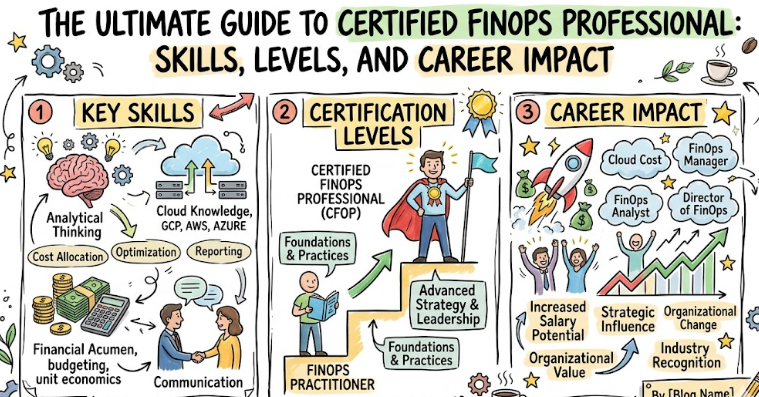
The certification is divided into three primary levels: Foundation, Professional, and Advanced. The Foundation level introduces the core framework, while the Professional level focuses on implementing these practices across large engineering teams. The Advanced and Specialist levels allow professionals to align their FinOps skills with other domains like SRE or DevSecOps. This clear progression allows engineers to grow their skills alongside their career advancement, moving from individual contributors to strategic advisors.
Complete Certified FinOps Professional Certification Table
| Track | Level | Who it’s for | Prerequisites | Skills Covered | Recommended Order |
| Foundation | Entry | Beginners, Finance Staff | Basic Cloud Knowledge | Lifecycle, Terminology, Personas | 1st |
| Professional | Mid-Level | DevOps, SREs, Managers | Foundation Cert | Cost Optimization, Forecasting | 2nd |
| Specialist | Advanced | Architects, FinOps Leads | Professional Cert | Governance, Policy Automation | 3rd |
| Leadership | Expert | Directors, CTOs, CFOs | Professional Cert | Cultural Shift, Strategy, ROI | 4th |
Detailed Guide for Each Certified FinOps Professional Certification
Certified FinOps Professional – Foundation Level
What it is
This certification validates a candidate’s understanding of basic FinOps principles and the three phases of the FinOps lifecycle. It ensures the professional can speak the language of cloud finance.
Who should take it
It is suitable for anyone new to cloud financial management, including junior engineers, business analysts, and finance team members who interact with cloud budgets.
Skills you’ll gain
- Understanding the FinOps lifecycle: Inform, Optimize, and Operate.
- Knowledge of core personas and their responsibilities.
- Ability to navigate cloud billing data and basic reports.
Real-world projects you should be able to do
- Create a basic cloud spend report for a single team.
- Identify unused or underutilized cloud resources using standard tools.
- Explain the difference between CapEx and OpEx to a technical team.
Preparation plan
- 7–14 days: Review the official study guide and take practice quizzes daily.
- 30 days: Engage with community forums and watch foundational webinars.
- 60 days: Not required for this level unless the candidate has zero cloud experience.
Common mistakes
- Ignoring the cultural aspect of FinOps and focusing only on tools.
- Not learning the specific terminology used by finance teams.
Best next certification after this
- Same-track option: Certified FinOps Professional – Mid Level.
- Cross-track option: Cloud Practitioner (AWS/Azure/GCP).
- Leadership option: FinOps for Managers.
Certified FinOps Professional – Professional Level
What it is
This level validates the ability to implement and manage FinOps practices within an organization. It focuses on driving accountability and implementing optimization strategies at scale.
Who should take it
This is meant for DevOps engineers, SREs, and cloud administrators who have at least some experience managing cloud environments and want to specialize in cost.
Skills you’ll gain
- Advanced cost allocation and tagging strategies.
- Implementing automated policies for cost governance.
- Analyzing and choosing between Reserved Instances and Savings Plans.
Real-world projects you should be able to do
- Implement a multi-cloud tagging policy that survives infrastructure changes.
- Build a dashboard that tracks unit economics for a specific product feature.
- Conduct a monthly cloud budget review meeting with engineering and finance leads.
Preparation plan
- 7–14 days: Intensive review of case studies and advanced optimization scenarios.
- 30 days: Set up a sandbox environment to practice setting up billing alerts and budgets.
- 60 days: Long-term study for those moving from a non-technical background.
Common mistakes
- Focusing too much on one cloud provider’s specific tools instead of general principles.
- Failing to understand how technical architecture decisions directly impact the bill.
Best next certification after this
- Same-track option: Certified FinOps Professional – Advanced/Specialist.
- Cross-track option: SRE Foundation or DevOps Master.
- Leadership option: Certified FinOps Director.
Choose Your Learning Path
DevOps Path
In the DevOps path, the focus is on integrating cost metrics directly into the CI/CD pipeline. Engineers learn to treat cost as a first-class metric, similar to performance or security. By mastering FinOps, DevOps professionals can ensure that automated scaling and deployment do not lead to unexpected budget overruns. This path is ideal for those who want to automate the “Operate” phase of the FinOps lifecycle.
DevSecOps Path
The DevSecOps path emphasizes the intersection of security, compliance, and cost. Professionals in this track learn how security tools and data retention policies impact the cloud bill. They focus on finding the balance between high-security infrastructure and cost-effective resource allocation. This ensures that security measures are not just effective but also economically sustainable for the business.
SRE Path
For Site Reliability Engineers, the FinOps path focuses on the relationship between reliability and cost. SREs learn how to set Service Level Objectives (SLOs) that consider the financial impact of over-provisioning for high availability. This path helps SREs build systems that are both resilient and cost-optimized, ensuring that uptime does not come at an infinite price.
AIOps Path
In the AIOps path, professionals use machine learning to predict cloud spend and identify anomalies automatically. This involves using intelligent tools to analyze historical billing data and forecast future needs with high accuracy. Candidates learn to implement AI-driven automation that can shut down resources or switch tiers based on predicted usage patterns.
MLOps Path
The MLOps path specifically addresses the high costs associated with training and deploying machine learning models. Professionals learn to optimize GPU usage, manage expensive data storage, and track the cost of specific model versions. This is critical for organizations that are scaling their AI capabilities without losing control of their infrastructure budget.
DataOps Path
The DataOps path focuses on the financial management of data pipelines and big data clusters. Data engineers learn to optimize ETL processes, manage data lake costs, and choose the right storage tiers for different types of data. This ensures that data-driven organizations can maintain large datasets without the storage and processing costs becoming prohibitive.
FinOps Path
This is the dedicated path for those who want to become full-time FinOps practitioners or consultants. It covers the entire lifecycle in depth, focusing on cultural change, organizational alignment, and advanced financial reporting. This path is perfect for individuals who want to lead a FinOps Center of Excellence (CoE) and bridge the gap between all departments.
Role → Recommended Certified FinOps Professional Certifications
| Role | Recommended Certifications |
| DevOps Engineer | Foundation + Professional |
| SRE | Professional + Specialist |
| Platform Engineer | Foundation + Professional |
| Cloud Engineer | Foundation + Professional |
| Security Engineer | Foundation + DevSecOps Specialist |
| Data Engineer | Foundation + DataOps Specialist |
| FinOps Practitioner | Professional + Advanced |
| Engineering Manager | Foundation + Leadership Track |
Next Certifications to Take After Certified FinOps Professional
Same Track Progression
Once you have achieved the Professional level, the best move is to aim for Specialist certifications. These focus on niche areas like container cost management or multi-cloud governance. Deepening your knowledge in these specific domains makes you a subject matter expert who can handle the most complex enterprise billing scenarios.
Cross-Track Expansion
If you want to broaden your skills, consider taking an SRE or DevSecOps certification. Understanding how reliability and security impact cost allows you to provide more holistic advice to your engineering teams. This makes you a more versatile professional who can contribute to various stages of the software development lifecycle.
Leadership & Management Track
For those aiming for executive roles, moving into the Leadership track is essential. This focuses on the business strategy, ROI analysis, and the cultural transformation required to make FinOps successful. It prepares you to lead large departments and make high-level decisions about cloud investment and vendor management.
Training & Certification Support Providers for Certified FinOps Professional
DevOpsSchool
DevOpsSchool is a leading platform that provides comprehensive training for various modern IT certifications. They offer deep-dive sessions into the FinOps framework, helping students understand the practical side of cloud cost management. Their instructors are industry experts who focus on hands-on labs and real-world scenarios, making it easier for professionals to clear their exams. The platform is well-known for its extensive library of technical resources and its focus on helping engineers transition into high-demand roles. They provide a structured environment that is perfect for those who prefer a guided learning experience over self-study.
Cotocus
Cotocus specializes in high-end technical training and consulting, focusing on helping organizations adopt modern infrastructure practices. Their approach to FinOps training is highly customized, ensuring that the content is relevant to the specific needs of an enterprise. They focus on the integration of finance and engineering teams, providing the tools and knowledge necessary to drive a cultural shift. Cotocus is an excellent choice for professionals who want to understand the strategic side of cloud economics and how it fits into the broader digital transformation journey. Their training programs are designed to be practical and result-oriented.
Scmgalaxy
Scmgalaxy is a community-driven platform that has been a staple in the software configuration management and DevOps space for years. They provide a wealth of free and paid resources for FinOps candidates, including blogs, tutorials, and practice tests. The platform is ideal for self-starters who want to learn at their own pace while having access to a large network of peers. Scmgalaxy focuses on the technical implementation of tools and how they can be used to achieve FinOps goals. Their content is written by practitioners for practitioners, ensuring that the advice is grounded in actual industry experience.
BestDevOps
BestDevOps focuses on making complex technical concepts simple and accessible for everyone. Their FinOps training modules are broken down into easy-to-understand segments that are perfect for beginners or those from a non-technical background. They prioritize clarity and practical application, ensuring that students can immediately use what they learn in their daily jobs. BestDevOps is a great resource for those who want a straightforward path to certification without getting bogged down in unnecessary jargon. Their commitment to student success is reflected in their high pass rates and positive community feedback.
devsecopsschool.com
This platform focuses specifically on the intersection of security and operations, providing unique insights into how these fields impact FinOps. They offer specialized courses that teach professionals how to integrate cost optimization into their security workflows. Their curriculum covers everything from automated compliance to the cost of security monitoring tools. For those who want to specialize in the “Safe and Cost-Effective” cloud, devsecopsschool.com is the go-to resource. Their training helps bridge the gap between the security team’s needs and the organization’s budget constraints, providing a balanced perspective on cloud management.
sreschool.com
sreschool.com is dedicated to the principles of Site Reliability Engineering and how they can be applied to build scalable systems. Their FinOps training highlights the importance of cost as a reliability metric. They teach students how to build infrastructure that is not just highly available but also financially efficient. The platform offers a variety of courses that cover SLOs, error budgets, and the financial impact of technical debt. This is an essential resource for SREs who want to take their career to the next level by adding financial management to their technical skillset.
aiopsschool.com
aiopsschool.com focuses on the future of operations, where artificial intelligence and machine learning play a central role. Their FinOps training explores how AI can be used to automate cost management and provide predictive insights into cloud spending. Students learn how to implement AIOps tools to detect anomalies and optimize resource allocation in real-time. This platform is perfect for forward-thinking professionals who want to stay ahead of the curve and master the latest technologies in cloud economics. Their courses are designed to be cutting-edge and highly technical.
dataopsschool.com
dataopsschool.com addresses the unique challenges of managing costs in data-heavy environments. Their training covers the financial management of data pipelines, storage, and analytics platforms. They provide practical advice on how to optimize big data workloads without sacrificing performance or data integrity. For data engineers and architects, this platform offers the specialized knowledge needed to keep data costs under control. Their focus on the data lifecycle ensures that students understand the financial impact of every decision from data ingestion to long-term archiving.
finopsschool.com
As the primary host for the certification, finopsschool.com provides the most direct and authoritative training available. They offer a comprehensive suite of resources, including the official curriculum, certification exams, and a global community of practitioners. The platform is designed to be the central hub for everything related to the FinOps certification. Their training is built on the official framework, ensuring that students are perfectly prepared for their assessments. It is the most reliable source for those who want to ensure their skills align exactly with the industry standard for cloud financial management.
Frequently Asked Questions (General)
- How difficult is the certification exam?
The difficulty depends on your level of cloud experience. The Foundation exam is manageable for those with basic cloud knowledge, while the Professional exam requires a deep understanding of infrastructure and financial principles. - How long does it take to prepare for the Foundation level?
Most professionals can prepare for the Foundation exam in 2 to 4 weeks, depending on their existing familiarity with cloud billing and lifecycle concepts. - Are there any prerequisites for the Professional certification?
Yes, you generally need to have completed the Foundation level certification and have a baseline of practical experience in cloud environments. - What is the return on investment (ROI) for this certification?
The ROI is high, as companies are actively looking for professionals who can save them money on their cloud bills. This often leads to higher salaries and more senior roles. - Does the certification focus on a specific cloud provider like AWS or Azure?
No, the certification is cloud-agnostic. It focuses on universal principles and frameworks that apply to AWS, Azure, GCP, and even private cloud environments. - How long is the certification valid?
Most certifications in this domain are valid for two to three years, after which you may need to recertify or earn continuing education credits to stay current. - Can a finance professional take this certification?
Absolutely. In fact, many organizations encourage their finance and procurement teams to take at least the Foundation level to better understand technical cloud costs. - Is there a coding requirement for the exam?
For the Foundation level, there is no coding required. For Professional and Specialist levels, a basic understanding of scripting or infrastructure-as-code can be very helpful for automation topics. - What kind of jobs can I get with this certification?
Common titles include FinOps Analyst, Cloud Cost Architect, DevOps Engineer, and Cloud Financial Manager. It is also valuable for Engineering Managers and CTOs. - How is the exam delivered?
The exam is usually delivered online through a proctored platform, allowing you to take it from the comfort of your home or office. - Are there practice exams available?
Yes, most training providers and the official hosting site offer practice exams to help you get used to the question format and timing. - Should I take this certification before or after a cloud provider cert?
It is often best to have at least one basic cloud provider certification (like AWS Cloud Practitioner) so you understand the underlying infrastructure being discussed.
FAQs on Certified FinOps Professional
- What is the main goal of the program?
The primary goal is to create a common language and framework between finance, engineering, and business teams. This ensures that every cloud-related spend is a conscious business decision rather than a surprise at the end of the month. It aims to drive value rather than just cutting costs. - How does this certification help with career growth?
As cloud bills grow, the role of a FinOps professional becomes indispensable. This certification proves you have the specific skills to manage millions of dollars in spend, making you a high-value asset for any enterprise. It moves you into a strategic advisory position. - What are the three phases of the FinOps lifecycle taught in this course?
The phases are Inform, Optimize, and Operate. Inform focuses on visibility and allocation; Optimize focuses on identifying saving opportunities like rightsizing; and Operate focuses on continuous improvement and automation of these processes within the organization. - Will this certification help me understand complex cloud bills?
Yes, a major part of the curriculum is dedicated to understanding how to read and analyze detailed billing reports. You will learn about amortized costs, unblended rates, and how to map shared costs back to specific teams or products. - Is the cultural aspect of FinOps covered?
Definitely. One of the hardest parts of FinOps is getting engineers to care about costs and finance teams to understand technical variability. The certification provides strategies for driving this cultural shift and breaking down organizational silos. - Does the program cover automation?
At the Professional and Advanced levels, there is a strong focus on using tools and scripts to automate cost governance. This includes setting up automated alerts, auto-tagging resources, and implementing scheduled shutdowns for non-production environments. - How does FinOps differ from traditional IT financial management?
Traditional management is often centralized and works on annual budgets. FinOps is decentralized, allowing engineering teams to make real-time spending decisions while providing the visibility needed to stay within an overall financial strategy. - What is the importance of unit economics in this certification?
Unit economics involves measuring the cloud cost per business metric, such as cost per customer or cost per transaction. The certification teaches you how to move away from total spend and toward efficiency-based metrics that prove business value.
Final Thoughts: Is Certified FinOps Professional Worth It?
If you are looking to advance your career in a cloud-native world, the Certified FinOps Professional is absolutely worth the investment. As a mentor, I have seen many engineers struggle to justify their infrastructure costs to management; this certification gives you the data and the framework to do exactly that. It transforms you from someone who just builds systems into someone who understands the business impact of those systems. In a competitive market, having the ability to optimize cloud spend is a superpower that will set you apart from your peers. It is a practical, high-impact path that provides immediate value to both your career and your organization.
