Limited Time Offer!
For Less Than the Cost of a Starbucks Coffee, Access All DevOpsSchool Videos on YouTube Unlimitedly.
Master DevOps, SRE, DevSecOps Skills!
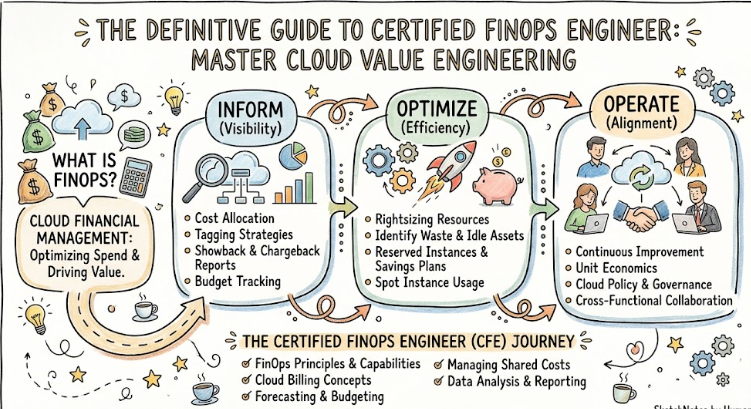
Introduction
The Certified FinOps Engineer is a professional milestone for engineers looking to bridge the gap between cloud infrastructure and financial accountability. As cloud environments become increasingly complex, the ability to architect for both performance and cost-efficiency has become a mandatory skill set for senior technical roles. This guide is designed for DevOps, SRE, and Platform engineers who want to understand how to operationalize cloud financial management within their daily workflows. By following the pathways outlined at finopsschool, professionals can transition from simply “keeping the lights on” to driving measurable business value through optimized cloud consumption.
What is the Certified FinOps Engineer?
The Certified FinOps Engineer represents a shift in how engineering teams interact with cloud billing and resource allocation. It is a technical certification that moves beyond high-level theory and focuses on the actual mechanics of implementing cost-visibility tools, automated tagging policies, and rightsizing scripts. It exists to solve the “black box” problem of cloud spending by providing a structured framework for engineers to take ownership of their infrastructure costs.
This certification aligns with modern enterprise practices by treating cost as a non-functional requirement, similar to security or reliability. It emphasizes a production-focused approach where engineers learn to integrate cost-optimization logic directly into their CI/CD pipelines and IaC templates. By mastering this domain, engineers ensure that their technical decisions are always backed by financial data, which is critical for scaling in large-scale Kubernetes or multi-cloud environments.
Who Should Pursue Certified FinOps Engineer?
This certification is primarily built for Cloud Engineers, SREs, and Platform Engineers who are tasked with managing large-scale distributed systems. It is also highly beneficial for Engineering Managers who need to justify their team’s infrastructure spend to leadership while maintaining high velocity. Beginners in the cloud space can use this to differentiate themselves, while seasoned architects use it to add a “business-aware” layer to their technical portfolio.
In the global market, and specifically within India’s massive IT services and product engineering landscape, there is a surging demand for FinOps-literate professionals. Organizations are moving away from centralized procurement and toward decentralized engineering ownership. Whether you are managing a small startup’s AWS bill or an enterprise’s multi-million dollar Azure footprint, the skills validated here help you navigate the friction between finance and engineering teams effectively.
Why Certified FinOps Engineer is Valuable and Beyond
As cloud adoption matures, the “lift and shift” phase is being replaced by a “refactor for value” phase, making FinOps knowledge a career-long asset. The demand for engineers who can automate cost governance is growing exponentially because tool-specific knowledge fades, but the logic of cloud unit economics remains constant. Holding this certification proves you can handle the fiscal responsibility that comes with modern cloud-native architectures.
The return on time investment is high because it places you in the room where strategic architectural decisions are made. Enterprises are prioritizing practitioners who can implement “Policy as Code” to prevent budget overruns before they happen. This longevity is secured because, regardless of whether the industry shifts toward serverless, edge computing, or AI-heavy workloads, the need to manage the cost of those resources will always remain a top priority for stakeholders.
Certified FinOps Engineer Certification Overview
The program is delivered via official training modules and hosted on the primary provider platform. The assessment approach is designed to be practical, testing a candidate’s ability to interpret billing data, identify anomalies, and recommend technical remediations. Unlike generic cloud exams, this focuses on the intersection of engineering action and financial outcome, ensuring that certified individuals can operate effectively within a FinOps team.
The structure is divided into logical domains covering visibility, optimization, and operation. It ownership remains with a community-driven body that ensures the curriculum stays updated with the latest cloud provider billing changes. Candidates are expected to demonstrate proficiency in tagging strategies, commitment-based discount management, and the technical implementation of cost-allocation tags across various cloud services.
Certified FinOps Engineer Certification Tracks & Levels
The certification path is tiered to support professionals at different stages of their career journey, starting with a foundation level that introduces core terminology and the FinOps lifecycle. The professional level dives deeper into the technical execution, requiring candidates to solve complex scenarios involving shared costs and container-level attribution. Advanced levels are aimed at those designing organizational-wide FinOps programs and governance frameworks.
Specialization tracks are available for those coming from specific backgrounds such as DevOps or SRE, allowing them to map FinOps principles to their existing toolsets. For example, a DevOps-focused FinOps track would emphasize integrating cost checks into Jenkins or GitHub Actions. These levels align with career progression from an individual contributor to a technical lead or architect role where high-level resource planning becomes a daily task.
Complete Certified FinOps Engineer Certification Table
| Track | Level | Who it’s for | Prerequisites | Skills Covered | Recommended Order |
| Core FinOps | Foundation | Junior Engineers / Managers | Basic Cloud Knowledge | FinOps Lifecycle, Terminology | 1 |
| Engineering | Professional | SRE / DevOps / Cloud Leads | 2+ Years Cloud Exp | Automation, Rightsizing, IaC | 2 |
| Architecture | Advanced | Solutions Architects | Professional Cert | Multi-cloud Governance, Unit Metrics | 3 |
| Leadership | Management | CTOs / IT Directors | Foundation Cert | Organizational Change, KPI Design | 4 |
Detailed Guide for Each Certified FinOps Engineer Certification
Certified FinOps Engineer – Foundation Level
What it is
This level validates a fundamental understanding of the FinOps phases: Inform, Optimize, and Operate. It ensures the candidate speaks the common language of cloud financial management.
Who should take it
It is suitable for newcomers to the FinOps space, project managers, and finance professionals who need to collaborate with engineering teams on cloud spend.
Skills you’ll gain
- Understanding the difference between OpEx and CapEx in cloud.
- Navigating the FinOps lifecycle phases.
- Identifying the key stakeholders in a FinOps practice.
- Basics of cloud billing and pricing models.
Real-world projects you should be able to do
- Conduct a basic audit of cloud resource tagging.
- Generate a monthly spend report for a specific department.
- Identify unattached storage volumes or idle resources.
Preparation plan
- 7-14 Days: Review official documentation and core terminology.
- 30 Days: Complete the introductory video course and practice quizzes.
- 60 Days: Participate in a study group and apply concepts to a personal cloud account.
Common mistakes
- Treating cloud cost as a one-time “cleanup” rather than a continuous cycle.
- Confusing FinOps with traditional IT procurement.
Best next certification after this
- Same-track option: Certified FinOps Engineer – Professional
- Cross-track option: Cloud Provider Administrator (AWS/Azure/GCP)
- Leadership option: FinOps Practitioner
Certified FinOps Engineer – Professional Level
What it is
This certification validates the technical ability to implement automated cost-saving measures and complex reporting structures. It focuses on the “Engineer” part of the FinOps title.
Who should take it
Suitable for DevOps Engineers, SREs, and Platform Engineers who are responsible for infrastructure code and automated deployments.
Skills you’ll gain
- Developing automated “Cleanup” scripts for cloud resources.
- Implementing Container and Kubernetes cost attribution.
- Advanced utilization of Spot instances and Reserved Instances.
- Creating real-time cost dashboards for dev teams.
Real-world projects you should be able to do
- Build an automated alert system for cost anomalies in Slack.
- Implement a tagging enforcement policy using OPA or Kyverno.
- Migration of workloads to more cost-effective instance families.
Preparation plan
- 7-14 Days: Focus on technical whitepapers regarding cloud billing APIs.
- 30 Days: Hands-on lab work with cost-optimization tools (open source or native).
- 60 Days: Execute a complete optimization project on a staging environment.
Common mistakes
- Ignoring the “Engineer” aspect and focusing too much on spreadsheets.
- Not considering the performance impact of aggressive rightsizing.
Best next certification after this
- Same-track option: Certified FinOps Architect
- Cross-track option: Certified Kubernetes Administrator (CKA)
- Leadership option: Technical Program Manager (TPM)
Choose Your Learning Path
DevOps Path
The DevOps path focuses on integrating cost-feedback loops directly into the developer experience. Engineers on this path learn how to provide “cost-at-commit” insights, allowing developers to see the financial impact of their infrastructure changes before they are deployed. This involves deep integration with CI/CD pipelines and infrastructure-as-code tools. By the end of this path, a DevOps engineer should be able to treat “cost” as a failing test case in a pipeline if it exceeds predefined limits.
DevSecOps Path
In this path, the focus is on the intersection of security, compliance, and cost. Professionals learn how security configurations, such as data retention policies or logging levels, can inadvertently drive up cloud costs. They implement governance policies that ensure resources are both secure and cost-efficient. The goal is to build a “Secure and Lean” infrastructure where compliance doesn’t come at an astronomical price tag, utilizing automated policy enforcement for both domains.
SRE Path
The SRE path views FinOps through the lens of reliability and the “Error Budget.” SREs learn to balance the cost of redundancy and high availability against the actual business requirements for uptime. They focus on efficient resource utilization, ensuring that the infrastructure is not over-provisioned “just in case.” This path teaches SREs how to use FinOps data to make informed decisions about scaling policies and disaster recovery strategies that align with the business’s financial goals.
AIOps Path
AIOps professionals leverage machine learning to automate the FinOps lifecycle. This path focuses on using AI models to predict future spend, detect complex cost anomalies that rule-based systems might miss, and suggest optimal resource configurations. Engineers learn to feed billing telemetry into AI engines to create self-healing infrastructures that adjust their own footprint based on predicted demand and cost-efficiency models.
MLOps Path
The MLOps path is specialized for managing the high costs associated with GPU instances and large-scale data processing for machine learning. Engineers learn how to optimize training jobs, use spot instances for model training, and manage the lifecycle of expensive experimental environments. This path is crucial for organizations where AI/ML research spend can quickly spiral out of control without technical guardrails and specialized lifecycle management.
DataOps Path
DataOps focuses on the financial management of data pipelines, warehouses, and big data clusters like Snowflake or Databricks. Practitioners on this path learn to optimize query costs, manage data egress charges, and implement lifecycle policies for massive datasets. The objective is to ensure that the value derived from data exceeds the cost of storing and processing it, which requires deep technical knowledge of how various data engines charge for compute and storage.
FinOps Path
This is the dedicated path for those looking to become full-time FinOps practitioners or consultants. It covers the entire breadth of the discipline, from technical engineering to cultural change management. This path focuses on building a “Cloud Center of Excellence” and bridging the gap between Finance, Procurement, and Engineering. It is ideal for those who want to lead the FinOps movement within an organization and establish a culture of cloud financial accountability.
Role → Recommended Certified FinOps Engineer Certifications
| Role | Recommended Certifications |
| DevOps Engineer | Certified FinOps Engineer – Professional |
| SRE | Certified FinOps Engineer – Professional |
| Platform Engineer | Certified FinOps Engineer – Advanced |
| Cloud Engineer | Certified FinOps Engineer – Foundation |
| Security Engineer | Certified FinOps Engineer – Foundation |
| Data Engineer | Certified FinOps Engineer – Professional |
| FinOps Practitioner | Certified FinOps Engineer – All Levels |
| Engineering Manager | Certified FinOps Engineer – Foundation |
Next Certifications to Take After Certified FinOps Engineer
Same Track Progression
Once you have mastered the engineering aspects, the logical next step is to move into the Architecture track. This involves designing complex, multi-cloud governance systems that can scale across thousands of accounts. You will focus on high-level strategy, such as negotiating Enterprise Discount Plans (EDPs) with cloud providers and designing internal chargeback systems that work across diverse business units. Deepening your specialization ensures you stay at the forefront of the FinOps movement.
Cross-Track Expansion
To become a more well-rounded professional, consider certifications in related domains such as Kubernetes (CKA) or Security (CKS). Understanding the underlying technology in depth allows you to find more creative ways to optimize costs. For instance, knowing how Kubernetes scheduling works in detail can help you better utilize spot instances or bin-pack containers more efficiently. Expanding your skills horizontally makes you an invaluable asset who can speak both “infrastructure” and “value.”
Leadership & Management Track
For those looking to move into people or program management, certifications like PMP or specialized FinOps leadership courses are recommended. These prepare you for the cultural challenges of FinOps, such as convincing engineering teams to prioritize optimization over new features. You will learn how to report to the CFO and CEO, translating technical savings into business outcomes like improved gross margins. This track transitions you from a technical implementer to a strategic business leader.
Training & Certification Support Providers for Certified FinOps Engineer
DevOpsSchool
DevOpsSchool provides a comprehensive curriculum that covers the technical depth required for FinOps engineering. Their approach includes hands-on labs where students can practice with real-world cloud billing datasets. The instructors are industry veterans who bring practical scenarios into the classroom, helping students understand not just the “how” but the “why” of cost optimization. They offer flexible learning options suitable for working professionals who need to balance their jobs with their certification goals.
Cotocus
Cotocus specializes in high-end technical training with a focus on cloud-native technologies. Their FinOps programs are designed to be intensive and project-based, ensuring that every candidate walks away with a portfolio of optimization scripts. They emphasize the integration of FinOps into the broader DevOps ecosystem, making it an ideal choice for platform engineers. Their support system includes mentorship and guidance on navigating complex enterprise cloud environments.
Scmgalaxy
Scmgalaxy is a well-known community and training hub that offers extensive resources for FinOps aspirants. They provide a wealth of documentation, practice exams, and community forums where learners can discuss challenges. Their training modules are updated frequently to reflect the changing landscape of cloud provider services. Scmgalaxy focuses on making technical concepts accessible to a wide audience, ensuring that even those new to cloud can find a clear path to certification.
BestDevOps
BestDevOps offers tailored training programs that focus on the ROI of certification. Their FinOps courses are structured to help professionals quickly gain the skills needed to make an impact in their current roles. They provide a mix of theoretical knowledge and practical application, with a strong emphasis on the tools commonly used in the industry for cloud cost management. Their career support services are particularly helpful for those looking to transition into dedicated FinOps roles.
devsecopsschool.com
This platform focuses on the intersection of security and operations, providing a unique perspective on FinOps. Their training highlights how to build cost-efficient security architectures and how to use automation to enforce both security and cost policies. For engineers who are already focused on DevSecOps, this provider offers the perfect bridge into the world of financial management. Their curriculum is highly technical and aimed at practitioners who want to lead in the “Secure-FinOps” space.
sreschool.com
Sreschool.com approaches FinOps from the perspective of reliability and performance. Their courses teach students how to treat cost as a key metric in the SRE handbook. They focus on advanced topics like observability for cost and how to build automated scaling systems that are cost-aware. This is the go-to provider for SREs who want to add financial accountability to their list of responsibilities without compromising on system stability or performance.
aiopsschool.com
Aiopsschool.com provides specialized training on using artificial intelligence to manage IT operations, including cloud costs. Their FinOps modules cover the use of machine learning for anomaly detection and predictive billing. This training is ideal for forward-thinking engineers who want to automate the “Inform” and “Optimize” phases of FinOps using cutting-edge AI tools. They bridge the gap between traditional engineering and the future of automated, intelligent cloud management.
dataopsschool.com
Dataopsschool.com is dedicated to the unique challenges of managing data infrastructure. Their FinOps training specifically targets the costs associated with data lakes, warehouses, and ETL processes. They provide deep dives into the pricing models of major data platforms and teach students how to architect data pipelines for maximum efficiency. This is a critical resource for Data Engineers and Architects who are seeing their cloud data bills grow as their organizations become more data-driven.
finopsschool.com
As a primary source of FinOps knowledge, finopsschool.com offers the most direct and comprehensive path to certification. Their programs are built around the official FinOps framework, ensuring that students receive the most accurate and up-to-date information. They provide a structured learning environment with a clear progression from beginner to advanced levels. Being at the center of the FinOps community, they offer unparalleled networking opportunities and access to industry leaders in the field.
Frequently Asked Questions (General)
- How difficult is the Certified FinOps Engineer exam?
The exam is moderately difficult as it requires both a solid understanding of cloud architecture and the ability to interpret financial data. It is not just about memorization; you must be able to apply concepts to real-world technical scenarios. - How long does it take to prepare for this certification?
For someone already working in a cloud environment, 30 to 60 days is a standard preparation period. This allows enough time to go through the theory and complete several hands-on projects or labs. - Are there any prerequisites for taking the exam?
While there are no hard prerequisites for the foundation level, the professional level strongly recommends at least two years of experience in cloud engineering or DevOps roles. - Is this certification recognized globally?
Yes, as organizations worldwide struggle with cloud costs, the demand for certified FinOps professionals is growing across North America, Europe, and Asia-Pacific regions, including India. - What is the typical ROI for this certification?
Professionals often see immediate career benefits, including eligibility for higher-level architect roles and potential salary increases due to the specialized nature of the skill set. - Do I need to be a developer to become a FinOps Engineer?
You don’t need to be a full-stack developer, but you should be comfortable with scripting (like Python or Bash) and infrastructure-as-code (like Terraform) to automate optimization tasks. - How does this certification differ from a standard Cloud Architect cert?
A standard architect cert focuses on how to build a system that works. This cert focuses on how to build a system that works at the lowest possible cost for the required performance. - Which cloud provider is the exam based on?
The certification is generally cloud-agnostic, focusing on principles that apply to AWS, Azure, and Google Cloud, though examples from these providers are frequently used. - Can a manager benefit from an “Engineer” certification?
Yes, an Engineering Manager with this cert can better lead technical teams in cost-saving initiatives and communicate more effectively with the finance department. - How often do I need to renew this certification?
Typically, certifications in this fast-moving field require renewal every two to three years to ensure your knowledge remains current with evolving cloud billing practices. - Is the exam proctored online?
Yes, most certification providers offer the flexibility of an online proctored exam, allowing you to take it from your home or office as long as you meet the technical requirements. - Are there many job openings for FinOps Engineers?
The market is currently seeing a significant uptick in “FinOps Engineer” and “Cloud Cost Architect” roles as enterprises look to stabilize their cloud budgets post-migration.
FAQs on Certified FinOps Engineer
- What specific tools are covered in the Certified FinOps Engineer curriculum?
The curriculum focuses on both cloud-native tools like AWS Cost Explorer and Azure Cost Management, as well as open-source projects like Kubecost and Prometheus-based exporters for granular visibility. - How does this certification address Kubernetes cost management?
It provides specific frameworks for container-level attribution, teaching engineers how to allocate costs to namespaces, labels, and individual pods, which is a major pain point for modern enterprises. - Does the certification cover multi-cloud cost management?
Yes, a significant portion of the advanced tracks is dedicated to normalizing data across different cloud providers to create a unified view of the organization’s total cloud footprint and spend. - Will I learn about commitment-based discounts like Reserved Instances?
Absolutely. The certification covers the technical and financial strategy behind purchasing and managing RIs and Savings Plans to ensure maximum coverage and utilization across your infrastructure. - Is there a focus on automation in the Certified FinOps Engineer program?
Automation is a core pillar. You will learn how to build “Automated Governance” where resources are automatically shut down, resized, or flagged if they don’t comply with cost-efficiency policies. - How does FinOps integrate with the existing DevOps culture?
It teaches you to treat “Cost” as a metric just like “Latency” or “Error Rate,” encouraging teams to include financial impact in their regular sprint planning and retrospective meetings. - Does the program help with “Unit Economics” in the cloud?
Yes, it teaches you how to move beyond total spend and calculate the cost per business transaction, such as “cost per customer login” or “cost per order processed.” - What is the passing score for the certification exam?
While it varies by provider, the passing score is typically around 70% to 75%. The exam consists of multiple-choice questions and case-study-based scenarios to test practical knowledge.
Final Thoughts: Is Certified FinOps Engineer Worth It?
In my two decades of experience across the engineering spectrum, I have seen many trends come and go. However, the need for fiscal responsibility in technology is not a trend; it is a fundamental shift in how we build software. The Certified FinOps Engineer is more than just another badge on your profile. It represents a mature understanding of how modern business operates in a cloud-first world.
If you are an engineer who wants to move beyond just writing code and start influencing the strategic direction of your company, this path is absolutely worth it. It gives you the tools to speak to leadership in a language they understand—value and efficiency. No hype is needed here; the reality is that the most successful engineers of the next decade will be those who can build reliably, securely, and cost-effectively. Invest in this certification if you are ready to take that next step into a more impactful, business-aware engineering role.
