Limited Time Offer!
For Less Than the Cost of a Starbucks Coffee, Access All DevOpsSchool Videos on YouTube Unlimitedly.
Master DevOps, SRE, DevSecOps Skills!
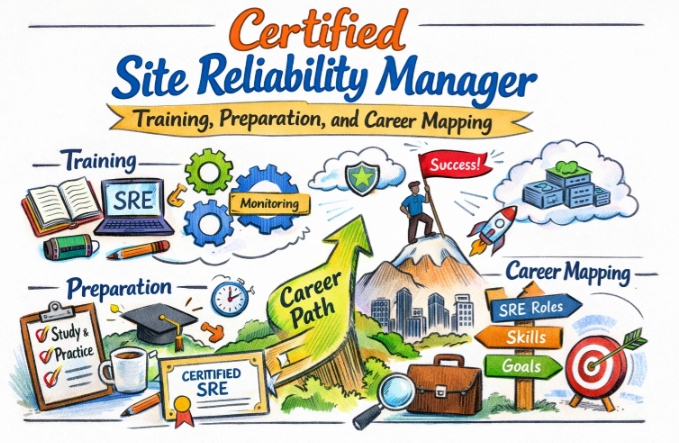
The Certified Site Reliability Manager is a professional designation designed to bridge the gap between traditional management and modern reliability engineering. This guide is built for professionals who want to lead SRE teams, manage production risks, and implement SLO-driven cultures. Whether you are a senior engineer transitioning to leadership or an existing manager looking to technicalize your skillset, this roadmap provides clarity on how to navigate the ecosystem at SREschool. Understanding the balance between feature velocity and system stability is the core objective of this certification journey.
What is the Certified Site Reliability Manager?
The Certified Site Reliability Manager represents a paradigm shift in how technical leadership is practiced in cloud-native environments. It is not a theoretical management course, but a practical framework that focuses on leading teams through production-heavy workflows. The certification exists because modern enterprises realized that managing SRE teams requires a deep understanding of error budgets, toil reduction, and incident response orchestration.
It aligns perfectly with modern engineering practices by teaching managers how to treat operations as a software problem. Instead of focusing on vanity metrics, this program emphasizes real-world outcomes such as reduced Mean Time to Recovery and improved system durability. It provides the vocabulary and the metrics needed to communicate technical risk to business stakeholders effectively.
Who Should Pursue Certified Site Reliability Manager?
This certification is primarily designed for individuals who occupy or aspire to occupy leadership roles within DevOps, SRE, and Platform Engineering teams. Senior individual contributors who are looking to move into a Principal or Lead role will find the strategic elements of the curriculum highly beneficial. It also serves as an essential upgrade for traditional IT managers who need to adapt to the fast-paced world of site reliability.
In the global market, and particularly within India’s massive technology hubs, there is a significant shortage of managers who actually understand SRE principles. Security professionals and data leaders are also increasingly pursuing this certification to ensure their respective domains meet the required uptime standards. It provides a standardized way to prove you can lead a team through a high-pressure production incident without losing focus on long-term stability.
Why Certified Site Reliability Manager is Valuable and Beyond
The demand for reliable systems is only increasing as more services move to the cloud, making this certification a long-term career asset. Enterprise adoption of SRE principles is no longer optional for large-scale organizations, ensuring that those who can manage these teams remain highly employable. This certification helps professionals stay relevant even as specific tools like Kubernetes or Terraform evolve, as the underlying management principles remain constant.
Investing time in this program offers a significant return on career investment by moving you into a high-impact, high-visibility leadership bracket. It validates your ability to manage the most expensive part of a software company: its production environment. By mastering the balance of reliability and speed, you become an indispensable asset to any organization focused on digital transformation and customer satisfaction.
Certified Site Reliability Manager Certification Overview
The program is delivered through a structured curriculum and is hosted on the SREschool platform for global accessibility. It utilizes a multi-tiered assessment approach that combines conceptual knowledge with practical, scenario-based evaluations to ensure real-world readiness. The certification is owned and maintained by industry practitioners who ensure the content stays aligned with current enterprise reliability challenges.
The structure is designed to be modular, allowing professionals to progress from foundational concepts to advanced organizational leadership strategies. It emphasizes ownership of the production lifecycle and provides a clear framework for measuring the success of an SRE organization. Candidates are evaluated on their ability to make data-driven decisions regarding system health and team performance.
Certified Site Reliability Manager Certification Tracks & Levels
The certification is divided into Foundation, Professional, and Advanced levels to cater to different stages of a professional’s career. The Foundation level focuses on the core vocabulary and metrics of SRE, making it ideal for those new to the management side of reliability. It establishes the baseline for what an SRE team should look like and how it interacts with development teams.
The Professional level dives deeper into incident management, post-mortem culture, and the technical aspects of toil reduction and automation. Finally, the Advanced level is geared toward directors and technical leaders who are responsible for building SRE organizations from scratch. These levels align with a natural career progression from a team lead to a department head in a modern technology organization.
Complete Certified Site Reliability Manager Certification Table
| Track | Level | Who it’s for | Prerequisites | Skills Covered | Recommended Order |
| Core SRE | Foundation | Aspiring Managers | 3+ Years IT Exp | SLOs, SLIs, Toil | First |
| Management | Professional | Current Team Leads | SRE Foundation | Incident Org, Budgets | Second |
| Leadership | Advanced | Directors / VPs | SRE Professional | Scaling SRE, Culture | Third |
| Specialized | Expert | Principal SREs | Advanced Level | Architecture Review | Optional |
Detailed Guide for Each Certified Site Reliability Manager Certification
What it is
This certification validates a candidate’s understanding of the fundamental principles that govern Site Reliability Engineering from a management perspective. It ensures that the professional can speak the language of reliability and understands the core metrics used to measure system health.
Who should take it
This is suitable for senior engineers, newly promoted team leads, or project managers who are transitioning into a DevOps or SRE environment. It is designed for those who need a solid grasp of SRE basics before moving into complex organizational management.
Skills you’ll gain
- Defining and measuring Service Level Indicators (SLIs).
- Establishing meaningful Service Level Objectives (SLOs).
- Identifying and quantifying operational toil within a team.
- Understanding the lifecycle of a production incident.
Real-world projects you should be able to do
- Create a reliability dashboard for a microservices-based application.
- Draft an initial Error Budget policy for a development squad.
- Conduct a basic audit of manual tasks to identify automation opportunities.
Preparation plan
- 7-14 Days: Review the core SRE handbook principles and focus on terminology like SLI/SLO/SLA.
- 30 Days: Complete the foundational modules and practice building simple monitoring alerts.
- 60 Days: Engage in community forums and case study reviews to understand real-world SRE failures.
Common mistakes
- Treating SLOs as rigid targets rather than negotiation tools with developers.
- Focusing too much on tool-specific knowledge instead of the underlying reliability principles.
Best next certification after this
- Same-track option: Certified Site Reliability Manager – Professional Level.
- Cross-track option: DevOps Professional Certification.
- Leadership option: Technical Product Management.
Choose Your Learning Path
DevOps Path
In the DevOps path, the focus is on the integration of development and operations through the lens of reliability. Managers learn how to embed SRE practices directly into the CI/CD pipeline to ensure that reliability is a first-class citizen. This path is ideal for those who want to oversee the entire software delivery lifecycle while maintaining high stability. It emphasizes the cultural shift required to make developers share the responsibility for production health.
DevSecOps Path
The DevSecOps path incorporates security as a fundamental component of system reliability and management. Professionals learn how to manage security incidents with the same rigor and blamelessness as operational outages. This path focuses on automating security gates and ensuring that compliance does not become a bottleneck for velocity. It is perfect for managers who need to balance rapid deployment with stringent regulatory and security requirements.
SRE Path
This is the core path for those dedicated to the pure discipline of Site Reliability Engineering management. It focuses heavily on the technical management of production systems, error budgets, and the reduction of manual operations. Managers on this path are experts in building platforms that enable self-healing and highly observable systems. This is the primary route for those wanting to lead dedicated SRE teams in large-scale cloud environments.
AIOps Path
The AIOps path focuses on the management of artificial intelligence tools that assist in system monitoring and incident response. Managers learn how to evaluate and implement machine learning models that can predict failures before they happen. This path explores the transition from manual observability to automated, intelligent insights that reduce the noise for on-call engineers. It is designed for forward-thinking leaders who want to leverage automation at the highest level.
MLOps Path
The MLOps path is specialized for those managing the reliability of machine learning production pipelines. Managing the reliability of an ML model is significantly different from traditional software, involving data drift and model retraining loops. This path teaches managers how to apply SRE principles to the unique challenges of data science and model deployment. It ensures that ML models are performant, reliable, and scalable in a production setting.
DataOps Path
In the DataOps path, the emphasis is on the reliability of data pipelines and large-scale data processing systems. Managers learn how to manage the “data uptime” and ensure that data quality and availability meet the needs of the business. This path applies SRE concepts like SLOs to data delivery, ensuring that downstream analytics and applications are always fed with accurate information. It is ideal for leaders in the data engineering and analytics space.
FinOps Path
The FinOps path focuses on the management of cloud costs as a technical metric related to reliability. Managers learn how to balance the performance and uptime of a system with the financial impact of the underlying infrastructure. This path teaches how to lead teams in optimizing cloud spend without compromising the stability of the service. It is increasingly important for leaders who are responsible for both the technical and financial health of their departments.
Role → Recommended Certified Site Reliability Manager Certifications
| Role | Recommended Certifications |
| DevOps Engineer | Certified Site Reliability Manager (Foundation) |
| SRE | Certified Site Reliability Manager (Professional) |
| Platform Engineer | Certified Site Reliability Manager (Professional) |
| Cloud Engineer | Certified Site Reliability Manager (Foundation) |
| Security Engineer | Certified Site Reliability Manager (DevSecOps Track) |
| Data Engineer | Certified Site Reliability Manager (DataOps Track) |
| FinOps Practitioner | Certified Site Reliability Manager (FinOps Track) |
| Engineering Manager | Certified Site Reliability Manager (Advanced) |
Next Certifications to Take After Certified Site Reliability Manager
Same Track Progression
Once you have mastered the management side of SRE, the next step is deep specialization in organizational design. This involves moving into certifications that focus on Enterprise Architecture or Global Infrastructure Management. The goal is to move from managing a single team or department to overseeing the reliability strategy for an entire corporation. This progression ensures that you stay at the forefront of high-level technical leadership.
Cross-Track Expansion
Broadening your skills into adjacent fields like FinOps or DevSecOps can make you a much more versatile leader. Understanding the financial implications of reliability or the security requirements of production systems adds layers to your management capabilities. Many SRE managers choose to get certified in Cloud Security or Data Management to better understand the various stakeholders they interact with daily. This expansion prevents silos and fosters a more holistic approach to engineering leadership.
Leadership & Management Track
For those looking to move into executive roles, the transition often involves certifications in business administration or strategic leadership. These programs focus on the human and financial side of the business, such as vendor management, budgeting, and long-term organizational scaling. Combining a deep technical background in SRE with formal leadership training makes for a powerful executive profile. It prepares you for roles such as CTO, VP of Engineering, or Head of Infrastructure.
Training & Certification Support Providers for Certified Site Reliability Manager
DevOpsSchool
DevOpsSchool is a leading provider of technical training that offers a comprehensive suite of resources for those pursuing reliability certifications. They provide deep-dive sessions that cover everything from infrastructure as code to advanced monitoring strategies used by SRE managers. Their curriculum is designed by industry experts who bring years of practical experience into the classroom environment. Students benefit from hands-on labs that simulate real-world production environments, ensuring they can apply what they learn immediately. The platform also offers a robust community where professionals can network and share insights on the latest trends in the DevOps ecosystem.
Cotocus
Cotocus focuses on providing specialized consulting and training services that help organizations and individuals master the art of modern engineering. They offer tailored programs for the Certified Site Reliability Manager that emphasize the practical application of SRE principles in enterprise settings. Their approach is highly interactive, focusing on solving actual business problems through technical excellence and leadership. Cotocus is known for its ability to bridge the gap between theoretical knowledge and the daily realities of managing complex cloud infrastructures. Their mentors are often practitioners who have led large-scale digital transformation projects for global clients.
Scmgalaxy
Scmgalaxy is a massive repository of knowledge and training for professionals in the software configuration management and DevOps space. It serves as a vital resource for anyone preparing for SRE-related certifications, providing access to a wealth of tutorials, blogs, and community forums. The site offers structured learning paths that guide candidates through the complexities of modern software delivery and reliability management. By focusing on both the tools and the culture of DevOps, Scmgalaxy helps managers build a well-rounded skillset. It is a go-to destination for staying updated on the latest open-source tools and industry best practices.
BestDevOps
BestDevOps provides a curated selection of training programs aimed at producing high-quality engineers and technical leaders. Their focus is on delivering high-impact learning experiences that are directly applicable to the current job market. For those interested in SRE management, they offer courses that break down complex topics into manageable, actionable steps. The training is designed to be efficient, respecting the time of busy professionals while ensuring they gain the necessary depth of knowledge. BestDevOps prides itself on its alumni network, which includes professionals working at some of the world’s leading technology companies.
devsecopsschool.com
This platform is dedicated entirely to the intersection of security and operations, providing essential training for modern managers. They offer specialized content that helps SRE leaders integrate security into the reliability lifecycle without slowing down development teams. Their courses cover critical topics like automated compliance, vulnerability management, and secure infrastructure design. By focusing on the “security as code” philosophy, they prepare managers to lead teams in environments where security is a top priority. The training is practical and focuses on the tools and workflows that make DevSecOps a reality in production.
sreschool.com
As the primary host for the Certified Site Reliability Manager program, this site provides the most direct and comprehensive path to certification. The curriculum is meticulously crafted to cover every aspect of the SRE management lifecycle, from foundational metrics to advanced leadership. They offer a variety of learning formats, including self-paced modules and expert-led workshops, to suit different learning styles. The platform is built by SREs for SREs, ensuring that the content is always relevant and grounded in real-world experience. It is the central hub for anyone serious about making a career in site reliability management.
aiopsschool.com
AIOpsSchool is at the forefront of teaching managers how to leverage artificial intelligence for system reliability. Their training programs focus on the implementation of AI and ML tools to enhance observability and automate incident response. For a Site Reliability Manager, this knowledge is crucial for staying ahead of the curve as systems become too complex for manual oversight. The courses cover the selection of AIOps tools, data strategy for monitoring, and the ethics of automated decision-making. It is an essential resource for leaders who want to build the next generation of intelligent, self-healing infrastructures.
dataopsschool.com
DataOpsSchool provides specialized training for managing the reliability and efficiency of data-driven organizations. They help managers apply SRE principles to data pipelines, ensuring that data is treated with the same rigor as software code. The curriculum includes topics like data quality monitoring, pipeline automation, and managing large-scale data infrastructure. As data becomes more central to every business, the ability to manage its reliability is a highly sought-after skill. DataOpsSchool equips leaders with the frameworks needed to ensure that data flows seamlessly and accurately across the enterprise.
finopsschool.com
FinOpsSchool focuses on the critical intersection of cloud engineering and financial management. They provide training that helps SRE managers understand the cost implications of their technical decisions and how to optimize cloud spend. The courses cover cloud billing models, resource right-sizing, and fostering a culture of financial accountability within engineering teams. In a world where cloud costs can easily spiral out of control, FinOps knowledge is essential for any senior technical leader. This school prepares managers to report on the business value of their infrastructure investments effectively.
Frequently Asked Questions (General)
- How long does it take to complete the certification?
Most professionals complete the foundation level in about 4-6 weeks, while the professional level may take 3-4 months depending on experience. - Are there any formal prerequisites for the foundation level?
While there are no strict requirements, having at least 3 years of experience in IT or software development is highly recommended for context. - How is the exam structured?
The exam usually consists of a mix of multiple-choice questions and scenario-based problems that require you to apply management logic. - Is the certification recognized globally?
Yes, the principles taught are based on industry-standard SRE practices used by major tech companies worldwide. - Do I need to be a coder to pass this certification?
You don’t need to be a full-time developer, but you must understand code logic, automation scripts, and how systems are architected. - What is the renewal policy for the certification?
Certifications are typically valid for two to three years, after which you may need to take a refresher course or prove continuing education. - Does this certification help in getting a salary hike?
While not guaranteed, managers with specialized SRE certifications often command higher salaries due to the high demand and niche skillset. - Can I skip the foundation level if I have experience?
It is generally recommended to start with the foundation to align with the specific terminology and framework of the program. - Is there a community or alumni group I can join?
Yes, most providers offer access to exclusive forums and Slack channels where you can connect with other certified managers. - Are the study materials included in the certification fee?
This depends on the provider, but usually, the core curriculum is included, while extra practice exams might be separate. - How does this differ from a standard DevOps certification?
This certification focuses specifically on the management and reliability of production systems, whereas DevOps is more about delivery and culture. - Is there a practical project involved in the assessment?
Higher levels of the certification often require the submission of a project or a detailed case study analysis.
FAQs on Certified Site Reliability Manager
- What makes a manager specifically an “SRE” manager?
An SRE manager focuses on treating operations as a software problem and uses data like error budgets to drive decision-making. - How does this certification address team burnout?
The curriculum includes modules on managing on-call health, reducing toil, and ensuring sustainable work practices for the team. - Can this certification be applied to on-premise environments?
Yes, while cloud-focused, the principles of reliability, monitoring, and incident management apply to any production environment. - What is the role of SLOs in this management program?
SLOs are the central tool for an SRE manager to balance the need for new features with the need for system stability. - How much focus is there on specific tools like Kubernetes?
The focus is on the strategy of managing such tools rather than the specific syntax of the tools themselves. - Does the program cover post-mortem documentation?
Yes, learning how to write and lead blameless post-mortems is a core component of the professional level. - How does a manager handle a conflict between Dev and SRE?
The certification provides frameworks for negotiation based on data and shared organizational goals rather than personal opinion. - Is this suitable for managers in small startups?
Absolutely, as startups often need to build reliable foundations early to scale without constant firefighting.
Final Thoughts: Is Certified Site Reliability Manager Worth It?
If you are looking to elevate your career from a generalist manager to a specialist leader in production excellence, this certification is a significant step forward. It moves you away from the “firefighter” mentality and into a strategic role where you manage risk with precision and data. In my experience, the most successful engineering organizations are those led by people who truly understand that reliability is the most important feature of any product.
This certification provides the framework to build that culture and the credentials to prove you can lead it. It is an investment in a skillset that remains relevant regardless of which cloud provider or automation tool becomes dominant. For the professional who wants to lead at the intersection of technology and business value, becoming a Certified Site Reliability Manager is an excellent decision.
