Limited Time Offer!
For Less Than the Cost of a Starbucks Coffee, Access All DevOpsSchool Videos on YouTube Unlimitedly.
Master DevOps, SRE, DevSecOps Skills!
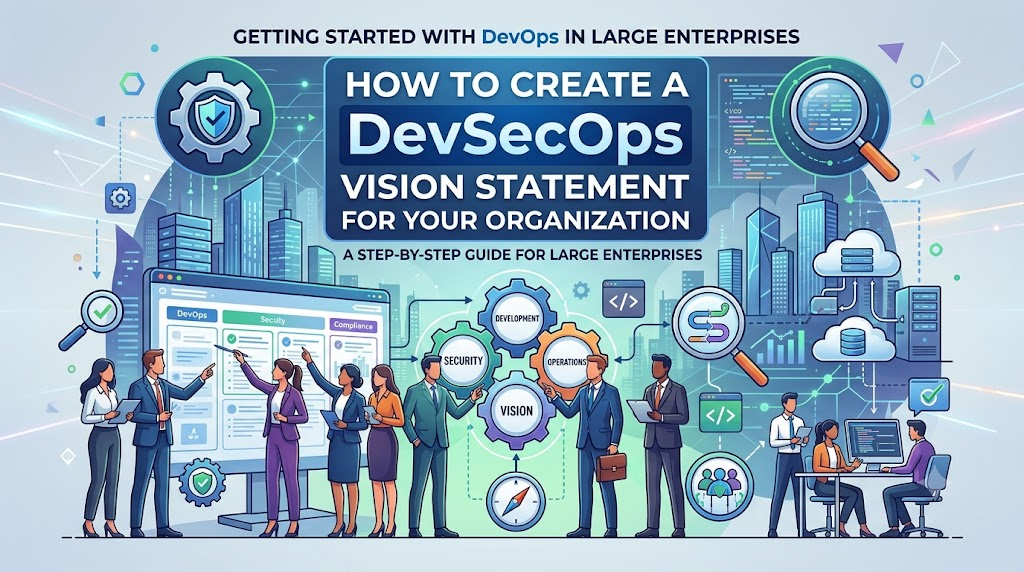
DevSecOps is often introduced through tools: security scanners in CI/CD, software composition analysis, container security, secrets detection, infrastructure scanning, policy-as-code, and security monitoring. Those tools matter, but they are not the starting point.
An organization can buy excellent security tools and still struggle with DevSecOps if engineering, security, operations, and leadership do not agree on what they are trying to achieve.
That is where a DevSecOps vision statement becomes useful. A good vision statement gives the organization a shared direction for integrating security into software delivery. It explains what secure software delivery should look like, why it matters to the business, and what teams should ultimately work toward. The key is to avoid turning the vision into a list of tools or a collection of security slogans. A strong DevSecOps vision should influence engineering practices, security priorities, platform design, governance, and day-to-day decision-making.
What Is a DevSecOps Vision Statement?
A DevSecOps vision statement is a concise description of the future state an organization wants to achieve by integrating security into its software development and delivery lifecycle.
It connects three areas:
- Development — building and changing software quickly
- Operations — delivering and running software reliably
- Security — managing security risk throughout the lifecycle
Instead of treating security as a final approval step before production, the vision should describe security as a shared responsibility embedded throughout software delivery.
For example, a weak vision might say:
“We will implement DevSecOps and use automated security tools.”
That sounds reasonable, but it does not provide much direction.
A stronger vision would describe the desired operating model:
“We will make secure software delivery a shared responsibility by embedding security controls, automation, and risk-based decision-making throughout the software lifecycle, enabling teams to release software quickly while maintaining appropriate levels of security, reliability, and compliance.”
The second statement gives teams something they can actually use when making decisions.
Why Your Organization Needs a DevSecOps Vision
DevSecOps initiatives often fail for organizational reasons rather than technical ones.
One team may view DevSecOps as a security requirement. Another may see it as a collection of CI/CD security tools. Developers may worry that security controls will slow releases, while security teams may believe development teams are moving too quickly and creating unacceptable risk.
Without a shared vision, these groups can optimize for different outcomes.
A well-defined vision helps establish a common understanding of:
- What secure software delivery means
- Who owns security responsibilities
- How security should fit into development workflows
- How risk should influence security decisions
- What should be automated
- What should remain subject to human review
- How security effectiveness will be measured
- What the organization wants to achieve over the next several years
The vision does not replace a roadmap. It gives the roadmap a direction.
Vision Statement vs. Mission Statement vs. Strategy
These terms are often mixed together, but they serve different purposes.
| Element | Main Question | Example |
|---|---|---|
| Vision | Where do we want to be? | Secure software delivery becomes part of normal engineering |
| Mission | What are we doing to get there? | Integrate security practices into development and delivery |
| Strategy | How will we achieve it? | Standardize pipelines, automate controls, improve developer security practices |
| Roadmap | What happens and when? | Implement SAST in Q1, SCA in Q2, policy-as-code in Q3 |
| Metrics | How will we know we are improving? | Vulnerability remediation time, coverage, escape rate |
A common mistake is writing a vision statement that is actually a roadmap.
For example:
“By December, we will deploy SAST, DAST, SCA, container scanning, and secrets scanning across all pipelines.”
That is a delivery objective, not a vision.
The vision should remain useful even when the tools, platforms, and implementation roadmap change.
Step 1: Start With the Business Problem
Before writing the statement, understand why the organization needs DevSecOps.
Do not begin with:
“Which security tools should we deploy?”
Start with:
“What problem are we trying to solve?”
Possible business drivers include:
- Increasing software delivery speed
- Reducing security vulnerabilities
- Reducing production security incidents
- Meeting regulatory or contractual requirements
- Improving auditability
- Reducing manual security reviews
- Improving vulnerability remediation
- Protecting customer data
- Reducing software supply-chain risk
- Making security practices consistent across teams
- Supporting cloud-native application delivery
- Improving confidence in frequent releases
Different organizations may have very different priorities.
A financial institution may emphasize regulatory risk and customer data protection.
A SaaS company may prioritize secure continuous delivery and software supply-chain risk.
A government organization may emphasize compliance, authorization, and traceability.
A startup may need security controls that provide meaningful risk reduction without creating excessive operational overhead.
Your vision should reflect the organization’s actual problem.
Step 2: Understand the Current State
A useful DevSecOps vision must acknowledge where the organization is starting.
Assess the current software delivery environment across several dimensions.
Development
Look at:
- Development workflows
- Code review practices
- Branching strategies
- Dependency management
- Developer security awareness
- Secure coding practices
CI/CD
Review:
- Build pipelines
- Deployment processes
- Pipeline security
- Security testing
- Artifact management
- Release approvals
- Secrets handling
Security
Evaluate:
- Vulnerability management
- Security testing
- Threat modeling
- Identity and access controls
- Security monitoring
- Incident response
- Risk acceptance processes
Infrastructure
Consider:
- Cloud infrastructure
- Infrastructure as Code
- Containers
- Kubernetes
- Network controls
- Configuration management
Governance
Assess:
- Security policies
- Compliance requirements
- Risk management
- Audit requirements
- Ownership models
- Exception processes
The goal is not to produce a perfect assessment before writing the vision.
The goal is to understand the gap between where the organization is today and where it wants to be.
Step 3: Define the Desired Future State
Now describe what successful DevSecOps should look like.
Think in terms of capabilities rather than tools.
For example, instead of saying:
“Every pipeline will use Tool X.”
Think:
“Security checks will be integrated into automated software delivery workflows and provide actionable feedback early enough for teams to address issues efficiently.”
That future state is more durable.
A mature DevSecOps environment might have characteristics such as:
- Developers receive security feedback during development.
- Security testing is automated where practical.
- High-risk issues are identified early.
- Security controls are integrated into existing engineering workflows.
- Security responsibilities are shared across teams.
- Security policies are increasingly expressed as automated controls.
- Risk decisions are documented and traceable.
- Security exceptions have defined ownership and expiration.
- Production systems are continuously monitored.
- Vulnerability remediation is prioritized according to risk.
- Security teams provide guardrails and expertise rather than becoming a permanent release bottleneck.
These are useful building blocks for a vision statement.
Step 4: Decide What DevSecOps Means for Your Organization
There is no single DevSecOps operating model that works for every company.
Your organization needs to define what the term means in its own context.
For one organization:
DevSecOps may primarily mean automated security testing in CI/CD.
For another:
It may include application security, cloud security, infrastructure security, software supply-chain security, compliance automation, and runtime protection.
Before finalizing the vision, agree on the scope.
A useful question for leadership is:
“When we say DevSecOps, which parts of our software lifecycle are we committing to change?”
The answer should include more than security tooling.
Step 5: Define the Principles Behind the Vision
The vision statement becomes much stronger when it is supported by a small set of principles.
Good principles might include:
1. Security Is a Shared Responsibility
Security should not belong exclusively to the security department.
Developers, platform engineers, operations teams, architects, and security professionals all have different responsibilities.
2. Security Should Move Earlier
Security activities should happen as early as practical in the lifecycle.
The objective is not simply to “shift left” every possible control. It is to provide useful security feedback at the point where teams can act on it efficiently.
3. Automate Repetitive Controls
Automate checks that are deterministic, repeatable, and suitable for automation.
Reserve human expertise for decisions involving context, risk, architecture, and exceptions.
4. Use Risk-Based Decisions
Not every vulnerability deserves the same response.
Severity, exploitability, exposure, business impact, asset criticality, compensating controls, and likelihood should influence remediation decisions.
5. Security Controls Should Fit Developer Workflows
If security tooling creates excessive false positives, confusing reports, or unnecessary friction, teams may find ways around it.
Security needs to be effective and usable.
6. Build Security Into Platforms
Where possible, provide secure defaults through shared platforms, templates, pipeline components, libraries, infrastructure modules, and deployment patterns.
7. Measure Outcomes, Not Tool Adoption
Having a scanner installed does not prove that security has improved.
Measure whether security risk is actually being reduced.
Step 6: Identify the Right Stakeholders
A DevSecOps vision should not be written by one department in isolation.
Important stakeholders may include:
- CIO or CTO
- CISO
- Engineering leadership
- Application security
- Developers
- DevOps teams
- Platform engineering
- SRE
- Cloud/infrastructure teams
- QA
- Compliance
- Risk management
- Product management
- Architecture teams
Each group sees different problems.
Developers understand workflow friction.
Security teams understand threat and control requirements.
Operations teams understand reliability and operational constraints.
Compliance teams understand regulatory obligations.
Executives understand business priorities and risk tolerance.
The vision should reconcile these perspectives rather than simply reflect one of them.
Step 7: Establish the Security and Risk Philosophy
This is one of the most important parts of the exercise.
A DevSecOps vision should answer:
How will our organization balance delivery speed and security risk?
The answer should not be:
“Security must never slow down development.”
That is unrealistic.
It should also not be:
“No release can proceed until every security issue is resolved.”
That can create unnecessary bottlenecks.
A more mature approach is risk-based.
For example:
| Situation | Possible Response |
|---|---|
| Critical exploitable vulnerability in an internet-facing system | Block or escalate release |
| Low-risk informational finding | Track without blocking |
| False positive | Suppress with documented justification |
| Accepted business risk | Record owner, rationale, and expiry |
| Vulnerability with effective compensating control | Evaluate residual risk |
| Repeated high-risk issue | Address underlying engineering problem |
The exact thresholds should be defined through organizational policy rather than hidden inside the vision statement.
Step 8: Write the First Draft
Once the inputs are clear, write a short statement.
A practical DevSecOps vision can follow this structure:
We will [desired future state] by [key approach], enabling [business or customer outcome] while maintaining [important risk/security objective].
For example:
“We will build a secure-by-design software delivery culture in which development, operations, and security teams share responsibility for managing risk throughout the software lifecycle. By combining automation, secure engineering practices, continuous security feedback, and risk-based governance, we will enable teams to deliver software quickly and reliably while protecting customers, systems, and business-critical information.”
This is broad enough to remain relevant while still communicating a clear direction.
Step 9: Keep the Vision Short
A vision statement should be memorable.
If employees need three minutes to read it, it is probably too long.
The detailed information belongs in supporting documents such as:
- DevSecOps strategy
- Security engineering standards
- Reference architectures
- Engineering policies
- Control requirements
- Implementation roadmaps
- Training plans
- Metrics frameworks
The vision should provide direction, not document every implementation detail.
A practical target is usually one strong paragraph or a few concise sentences.
Step 10: Turn the Vision Into Strategic Objectives
A vision is only useful if it influences action.
Translate it into measurable strategic objectives.
For example:
Objective 1: Integrate Security Into Development
Potential initiatives:
- Secure coding guidance
- Developer security training
- IDE security feedback
- Code review practices
- Threat modeling
Objective 2: Automate Security Testing
Potential initiatives:
- SAST
- SCA
- Secret detection
- IaC scanning
- Container security
- API security testing
- DAST where appropriate
Objective 3: Improve Vulnerability Management
Potential initiatives:
- Risk-based prioritization
- Defined remediation targets
- Ownership mapping
- Exception management
- Vulnerability lifecycle tracking
Objective 4: Strengthen Software Supply-Chain Security
Potential initiatives:
- Dependency governance
- Artifact integrity
- Build security
- Provenance
- Signed artifacts
- Third-party risk management
Objective 5: Improve Runtime Security
Potential initiatives:
- Security monitoring
- Detection engineering
- Cloud security controls
- Runtime protection
- Incident response integration
The important distinction is that the vision defines direction while objectives define measurable progress toward that direction.
Step 11: Define What Success Looks Like
A DevSecOps vision should eventually translate into measurable outcomes.
Useful metrics may include:
Security outcomes
- Number of critical vulnerabilities reaching production
- Mean time to remediate high-risk vulnerabilities
- Vulnerability recurrence
- Security defect escape rate
- Security incident frequency
Engineering outcomes
- Pipeline security-control coverage
- Percentage of applications following approved security patterns
- Automated security test coverage
- Developer remediation time
- Security feedback cycle time
Operational outcomes
- Number of security-related deployment exceptions
- Exception age
- Security control failure rate
- False-positive rate
- Pipeline failure caused by security controls
Governance outcomes
- Audit findings
- Control coverage
- Policy compliance
- Evidence collection effort
- Risk acceptance review completion
Be careful with vanity metrics.
For example, saying:
“We have scanned 100% of repositories.”
does not necessarily mean:
“We have reduced application security risk.”
Coverage is useful, but outcomes matter more.
A Practical DevSecOps Vision Framework
The following framework can help leadership teams develop their own statement.
| Question | What to Define |
|---|---|
| Why are we doing DevSecOps? | Business and security drivers |
| What future state do we want? | Desired operating model |
| Who owns security? | Shared responsibilities |
| Where does security operate? | Lifecycle scope |
| How much should we automate? | Automation philosophy |
| How do we manage risk? | Risk-based decision model |
| What should developers experience? | Developer workflow |
| What should leadership see? | Business and security outcomes |
| How will we measure progress? | KPIs and outcomes |
| What should not change? | Important organizational constraints |
If these questions cannot be answered, the organization probably needs more alignment before finalizing the vision.
Example: Weak vs. Strong Vision Statements
Weak Example
“Our goal is to implement DevSecOps tools across the organization to improve security.”
The problem is that this statement focuses on tools rather than outcomes.
Better Example
“We will integrate security into our software development and delivery processes through automation, shared ownership, and continuous risk management.”
This is better, but still fairly generic.
Stronger Example
“We will make secure software delivery a normal part of engineering by embedding security practices, automated controls, and risk-based decision-making throughout the software lifecycle. Development, operations, and security teams will share responsibility for managing risk, enabling frequent and reliable delivery while protecting customers, systems, and business-critical data.”
This version communicates:
- Desired future state
- Shared responsibility
- Lifecycle integration
- Automation
- Risk management
- Business outcomes
Example for a Large Enterprise
A large enterprise may need a more governance-oriented vision:
“We will establish a consistent, risk-based DevSecOps operating model across the enterprise, integrating security into software architecture, development, delivery, and runtime operations. Teams will use secure-by-default platforms, automated controls, continuous security feedback, and measurable risk management to deliver software at scale while meeting business, security, and compliance requirements.”
This works well for an organization dealing with:
- Multiple business units
- Large engineering teams
- Hybrid or multi-cloud environments
- Regulatory requirements
- Legacy applications
- Multiple development platforms
Example for a Startup
A startup usually should avoid copying an enterprise security model wholesale.
A practical startup vision could be:
“We will build security into our engineering workflows from the beginning, using automated and risk-based controls that protect customers and our platform without creating unnecessary delivery friction. Security will be owned jointly by engineering and security stakeholders and continuously improved as the company grows.”
The important idea is proportionality.
A startup does not necessarily need dozens of security platforms on day one.
It needs the right controls for its risk profile and stage of maturity.
Example for a Regulated Organization
For a heavily regulated environment, the vision might emphasize evidence and governance:
“We will integrate security, compliance, and risk management into the software lifecycle through standardized engineering practices, automated controls, continuous validation, and traceable decision-making. Our DevSecOps model will enable teams to deliver software efficiently while maintaining demonstrable control over security and regulatory risk.”
Here, auditability is part of the desired future state rather than something added at the end.
Common Mistakes When Writing a DevSecOps Vision
1. Making It a Tool List
A vision should survive technology changes.
If the statement names ten specific tools, it may become outdated quickly.
Focus on capabilities and outcomes.
2. Making Security the Only Objective
DevSecOps is not simply about adding more security controls.
The goal is to integrate security into software delivery while balancing:
- Security
- Delivery speed
- Reliability
- Developer experience
- Business requirements
- Operational cost
3. Treating Security as the Security Team’s Job
A centralized security team cannot realistically review every code change manually at scale.
The vision should establish appropriate shared responsibility.
Security teams should provide expertise, standards, guardrails, platforms, and risk guidance.
Engineering teams must still own the security of the systems they build and operate.
4. Promising Zero Risk
No software organization can eliminate all security risk.
A better goal is to:
- Identify important risks
- Reduce them
- Detect them
- Respond to them
- Make informed decisions about residual risk
A credible vision acknowledges that security is a risk-management discipline, not a promise of perfection.
5. Ignoring Developer Experience
Security controls that create constant friction will eventually be bypassed, disabled, or treated as noise.
Ask:
“Can developers understand the finding?”
“Can they fix it?”
“Is the feedback arriving at the right time?”
“Are we blocking releases for issues that genuinely require blocking?”
Good DevSecOps makes the secure path easier to follow.
6. Measuring Tool Deployment Instead of Risk Reduction
Installing a scanner is an activity.
Reducing exploitable vulnerabilities is an outcome.
The distinction matters.
7. Making the Vision Too Long
If the statement contains detailed implementation instructions, architecture decisions, and project milestones, move those details into the strategy or roadmap.
How to Get Leadership Alignment
Before formally approving the vision, hold a structured discussion with key stakeholders.
Ask each group:
Engineering
- Will this support delivery rather than create unnecessary friction?
- Are responsibilities realistic?
- What developer workflows will change?
Security
- Does the vision address meaningful risk?
- Are security responsibilities clear?
- Does it support measurable improvement?
Operations/SRE
- Can the controls operate reliably at scale?
- Will security automation affect availability or deployment reliability?
Compliance
- Does the vision support required evidence and controls?
- Can security decisions be demonstrated during audits?
Executives
- Does this support business objectives?
- Are the expected outcomes measurable?
- Is the proposed level of security appropriate for the organization’s risk appetite?
Alignment does not mean everyone gets everything they want.
It means everyone understands the direction and the reasoning behind it.
From Vision to Implementation
Once the vision is approved, connect it to a practical maturity roadmap.
A simplified progression might look like this:
Stage 1: Establish the Foundation
Focus on:
- Ownership
- Baseline policies
- Security awareness
- Repository and pipeline visibility
- Basic vulnerability management
Stage 2: Automate Core Controls
Introduce appropriate automation for:
- Source code
- Dependencies
- Secrets
- Infrastructure
- Containers
- Build pipelines
Stage 3: Integrate Risk Management
Improve:
- Risk prioritization
- Exception handling
- Threat modeling
- Security gates
- Security metrics
Stage 4: Standardize Secure Platforms
Build reusable:
- Pipeline templates
- Infrastructure modules
- Security libraries
- Golden paths
- Secure-by-default deployment patterns
Stage 5: Continuous Improvement
Use operational data to improve:
- Detection
- Prevention
- Developer experience
- Control effectiveness
- Security architecture
- Incident response
The exact sequence will vary by organization.
The vision remains the north star while the roadmap evolves.
How to Know Whether the Vision Is Working
A DevSecOps vision is successful when it changes behavior and decision-making.
Look for evidence such as:
- Security discussions happen during architecture and design.
- Developers receive useful security feedback early.
- Security controls are increasingly automated.
- Teams understand their security responsibilities.
- Vulnerabilities have clear ownership.
- Security exceptions are visible and managed.
- Secure engineering patterns are reused.
- Security controls become part of normal delivery workflows.
- Leadership can see meaningful security and delivery trends.
- Security becomes less dependent on manual intervention.
- Teams can release frequently without losing control of important risks.
The ultimate test is not whether people can recite the vision.
It is whether the organization makes different decisions because of it.
A Simple DevSecOps Vision Statement Template
Organizations can use this template as a starting point:
“We will [desired future state] by embedding [key security practices/capabilities] throughout [software lifecycle or organizational scope]. Through [automation/shared responsibility/risk-based governance/etc.], we will enable [business or engineering outcome] while managing [key security, compliance, reliability, or customer risks].”
For example:
“We will create a secure-by-design software delivery culture by embedding security practices, automated controls, and risk-based decision-making throughout the software lifecycle. Through shared responsibility across development, operations, and security, we will enable reliable and frequent software delivery while reducing material security risk and protecting customers and business-critical systems.”
DevSecOps Vision Checklist
Before approving your organization’s vision statement, verify that it answers the following:
- Does it explain the desired future state?
- Does it connect security with business objectives?
- Does it promote shared responsibility?
- Does it cover the appropriate software lifecycle?
- Does it emphasize outcomes rather than tools?
- Does it acknowledge risk rather than promise zero risk?
- Does it support automation where appropriate?
- Does it consider developer experience?
- Does it work across teams and organizational boundaries?
- Can the vision remain relevant as technologies change?
- Can it be translated into measurable objectives?
- Can leadership use it to make strategic decisions?
- Can engineering teams use it to guide implementation?
- Are security and compliance requirements appropriately represented?
- Is the statement short enough to remember?
If most of these answers are yes, you are probably close to a useful vision.
Final Recommendation
A DevSecOps vision statement should not be treated as a branding exercise. Its real purpose is to establish a shared understanding of how the organization wants software security to work in the future. Start with the business problem. Understand the current environment. Define the desired future state. Establish principles around shared responsibility, automation, developer experience, and risk management. Then turn those principles into a short statement that leadership and engineering teams can both understand. Most importantly, keep the vision independent from individual security products. Tools will change. Cloud platforms will change. Development practices will change. Teams will change.
The underlying objective should remain stable:
Build and deliver software quickly, reliably, and securely while making security an integrated part of engineering rather than a separate checkpoint at the end.
A strong DevSecOps vision gives the organization that direction. The strategy, architecture, controls, metrics, and roadmap then provide the machinery for turning that direction into reality.
