Limited Time Offer!
For Less Than the Cost of a Starbucks Coffee, Access All DevOpsSchool Videos on YouTube Unlimitedly.
Master DevOps, SRE, DevSecOps Skills!
Introduction
Modern software products require security throughout the entire development lifecycle. When security is bolted on at the end of the pipeline, vulnerabilities are discovered late, making them exponentially more expensive and time-consuming to fix.
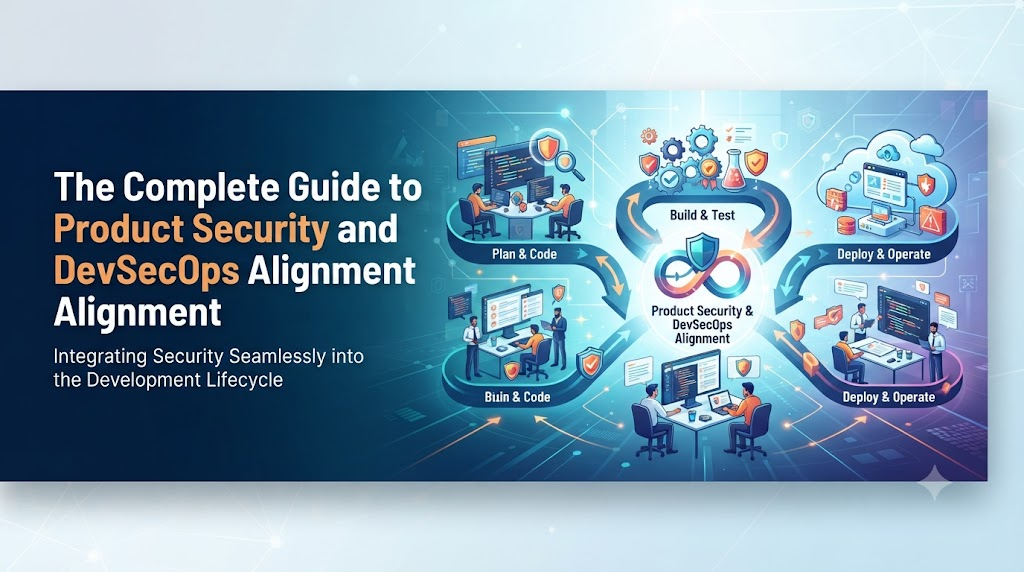
Treating security as a final-stage activity creates a toxic dynamic where development teams view security professionals as blockers, while security teams view developers as reckless. Aligning product security with DevSecOps practices bridges this gap. It integrates security into daily engineering workflows, transforming security from a compliance hurdle into a shared enabler of resilient software delivery.
What Is Product Security?
Product Security is a comprehensive discipline focused on ensuring that the software products an organization builds are resilient against attacks throughout their entire existence. It encompasses multiple domains:
- Application Security (AppSec): Protecting software code and logic from exploits.
- Infrastructure Security: Hardening the underlying environments where applications run.
- Data Protection: Safeguarding data at rest, in transit, and in use.
- Identity and Access Management (IAM): Ensuring proper authentication and authorization.
- Vulnerability Management: Identifying, prioritizing, and remediating security flaws.
- Supply-Chain Security: Securing third-party components, open-source libraries, and dependencies.
What Is DevSecOps?
DevSecOps extends traditional DevOps by injecting security practices into every phase of the software delivery lifecycle (SDLC)—from design and coding to testing, deployment, and operations. Instead of relying on a separate security team to review applications post-development, DevSecOps champions “security as code” and shared responsibility. Every engineer, developer, and operator takes ownership of security hygiene from day one.
Product Security vs DevSecOps: Understanding the Difference
While they are deeply interconnected, product security and DevSecOps serve distinct functions:
- Product Security defines what needs to be protected, establishing the security posture, risk tolerance, policies, and architectural standards for the product.
- DevSecOps defines how those standards are operationalized, automated, and enforced continuously within the software delivery pipeline.
Think of Product Security as the architectural blueprint and governance model, while DevSecOps is the automated machinery that builds safety into every gear and rotation.
Why Align Product Security With DevSecOps Goals?
Aligning product security with DevSecOps unlocks profound business and technical advantages:
- Faster Vulnerability Remediation: Catching bugs during coding or code review costs a fraction of fixing them in production.
- Reduced Security Risks: Automated scanning prevents critical flaws from ever reaching end-users.
- Improved Collaboration: Silos break down as development, security, and operations teams share unified dashboards and objectives.
- Secure Releases: Automation ensures that compliance and security checks run consistently on every commit.
- Better Compliance: Continuous auditing and policy validation make regulatory compliance an ongoing byproduct of development rather than a stressful, manual scramble.
Define Shared Security and Business Objectives
Misalignment usually happens when different teams chase conflicting key performance indicators (KPIs). Developers are measured on feature delivery speed, operations on uptime, and security teams on risk reduction.
Organizations must establish common goals that bridge these gaps. Measurable objectives should include:
- Reducing the count of critical and high-severity vulnerabilities.
- Improving mean time to remediate (MTTR) known security flaws.
- Increasing automated security test coverage across all active repositories.
Shift Security Left Without Ignoring Runtime Security
“Shift left” has become a mantra in modern engineering, emphasizing early security testing during design, coding, and code review. While finding bugs early is vital, security cannot stop once code is compiled.
A mature alignment balances early prevention with rigorous runtime security. Organizations must monitor production environments continuously for zero-day exploits, misconfigurations, and anomalous behavioral patterns.
Integrate Security Into the CI/CD Pipeline
To make security seamless, automated checks must be baked directly into the CI/CD workflow. Key practices include:
- Static Application Security Testing (SAST): Analyzing source code for vulnerabilities before compilation.
- Software Composition Analysis (SCA): Inspecting open-source dependencies and third-party libraries for known CVEs.
- Secret Detection: Scanning repositories to prevent accidental leaks of API keys, passwords, and tokens.
- Infrastructure-as-Code (IaC) Scanning: Checking Terraform, CloudFormation, or Kubernetes manifests for security misconfigurations.
- Container Image Scanning: Identifying vulnerabilities in base images and runtime layers.
- Dynamic Application Security Testing (DAST): Probing running applications for vulnerabilities.
- Policy Validation: Ensuring builds comply with internal security baselines prior to deployment.
Automation acts as an unbiased quality gate, ensuring unsecure code never slips into production.
Build Security Into the Software Development Lifecycle
Security must accompany every phase of the SDLC:
- Requirements: Define security use cases and threat models early.
- Architecture: Design secure patterns, data segregation, and least-privilege access.
- Development: Practice secure coding guidelines and peer reviews.
- Testing: Run automated SAST, DAST, and SCA scans.
- Deployment: Enforce secure release gates and automated provisioning.
- Maintenance: Continuously patch vulnerabilities and monitor telemetry.
Establish Security Ownership Across Teams
True DevSecOps relies on shared responsibility. Everyone plays a distinct role in product security:
- Developers: Write clean, secure code and fix identified flaws promptly.
- DevOps Engineers: Maintain secure CI/CD pipelines, clusters, and deployment automations.
- Security Professionals: Define policies, threat models, and provide security tooling guidance.
- QA Engineers: Incorporate security test cases into functional testing workflows.
- Product Managers: Prioritize security tech debt alongside feature development.
- Leadership: Foster a culture that values security as much as velocity.
Use Threat Modeling to Improve Product Security
Threat modeling allows engineering teams to wear an attacker’s hat before writing a single line of code. By breaking down architecture diagrams, teams can identify sensitive assets, map out potential attack surfaces, anticipate threat vectors, and implement robust mitigations early in the design phase.
Automate Security Testing and Vulnerability Management
Manual security reviews do not scale. Organizations must automate vulnerability triage and prioritization. By integrating scanning tools with issue-trackers and establishing risk-based security gates, teams can automatically route high-priority tickets to the right developers while failing builds that violate critical security thresholds.
Secure the Software Supply Chain
Modern software relies heavily on external code, open-source packages, container registries, and third-party build tools. Supply-chain attacks target these dependencies.
DevSecOps addresses this by verifying artifact integrity using cryptographic signing (e.g., Sigstore, Cosign), maintaining Software Bill of Materials (SBOMs), and locking down CI/CD runner permissions.
Integrate Security Into Infrastructure and Cloud Operations
Application security is only half the battle. Cloud infrastructure, Kubernetes clusters, IAM roles, and network configurations must also be hardened. Using Infrastructure as Code (IaC) security tools ensures that cloud environments are deployed securely and remain drift-free over time.
Use Security Metrics That Matter
To gauge the success of a DevSecOps strategy, track actionable metrics:
- Mean Time to Remediate (MTTR): How quickly vulnerabilities are patched after discovery.
- Critical Vulnerability Count: The total volume of active high-risk flaws.
- Security Test Coverage: The percentage of repositories actively scanned by SAST/SCA.
- Vulnerability Escape Rate: How many security issues slip past staging into production.
- Dependency Risk: The health and safety index of third-party packages.
- Secure Deployment Percentage: The ratio of deployments passing security gates cleanly.
Balance Security With Developer Productivity
If security controls slow developers down too much, they will find ways to bypass them. To maintain developer velocity:
- Provide developer-friendly security tools integrated directly into IDEs.
- Eliminate noisy, false-positive alerts.
- Use automated, risk-based security gates rather than cumbersome manual approvals.
Common Challenges in Aligning Product Security and DevSecOps
Organizations often face hurdles when merging these practices:
- Silos: Development and security operate in isolation.
- Alert Fatigue: Security tools flooding teams with unprioritized warnings.
- Skills Gaps: Engineers lacking formal security training.
- Resistance to Change: Developers viewing security as a bureaucratic nuisance.
- Legacy Systems: Older architectures that are difficult to scan or patch.
Addressing these challenges requires cultural empathy, gradual automation, executive backing, and continuous education.
Best Practices for Aligning Product Security With DevSecOps
- Shift security left into design and coding stages.
- Automate repetitive security checks within CI/CD pipelines.
- Enforce shared ownership across all engineering roles.
- Prioritize risks based on real-world business impact.
- Continuously monitor production environments.
- Train developers in secure coding practices.
- Standardize security policies across squads.
Real-World Example: Product Security and DevSecOps Working Together
Consider a fintech company releasing a new payment microservice.
- Design: The team runs a threat-modeling session, identifying potential data leakage paths.
- Coding: Developers write code in their IDE, where lightweight plugins flag insecure API calls immediately.
- CI/CD: Upon committing code to GitHub, automated SAST, SCA, and secret detection tools execute inside the pipeline.
- Deployment: Container images are scanned, signed, and deployed to a secure Kubernetes cluster using automated IaC scripts.
- Monitoring: Runtime telemetry continuously audits traffic anomalies, feeding insights back into the product security backlog.
How DevSecOps Training Can Improve Product Security Capabilities
Implementing tools alone is not enough; organizations need skilled people. Structured DevSecOps Training helps developers, engineers, and security professionals master security automation, secure CI/CD orchestration, cloud hardening, container security, and vulnerability management.
Programs from providers like DevOpsSchool equip engineering teams with practical, real-world knowledge and hands-on skills necessary to build resilient, secure software pipelines without compromising delivery speed.
Future of Product Security and DevSecOps
The landscape continues to evolve rapidly. Emerging trends shaping the future include AI-assisted vulnerability remediation, autonomous policy-as-code enforcement, advanced software supply-chain verification, and hyper-automated continuous compliance models.
Frequently Asked Questions
- What is product security? It is the practice of protecting software products against vulnerabilities throughout their entire lifecycle, spanning code, infrastructure, and supply chains.
- How is product security related to DevSecOps? Product security sets the standards and risk posture, while DevSecOps provides the automated mechanisms to embed those standards into software delivery workflows.
- Why should security be integrated into DevOps? Integrating security early eliminates bottlenecks, lowers remediation costs, and prevents critical vulnerabilities from reaching production.
- How can organizations align security and development teams? By establishing shared KPIs, adopting collaborative tooling, and embedding security ownership into daily engineering tasks.
- What security tools are commonly used in DevSecOps? Tools for SAST, DAST, SCA, container scanning, secret detection, and IaC compliance.
- How can CI/CD improve product security? By running automated security tests on every code commit, preventing unverified or vulnerable code from progressing.
- What are the biggest challenges in implementing DevSecOps? Cultural resistance, alert fatigue, skill gaps, and legacy application constraints.
- How can developers improve their security skills? Through continuous education, hands-on labs, and structured training programs focused on secure software development.
Conclusion
Product security should never operate as an isolated island disconnected from software delivery. By fostering collaboration, leveraging smart automation, embedding security continuously across the SDLC, and measuring meaningful outcomes, organizations can bridge the gap between speed and safety. Embracing this holistic approach empowers teams to deliver robust, reliable, and secure applications with confidence.
