Limited Time Offer!
For Less Than the Cost of a Starbucks Coffee, Access All DevOpsSchool Videos on YouTube Unlimitedly.
Master DevOps, SRE, DevSecOps Skills!
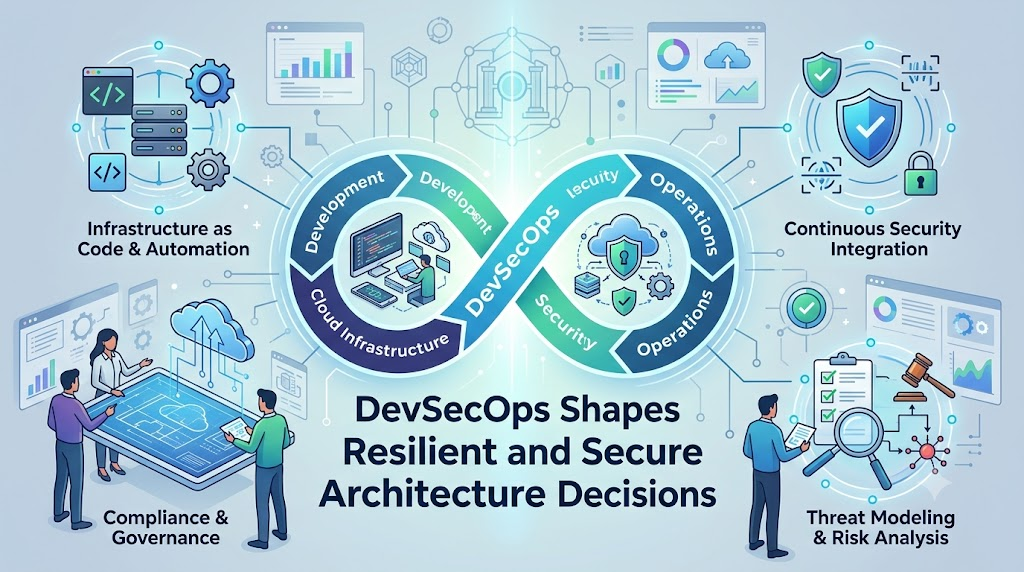
An engineering team sets out to build a modern, cloud-native transactional platform. The roadmap looks familiar: deploy containerized microservices behind an API gateway, provision managed cloud databases, establish automated CI/CD pipelines, and scale horizontally on demand. Early sprints move fast because the architecture prioritizes feature velocity and throughput.
Problems emerge as the system approaches production. A pre-launch security review discovers that backend services communicate over unauthenticated internal networks. Application secrets are embedded in configuration files. Cloud storage buckets lack explicit boundary policies, and microservices run with broad, administrative cloud IAM permissions. Fixing these issues at this stage requires refactoring database connections, rewriting API authentication contracts, and restructuring network topologies.
[ Traditional Approach: Late-Stage Security Checks ]
Design Phase ──> Build Phase ──> Deployment ──> [Security Review: Blockers Found] ──> Costly Redesign

[ DevSecOps Approach: Integrated Architecture Decisions ]
Design & Threat Model ──> Policy as Code ──> Automated Validation ──> Observable Deployments
       ▲                                                                      │
       └──────────────────────── Continuous Feedback ─────────────────────────┘
This scenario highlights why security cannot be treated as an operational afterthought. DevSecOps bridges the gap between fast delivery and resilient system design by bringing security into architectural decisions from day one.
Understanding DevSecOps in System Design
DevSecOps is the cultural, architectural, and technical practice of integrating security responsibilities across every phase of the engineering lifecycle:
$$\text{Plan} \longrightarrow \text{Design} \longrightarrow \text{Code} \longrightarrow \text{Build} \longrightarrow \text{Test} \longrightarrow \text{Release} \longrightarrow \text{Deploy} \longrightarrow \text{Operate} \longrightarrow \text{Monitor} \longrightarrow \text{Improve}$$
DevSecOps is far more than adding static vulnerability scanners to a CI/CD pipeline. It establishes a shared responsibility model where security, infrastructure, and development teams evaluate risks together. Instead of relying on manual security checkpoints right before release, DevSecOps introduces automated guardrails, continuous feedback, and secure-by-design thinking to ensure systems remain resilient throughout their operational life.
Defining Secure Architecture
Secure architecture is the practice of designing software, data flows, and infrastructure so that defensive controls, isolation boundaries, and risk mitigation strategies are embedded directly into system components.
+-----------------------------------------------------------------------+
|                         Secure Architecture                           |
+-----------------------------------+-----------------------------------+
| Structural Foundations            | Operational Capabilities          |
+-----------------------------------+-----------------------------------+
| * Identity & Least Privilege      | * Continuous Observability        |
| * Explicit Trust Boundaries       | * Immutable Audit Logging         |
| * Isolated Network Segmentation   | * Automated Drift Detection       |
| * End-to-End Data Encryption      | * Disaster Recovery & Resilience  |
+-----------------------------------+-----------------------------------+
A well-architected system assumes that individual components can and will fail or be compromised. Secure architecture minimizes the blast radius of those failures, protects sensitive data, and ensures fast recovery without requiring complex, retrofitted fixes later.
Why Early Architecture Decisions Dictate Long-Term Security
Decisions made during the initial design phase establish the boundaries within which an application operates for years. Consider the difference between architectural design choices:
- Identity Architecture: Relying on centralized OpenID Connect (OIDC) identity providers versus fragmented, service-specific authentication databases.
- Network Exposure: Placing microservices inside private subnets behind an authenticated gateway versus exposing endpoints directly to the public internet.
- Data Segregation: Storing mixed-tenant data in a single shared table without row-level security versus logically isolating data stores using dedicated encryption keys.
- Service Communication: Enforcing mutual TLS (mTLS) with cryptographically verifiable service identities versus transmitting cleartext traffic over an assumed “safe” internal network.
Refactoring these structural foundations after a system is running in production is costly, risky, and disruptive. DevSecOps ensures these trade-offs are evaluated before engineering teams write the first lines of code.
Integrating Security-by-Design Across the Lifecycle
“Shift left” is a common industry phrase, but shifting security left must not mean ignoring runtime operations. DevSecOps applies security-by-design principles across the entire system lifecycle:
- Requirements and Planning: Defining regulatory, compliance, and threat requirements alongside functional capabilities.
- System Design: Establishing trust boundaries, authentication models, and data protection strategies before selecting tools.
- Implementation and Build: Enforcing coding standards, secret scanning, and automated dependency checks within developer workflows.
- Deployment and Operations: Validating infrastructure configurations against security policies and monitoring runtime environments for abnormal behavior.
Security-by-design ensures that system protection evolves as new features and infrastructure components are introduced.
Threat Modeling as an Architectural Foundation
Threat modeling is a structured engineering practice used to identify potential security threats, attack vectors, and mitigations during the design phase.
+---------------------------------------------------------------------------------+
|                            Threat Modeling Workflow                             |
+---------------------+-----------------------------------------------------------+
| 1. Asset Mapping    | Identify critical data stores, credentials, and compute.   |
| 2. Flow Analysis    | Trace data as it moves across networks and components.    |
| 3. Boundary Mapping | Pinpoint where trust levels change between systems.       |
| 4. Abuse Cases      | Analyze how malicious actors could exploit functionality. |
| 5. Control Design   | Implement mitigations before writing application code.    |
+---------------------+-----------------------------------------------------------+
Threat Modeling Example: Public API to Backend Database
Consider a public-facing API that processes user profiles and reads from an internal database:
[ Untrusted Client ] ──( Public Internet )──> [ API Gateway ] ──( Private Network )──> [ User Microservice ] ──( Encrypted Query )──> [ Relational DB ]
                                                     │                                         │                                      │
                                              [ Rate Limiting & ]                      [ Token Validation & ]                   [ Dedicated Role & ]
                                              [ WAF Inspection  ]                      [ Input Sanitization ]                   [ Least Privilege  ]
Threat modeling systematically reveals design risks across this path:
- Threat: Credential Stuffing and Denial of Service. Mitigated by placing an API gateway with rate limiting and automated web application firewall rules in front of the API.
- Threat: Broken Object-Level Authorization (BOLA). Mitigated by designing context-aware authorization checks within the user microservice rather than relying solely on perimeter authentication.
- Threat: SQL Injection and Data Exfiltration. Mitigated by using parameterized database access frameworks, encrypting columns containing sensitive data, and restricting database user permissions to specific tables.
Identifying and Enforcing Trust Boundaries
A trust boundary is any point in an architecture where data or execution transitions between different levels of security, trust, or administrative control.
                           TRUST BOUNDARY 1                    TRUST BOUNDARY 2
                         (Internet / Perimeter)              (Compute / Data Layer)
                                   |                                   |
[ Public User / Client ] ──────────┼─────> [ Microservice Engine ] ────┼─────> [ Protected Database ]
                                   |                                   |
                             Enforce: API Auth,                 Enforce: IAM Roles,
                             TLS Termination,                   Data Encryption,
                             Schema Validation                  Private Subnets
DevSecOps requires teams to define boundaries across multiple layers:
- Perimeter Boundaries: Between the public internet and application ingress points.
- Service Boundaries: Between decoupled microservices communicating across internal networks.
- Workload Boundaries: Between compute workloads and underlying cloud infrastructure APIs.
- Environment Boundaries: Between development, staging, and production environments.
- Data Boundaries: Between active compute environments and cold storage or backups.
Identifying these boundaries helps architects determine exactly where to place strict input validation, mutual authentication, encryption, and audit logging.
Identity and Access Architecture
Identity serves as the primary security perimeter in cloud-native systems. DevSecOps principles guide identity architecture away from static credentials and toward automated, verifiable access controls.
- Workload Identity: Services should authenticate using short-lived tokens issued by an identity provider rather than static API keys stored in configuration files.
- Role-Based Access Control (RBAC): Permissions must follow the principle of least privilege, granting services and human users only the specific permissions needed to perform their tasks.
- Automated Credential Rotation: Ephemeral credentials and short session lifetimes minimize the operational window of an accidental credential leak.
- Separation of Concerns: Administrative functions, operational workflows, and end-user transactions must operate under separate identity planes with mandatory multi-factor authentication for human operators.
Network Security and Zero Trust Architecture
Modern cloud architecture operates under the assumption that internal networks cannot be implicitly trusted. DevSecOps applies Zero Trust principles directly to network designs.
+---------------------------------------------------------------------------------+
|                             Zero Trust Architecture                             |
+-----------------------+---------------------------------------------------------+
| Micro-Segmentation    | Isolate workloads using private subnets, security       |
|                       | groups, and network policies.                           |
+-----------------------+---------------------------------------------------------+
| Explicit Verification | Require mutual TLS (mTLS) and token authentication for  |
|                       | every service-to-service call.                          |
+-----------------------+---------------------------------------------------------+
| Managed Gateways      | Route ingress traffic through controlled API gateways   |
|                       | rather than exposing individual instances directly.     |
+-----------------------+---------------------------------------------------------+
| Perimeter Defense     | Enforce centralized ingress filtering and egress domain |
|                       | whitelisting to block outbound command-and-control calls.|
+-----------------------+---------------------------------------------------------+
API Security Architecture
APIs are the core communication pathways for modern applications, making them a frequent target for exploitation. Secure API design requires controls embedded into the application architecture:
[ Inbound Request ]
        │
        ▼
[ API Gateway Layer ] ──> Validates schema, checks rate limits, terminates TLS
        │
        ▼
[ Service Auth Layer ] ──> Verifies JWT signature, checks user identity and tenant scope
        │
        ▼
[ Application Logic ] ──> Enforces fine-grained object-level authorization (BOLA defense)
        │
        ▼
[ Data Access Layer ] ──> Executes parameterized query using least-privilege DB role
Key API architectural decisions include:
- Schema Validation: Reject malformed payloads at the gateway layer before they reach backend business logic.
- Contextual Authorization: Validate that the authenticated identity has explicit permission to access the specific record requested.
- Rate Limiting and Throttling: Prevent resource exhaustion by setting rate limits per client, API key, and IP address.
- API Versioning and Deprecation: Maintain clear lifecycle policies to deprecate and decommission older, unmonitored API versions that may harbor unpatched vulnerabilities.
Secure Data Architecture
Data architecture decisions determine how an organization protects its most valuable assets throughout their operational lifecycle.
+-------------------------------------------------------------------------------+
|                            Data Protection Domains                            |
+--------------------+----------------------------------------------------------+
| Data in Transit    | Enforce modern TLS protocols across all internal and     |
|                    | external network hops.                                   |
+--------------------+----------------------------------------------------------+
| Data at Rest       | Encrypt storage volumes, databases, and object stores    |
|                    | using customer-managed cryptographic keys.               |
+--------------------+----------------------------------------------------------+
| Key Management     | Centralize key lifecycle management with automated       |
|                    | rotation policies and access logging.                    |
+--------------------+----------------------------------------------------------+
| Retention Policies | Automatically purge or archive records based on defined  |
|                    | compliance and regulatory schedules.                     |
+--------------------+----------------------------------------------------------+
| Data Masking       | Redact sensitive fields before writing records to logs,  |
|                    | traces, or non-production environments.                  |
+--------------------+----------------------------------------------------------+
Secrets Management Architecture
Hard-coded credentials, static configuration tokens, and shared database passwords represent critical architectural risks. DevSecOps dictates a clear secrets management framework:
[ Application Workload ] ──( Requests Short-Lived Token )──> [ Centralized Secrets Manager ]
           │                                                               │
           │                                               [ Authenticates Instance via ]
           │                                               [ Cloud IAM / Workload ID    ]
           │                                                               │
           ▼                                                               ▼
[ In-Memory Secret Usage ] <────────( Injects Ephemeral DB Password )───────┘
- Centralized Storage: Secrets must reside in dedicated, access-controlled key-value vaults rather than source repositories, container images, or environment variables.
- Dynamic Generation: Where possible, architectures should generate short-lived database credentials on the fly, eliminating static credentials entirely.
- Automated Rotation: Secrets should rotate on a scheduled basis without requiring application restarts or manual operator intervention.
Cloud Infrastructure Security Architecture
Cloud architectures demand rigorous isolation, least privilege, and continuous compliance checks:
- Multi-Account Topology: Separate workloads across distinct cloud accounts to isolate production systems from development, testing, and security tooling.
- Immutable Infrastructure: Deploy servers and compute nodes as disposable instances that are never modified directly in production.
- Declarative Configuration: Define all infrastructure components using version-controlled code, allowing teams to audit changes before deployment.
Infrastructure as Code and Architecture Guardrails
Infrastructure as Code (IaC) transforms architectural design from static diagrams into testable, version-controlled software assets.
+-------------------------------------------------------------------------------+
|                           IaC Pipeline Validation                             |
+-------------------------------------------------------------------------------+
| 1. Code Commit: Engineer updates infrastructure template (e.g., Terraform).   |
| 2. Static Analysis: Linter checks syntax and formatting.                      |
| 3. Security Scanning: Tool checks for open security groups or missing TLS.   |
| 4. Policy as Code: Guardrails verify compliance against organizational rules. |
| 5. Plan & Review: Infrastructure changes are audited in a pull request.       |
| 6. Automated Deploy: Verified configuration is applied to the environment.    |
+-------------------------------------------------------------------------------+
Using IaC, security architects can define baseline templates that development teams use to provision compliant infrastructure automatically.
Container and Kubernetes Architecture Security
Deploying workloads on container orchestrators introduces unique operational requirements:
- Base Image Governance: Build containers using minimal, distroless base images that contain only the binaries and libraries required to run the workload.
- Non-Root Execution: Configure container runtimes to execute processes as unprivileged users with read-only root filesystems.
- Cluster Access Controls: Implement Kubernetes RBAC to restrict access to the cluster API, and isolate tenant workloads using dedicated namespaces.
- Runtime Policies: Apply admission controllers and container security profiles to block unverified container images and prevent privilege escalation at runtime.
Microservices Security Architecture
While microservices provide independent scaling and deployment flexibility, they also expand the system’s attack surface by replacing in-process function calls with network communications.
                                  MICROSERVICES TOPOLOGY

                                    [ Ingress Gateway ]
                                             │
                       ┌─────────────────────┴─────────────────────┐
                       ▼                                           ▼
             [ Order Microservice ] <──────( mTLS / Auth )──────> [ Payment Service ]
                       │                                                   │
             [ Workload IAM Token ]                              [ Workload IAM Token ]
                       │                                                   │
                       ▼                                                   ▼
             [ Order Database ]                                  [ Payment Gateway ]
Securing a microservices architecture requires:
- Explicit Identity for Every Service: Every service instance must carry a verifiable cryptographic identity.
- Decentralized Authorization: Use localized policy validation agents or service mesh sidecars to authorize requests at each microservice boundary.
- Distributed Tracing: Include correlation IDs across service calls to maintain full visibility of requests as they travel across distributed systems.
Monolith vs. Microservices: Security Architecture Comparison
Choosing between a monolithic and a microservices architecture involves distinct operational and security trade-offs.
| Security Consideration | Monolithic Architecture | Microservices Architecture |
| Attack Surface | Consolidated; fewer external entry points. | Broad; numerous network endpoints and APIs. |
| Identity Management | Centralized session management in memory. | Distributed; requires token validation across services. |
| Service Communication | In-memory function calls; low network risk. | Network-based; requires mTLS and explicit encryption. |
| Network Controls | Simple network perimeter defenses. | Complex; requires granular micro-segmentation. |
| Secrets Management | Concentrated in a single application runtime. | Distributed across multiple independent services. |
| Monitoring & Auditing | Centralized logging; straightforward traces. | Distributed; requires log aggregation and tracing IDs. |
| Blast Radius | High; a breach can compromise the entire app. | Low; containment policies can isolate breaches. |
| Deployment Complexity | Low pipeline complexity; large release size. | High pipeline complexity; continuous, decoupled releases. |
Neither pattern is inherently more secure. A monolith simplifies network controls but carries a larger blast radius. Microservices limit blast radius through isolation but introduce distributed networking and authentication complexity.
CI/CD Pipeline Architecture and Security
The delivery pipeline is a mission-critical system component. If compromised, an attacker can inject malicious code directly into production environments.
[ Developer Commit ]
        │
        ▼
[ Pipeline Ingestion ] ──> Secret Detection (pre-commit / build hooks)
        │
        ▼
[ Build Stage ]        ──> SAST, Dependency Scanning, SBOM Generation
        │
        ▼
[ Container Build ]    ──> Container Vulnerability Scans, Artifact Signing
        │
        ▼
[ Infrastructure Plan] ──> Static IaC Scanning & Policy as Code Validation
        │
        ▼
[ Deployment Stage ]   ──> Attestation Verification & Immutable Release
A secure CI/CD architecture requires:
- Automated Pipeline Scans: Integrate static application security testing (SAST), software composition analysis (SCA), and container scanning into automated build steps.
- Cryptographic Attestation: Sign artifacts, container images, and deployment manifests at build time, verifying their signatures before allowing execution.
- Pipeline Isolation: Run build jobs in ephemeral, isolated worker instances with restricted access to production deployment credentials.
Enforcing Architectural Standards with Policy as Code
Policy as Code allows security teams to write programmatic guardrails that evaluate infrastructure definitions, container configurations, and runtime states against compliance rules.
Instead of writing security guidelines in static policy documents, teams express rules as executable code:
- Ensure that all object storage buckets block public read access.
- Reject container configurations that request root privileges.
- Block the provisioning of virtual machines that lack encryption-at-rest tags.
- Require that all internet-facing load balancers use modern TLS configurations.
These rules run automatically within CI/CD pipelines and cloud environments, preventing non-compliant architecture patterns from being deployed.
Security Guardrails vs. Operational Gates
Traditional security governance often relied on strict manual approval gates. These gates frequently created friction, leading development teams to bypass security processes to meet delivery deadlines.
[ Traditional Security Gate: Disruptive & Manual ]
Developer ──> Code Complete ──> [ Manual Security Sign-Off ] ──> Bottleneck ──> Delayed Deploy

[ Modern Security Guardrail: Automated & Continuous ]
Developer ──> [ Pre-Approved Templates & Policy as Code ] ──> Automated Validation ──> Safe Deploy
DevSecOps replaces manual gates with automated architectural guardrails:
- Pre-Approved Infrastructure Modules: Provide development teams with secure, pre-configured building blocks for databases, queues, and compute clusters.
- Self-Service Verification: Allow developers to scan their infrastructure and code locally, receiving immediate feedback on misconfigurations.
- Fail-Safe Defaults: Configure system platforms to default to the most secure setting (e.g., default-deny network rules, automated encryption).
Observability and Security Telemetry
Secure architecture requires deep visibility into system state and behavior. Observability enables engineering teams to detect, investigate, and mitigate security incidents in real time.
+-------------------------------------------------------------------------------+
|                        Core Observability Data Streams                        |
+-------------------+-----------------------------------------------------------+
| Structured Logs   | Centralized, tamper-resistant records of authentication   |
|                   | events, administrative actions, and authorization checks. |
+-------------------+-----------------------------------------------------------+
| System Metrics    | Real-time measurements of traffic spikes, error rates,    |
|                   | and resource consumption anomalies.                       |
+-------------------+-----------------------------------------------------------+
| Distributed Traces| End-to-end request paths that expose unexpected lateral   |
|                   | service hops or unauthorized database queries.            |
+-------------------+-----------------------------------------------------------+
| Audit Trails      | Immutable records tracking infrastructure changes, cloud  |
|                   | API calls, and pipeline executions.                       |
+-------------------+-----------------------------------------------------------+
Designing for Resilience and Failure Containment
Security and system availability are deeply connected. A secure system must withstand component failures, network outages, and deliberate resource exhaustion attacks without catastrophic downtime.
- Graceful Degradation: Design services to fallback to read-only modes or return cached responses when downstream dependencies experience disruption.
- Circuit Breakers and Rate Limiters: Protect core application services from cascading failures during traffic surges or denial-of-service attempts.
- Isolated Blast Radii: Partition data stores and compute environments so that an outage or security compromise in one service does not take down the entire platform.
- Automated Disaster Recovery: Maintain tested, automated failover workflows and immutable, isolated backups to recover quickly from data loss or ransomware events.
Secure Architecture Decision-Making Framework
When evaluating an architectural change or designing a new service, engineering teams can use this ten-question framework to balance security with functional requirements:
                          1. What are we protecting?
                                     │
                          2. Who requires access?
                                     │
                          3. What could go wrong?
                                     │
                          4. Where are the trust boundaries?
                                     │
                          5. What is the attack surface?
                                     │
                          6. What controls mitigate this?
                                     │
                          7. How will we detect anomalies?
                                     │
                          8. How do we respond to failure?
                                     │
                          9. What is the operational cost?
                                     │
                         10. How will this design evolve?
- What are we protecting? Identify the sensitivity of the data and compute assets involved.
- Who requires access? Define the exact human, system, and service identities that need access.
- What could go wrong? Brainstorm potential failure modes, abuse scenarios, and vulnerabilities.
- Where are the trust boundaries? Map where data crosses networks, environments, or domains.
- What is the attack surface? Determine which endpoints, ports, or interfaces are exposed.
- What controls mitigate this? Select the simplest effective technical controls (encryption, auth, filtering).
- How will we detect anomalies? Identify the logs, metrics, and alerts needed to spot issues.
- How do we respond to failure? Plan fallback mechanisms, containment steps, and recovery procedures.
- What is the operational cost? Evaluate latency, infrastructure expense, and developer cognitive load.
- How will this design evolve? Ensure the design can adapt as traffic scales and requirements shift.
Balancing Security, Performance, Cost, and Developer Experience
Architecture is the practice of navigating trade-offs. Implementing maximum security controls across every layer can degrade system performance, increase cloud costs, and slow down development.
+---------------------------------------------------------------------------------+
|                       Architectural Trade-Off Analysis                          |
+--------------------+------------------------------------------------------------+
| Security vs.       | Deep payload inspection adds latency; place inspection at |
| Performance        | the network edge and use streamlined checks internally.   |
+--------------------+------------------------------------------------------------+
| Security vs.       | Running multi-region active-active clusters increases cloud|
| Cost               | bills; match redundancy to the actual business risk.       |
+--------------------+------------------------------------------------------------+
| Security vs.       | Burdensome security steps encourage unsafe workarounds;    |
| Developer Velocity | provide clean CLI tools and automated local validations.   |
+--------------------+------------------------------------------------------------+
| Security vs.       | Complex nested security layers can obscure root causes;    |
| Maintainability    | favor simple, well-documented, standardized controls.      |
+--------------------+------------------------------------------------------------+
Architectural decisions must be risk-appropriate. Teams should assess real-world threats and business impact rather than attempting to apply maximum controls universally.
The Security Architecture Review Workflow
A mature DevSecOps workflow incorporates structured architecture reviews throughout the development lifecycle:
[ 1. Requirements & Asset Definition ]
                 │
                 ▼
[ 2. Data Flow & Boundary Mapping ]
                 │
                 ▼
[ 3. Collaborative Threat Modeling ]
                 │
                 ▼
[ 4. Control Selection & Architecture Decision Records (ADRs) ]
                 │
                 ▼
[ 5. Infrastructure as Code & Pipeline Implementation ]
                 │
                 ▼
[ 6. Automated Testing & Observability Validation ]
                 │
                 ▼
[ 7. Runtime Monitoring & Iterative Review ]
- Requirements & Asset Definition: Clarify functional goals, regulatory requirements, and data classification.
- Data Flow & Boundary Mapping: Diagram how information moves between users, microservices, and databases.
- Collaborative Threat Modeling: Bring developers, architects, and security specialists together to evaluate abuse cases.
- Control Selection & ADR Documentation: Choose mitigations and formally document the context, rationale, and trade-offs.
- IaC & Pipeline Implementation: Translate architecture designs into declarative code with automated security policies.
- Automated Testing & Validation: Verify controls in CI/CD environments through automated scanning and test suites.
- Runtime Monitoring & Iterative Review: Track real-world metrics, analyze system performance, and refine architecture over time.
Documenting Security Rationale with Architecture Decision Records
An Architecture Decision Record (ADR) is a concise document that captures an architectural decision, its context, and its consequences. Including security rationale in ADRs ensures that future engineering teams understand why specific controls were put in place.
+-------------------------------------------------------------------------------+
|                       Architecture Decision Record Structure                  |
+-------------------+-----------------------------------------------------------+
| Title             | ADR-042: Workload Identity Federation for Microservices   |
+-------------------+-----------------------------------------------------------+
| Status            | Accepted                                                  |
+-------------------+-----------------------------------------------------------+
| Context           | Microservices require database access across accounts.    |
|                   | Static credentials present high exfiltration risks.       |
+-------------------+-----------------------------------------------------------+
| Decision          | Implement OIDC-based Workload Identity Federation to issue|
|                   | short-lived, ephemeral database credentials dynamically.  |
+-------------------+-----------------------------------------------------------+
| Security Impact   | Eliminates hard-coded secrets from repositories and vaults|
|                   | reduces credential exposure window to 15 minutes.         |
+-------------------+-----------------------------------------------------------+
| Trade-Offs        | Introduces identity provider dependency; requires local   |
|                   | mocking tools for offline development workflows.          |
+-------------------+-----------------------------------------------------------+
| Consequences      | All new services must inherit the standardized identity   |
|                   | module from our centralized infrastructure repository.    |
+-------------------+-----------------------------------------------------------+
Common Secure Architecture Mistakes and Mitigations
Even experienced engineering teams can encounter architectural pitfalls. Recognizing these anti-patterns early saves significant rework:
- Post-Implementation Security Reviews: Security is evaluated only right before production launch.
- Correction: Integrate threat modeling and automated Policy as Code into early design sprints.
- Excessive Administrative Privileges: Cloud resources and application workloads run with broad wildcard permissions.
- Correction: Implement fine-grained IAM policies and require scoped workload identities.
- Implicit Network Trust: Systems assume that all traffic inside a private virtual cloud network is safe.
- Correction: Enforce mTLS, service authentication tokens, and granular security group rules.
- Unstructured Secrets Management: API keys, database credentials, and certificates are committed to repositories or passed via unencrypted configs.
- Correction: Adopt centralized secret vaults that dynamically issue short-lived credentials.
- Unprotected Internal APIs: Internal microservices lack authentication under the assumption that the ingress gateway is sufficient.
- Correction: Require token validation and object-level authorization checks at every service boundary.
- Neglected Observability and Audit Trails: Systems log debug text to local disks without structured formats or centralized analysis.
- Correction: Implement structured, immutable, and centralized logging with correlated trace identifiers.
Collaborative DevSecOps Roles in Secure Architecture
Building secure architectures requires continuous collaboration across multiple disciplines. DevSecOps does not replace experienced security architects; it provides a shared operational framework where different engineering disciplines contribute their expertise.
+---------------------------------------------------------------------------------+
|                        Cross-Functional Security Matrix                         |
+----------------------+----------------------------------------------------------+
| Software Developers  | Write clean application code, perform input validation,  |
|                      | implement fine-grained authorization, and address tests. |
+----------------------+----------------------------------------------------------+
| Platform & DevOps    | Build secure deployment pipelines, maintain base images, |
| Engineers            | automate infrastructure provisioning, and apply policies.|
+----------------------+----------------------------------------------------------+
| Security Architects  | Guide threat modeling, evaluate system-wide risks,       |
|                      | define security standards, and lead architecture reviews.|
+----------------------+----------------------------------------------------------+
| SRE Teams            | Monitor system reliability, maintain observability,      |
|                      | optimize failover mechanisms, and lead incident response.|
+----------------------+----------------------------------------------------------+
| Engineering Leaders  | Balance delivery timelines with risk management, allocate|
|                      | resources, and foster a blameless security culture.      |
+----------------------+----------------------------------------------------------+
Practical Example: Designing a Secure Cloud Platform
To see these principles in practice, consider the design of a modern cloud-native transactional application consisting of a web frontend, an API service, background workers, a relational database, and an object store.
                               SECURE CLOUD ARCHITECTURE

     [ Public Client ]
             │
             ▼
  [ Cloud CDN / WAF Edge ] ──( HTTPS / TLS 1.3 Termination )
             │
             ▼
    [ Ingress API Gateway ] ──( Private Subnet Routing )
             │
     ┌───────┴───────────────────────────────┐
     ▼                                       ▼
[ Auth & User Service ]             [ Transaction Worker Service ]
     │                                       │
     ├─( Workload Identity Auth )            ├─( Workload Identity Auth )
     ▼                                       ▼
[ Encrypted SQL DB ]                [ Private Object Storage ]
( KMS Customer Key )                ( Strict Bucket Policy / No Public Access )
Applying DevSecOps principles shapes each architectural tier:
- Edge and Ingress: A cloud web application firewall inspects incoming web traffic, enforces rate limits, and terminates TLS using modern cipher suites before routing valid requests to internal subnets.
- Service Communication: The API gateway forwards requests to containerized backend microservices running in private subnets. Every service validates signed identity tokens on arrival.
- Database Access: Backend services authenticate to the managed database using short-lived credentials requested dynamically via workload identity federation.
- Storage Protection: The object storage bucket enforces a bucket policy that blocks all public access and requires all writes to be encrypted using a dedicated key management service key.
- Delivery & Governance: All infrastructure is provisioned through version-controlled Terraform modules, validated against Policy as Code rules in the CI/CD pipeline before deployment.
Strengthening Architecture Through Continuous Feedback Loops
DevSecOps creates continuous feedback loops that inform future architecture iterations:
[ Automated Pipeline Scans ] ──┐
[ Runtime Telemetry & Logs ] ──┼──> [ Architecture Review Board ] ──> [ Updated ADRs & Templates ]
[ Post-Incident Reviews    ] ──┘
- Vulnerability Trends: Repeated vulnerability patterns discovered during dependency scans indicate where shared libraries or base templates need architectural updates.
- Operational Telemetry: Monitoring real-world traffic flows helps architects identify unnecessary service dependencies and prune excessive IAM permissions.
- Incident Retrospectives: Post-incident investigations highlight systemic architecture gaps, allowing teams to refine trust boundaries and improve disaster recovery runbooks.
Implementing Secure Architecture Step by Step
Adopting a secure architecture practice is an iterative process. Organizations can follow this twelve-step roadmap to build mature DevSecOps capabilities:
+---------------------------------------------------------------------------------+
|                       Implementation Roadmap: Steps 1 to 12                     |
+---------------------------------------------------------------------------------+
| Step 1: Identify and catalog critical business assets and data classifications.  |
| Step 2: Define baseline security, compliance, and availability requirements.    |
| Step 3: Map end-to-end data flows and interaction pathways.                     |
| Step 4: Conduct collaborative threat modeling sessions on new services.         |
| Step 5: Establish explicit trust boundaries across networks and workloads.      |
| Step 6: Design an identity-centric access architecture using least privilege.   |
| Step 7: Codify infrastructure security baselines using version-controlled IaC.  |
| Step 8: Integrate automated security checks and signing into CI/CD pipelines.   |
| Step 9: Implement structured observability, distributed tracing, and audit logs. |
| Step 10: Perform regular security testing and disaster recovery exercises.      |
| Step 11: Document all design choices and security trade-offs in ADRs.           |
| Step 12: Refine architecture standards using operational feedback.              |
+---------------------------------------------------------------------------------+
Building Technical Capabilities with Structured Education
Establishing mature DevSecOps and secure architecture practices requires skilled engineering teams that understand how modern software delivery, cloud infrastructure, and security controls interact. Organizations succeed when their developers, architects, and operations engineers share a common foundation in continuous delivery, container orchestration, automated policy enforcement, and infrastructure automation.
Continuous technical development helps engineering organizations bridge knowledge gaps across cloud security, Site Reliability Engineering, microservices design, and automated pipeline security. Engaging with structured, professional training programs—such as the specialized curriculums offered by DevOpsSchool—provides practitioners with hands-on experience in implementing real-world automation, container security, cloud governance, and modern architectural principles.
Future Trends in DevSecOps and Secure Architecture
As system architectures grow more distributed, secure design practices continue to evolve:
- Automated Remediation and Self-Healing: Systems will increasingly detect and automatically correct runtime configuration drift against declared Policy as Code standards.
- Software Supply Chain Security: Cryptographic software bills of materials (SBOMs) and artifact provenance tracking are becoming standard architectural requirements across build and deployment pipelines.
- AI-Assisted Architecture and Analysis: Machine learning models will assist engineers by analyzing architecture diagrams, identifying threat vectors, and suggesting least-privilege policies during early design phases.
- Identity-First Edge Architectures: As edge computing expands, identity-centric verification will completely replace traditional perimeter-based security models.
Frequently Asked Questions
How does DevSecOps directly improve secure architecture decisions?
DevSecOps introduces security evaluations into early planning, threat modeling, and design phases. This ensures that trust boundaries, identity models, data encryption, and network controls are built directly into system structures rather than retrofitted onto running applications.
What is the role of threat modeling in DevSecOps architecture?
Threat modeling helps engineering teams identify potential threat actors, attack surfaces, and abuse cases before writing code. This allows architects to select appropriate defensive controls, define strict trust boundaries, and minimize systemic risk early in the development lifecycle.
Why should security be considered during architecture planning rather than testing?
Remediating architectural vulnerabilities—such as weak identity federation, improper data partitioning, or unauthenticated internal APIs—often requires major structural redesigns. Addressing these considerations during planning reduces engineering rework, prevents project delays, and lowers operational risk.
How does Infrastructure as Code support secure architecture?
Infrastructure as Code (IaC) turns architectural designs into version-controlled, auditable, and repeatable software assets. Teams can run automated security linters and Policy as Code evaluations against IaC templates to ensure that deployed environments adhere to defined security baselines.
Can DevSecOps replace formal security architecture reviews?
No. DevSecOps automates standard checks, provides guardrails, and fosters shared security responsibility, but it does not eliminate the need for experienced security architects. Human expertise remains essential for evaluating complex risk models, reviewing novel architecture designs, and guiding strategic security decisions.
How do microservices change the security architecture landscape?
Microservices increase architectural complexity by replacing in-process function calls with distributed network communications. This requires explicit workload identities, mutual TLS (mTLS), decentralized authorization policies, and distributed observability to maintain system security.
What are security guardrails, and how do they differ from security gates?
Security gates are manual review checkpoints that often slow down delivery and create engineering bottlenecks. Security guardrails are automated, pre-approved templates and Policy as Code rules that allow developers to build and deploy systems independently while remaining within safe organizational boundaries.
What is the first step an organization should take to implement secure architecture practices?
The first step is identifying and classifying critical data and compute assets. Understanding what needs protection and mapping how data flows across current systems provides the foundation needed for effective threat modeling, boundary definition, and control selection.
Final Thoughts
Secure architecture is not a final checklist or a single pre-launch sign-off; it is an ongoing engineering discipline that spans the entire software development lifecycle. By integrating security into requirements gathering, threat modeling, infrastructure design, and continuous monitoring, DevSecOps enables engineering teams to build platforms that are resilient, scalable, and secure by design.
Making deliberate architecture decisions—grounded in least privilege, explicit trust boundaries, automated guardrails, and deep observability—allows organizations to innovate rapidly without compromising system integrity. DevSecOps shifts security from a reactive bottleneck to an essential foundation of modern software engineering.
