Limited Time Offer!
For Less Than the Cost of a Starbucks Coffee, Access All DevOpsSchool Videos on YouTube Unlimitedly.
Master DevOps, SRE, DevSecOps Skills!
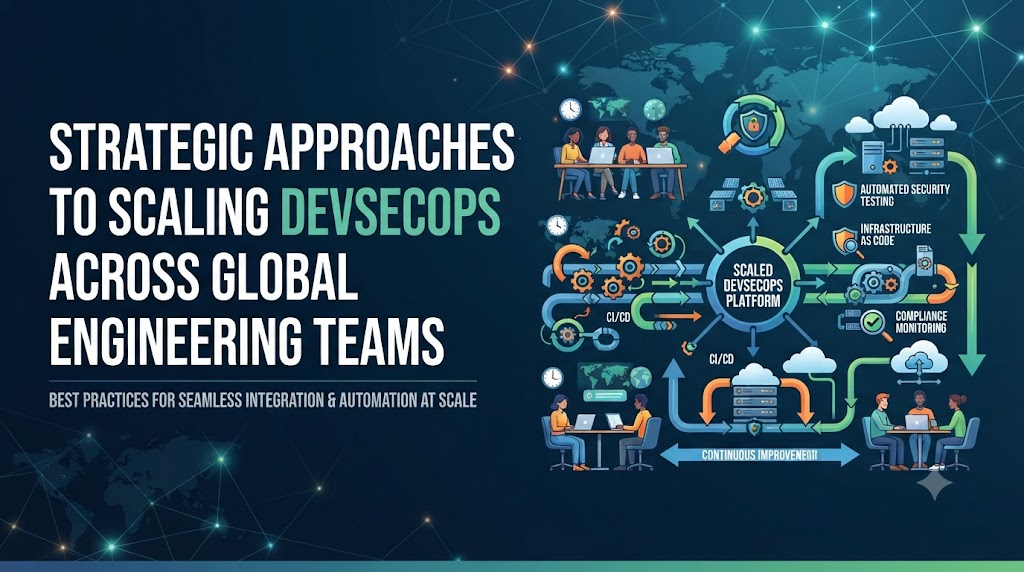
Engineering organizations operating across multiple continents, time zones, and cloud providers face a complex balancing act. When development teams expand globally, maintaining consistent security baselines while preserving the speed and autonomy needed to ship software becomes a major challenge.
Scaling DevSecOps requires more than deploying security tooling across pipelines. It demands a coordinated effort involving development, security, operations, platform engineering, quality assurance, compliance, and engineering leadership.
What Does Scaling DevSecOps Mean?
Implementing DevSecOps within a single team focuses on embedding security checks into local workflows. Scaling DevSecOps across an entire enterprise involves transforming security from an isolated function into an organizational capability.
Successful scaling relies on several core pillars:
- Common Standards: Establishing shared definitions for secure code, dependencies, and infrastructure.
- Reusable Practices: Delivering standardized pipelines, modules, and policies that teams can adopt without friction.
- Governance Through Automation: Replacing manual reviews with automated policy enforcement and guardrails.
- Continuous Measurement: Tracking operational, delivery, and security metrics to drive ongoing improvements.
Why Scaling DevSecOps Is Difficult
Global engineering organizations encounter unique barriers that complicate security transformations:
- Cultural Fragmentation: Different regional offices often maintain distinct engineering cultures and risk tolerances.
- Technology Diversity: Teams frequently use disparate technology stacks, legacy systems, and multi-cloud architectures.
- Tool Sprawl: Disconnected teams often adopt overlapping security tools, leading to fragmented visibility and conflicting vulnerability data.
- Communication Barriers: Operating across multiple time zones can stall security reviews and incident response coordination if workflows are not asynchronous.
Relying solely on a centralized security team to review every artifact or configuration quickly creates a bottleneck that stalls software delivery.
Establish a DevSecOps Operating Model
Organizations must define clear responsibilities across development, security, operations, platform teams, QA, and compliance. Centralized models often create bottlenecks, while completely decentralized models lead to inconsistent security baselines.
Many global organizations adopt a hybrid or federated operating model:
- Central Security Enablement: Defines global baselines, maintains core security tooling, and provides architectural guidance.
- Platform Engineering: Translates security standards into self-service infrastructure templates and CI/CD building blocks.
- Distributed Development Teams: Own feature delivery while adhering to embedded security guardrails.
Create Common Security Standards
Global engineering teams need a shared security baseline to prevent vulnerabilities from reaching production. Standards should provide consistency across critical operational domains:
- Code and Dependencies: Enforcing secure coding guidelines and automated dependency scanning.
- Secrets and Identity: Standardizing authentication, service identities, and credential management.
- Infrastructure and Containers: Defining hardening benchmarks for cloud resources and container images.
- Logging and Vulnerability Management: Ensuring uniform log aggregation and risk prioritization.
Standards should be pragmatic, focusing on risk reduction without unnecessarily blocking deployment velocity.
Balance Global Standards with Local Requirements
Global organizations must navigate complex regional regulations, data residency laws, and industry-specific compliance requirements. Enforcing a rigid, one-size-fits-all security model rarely succeeds.
The ideal approach follows a simple principle:
$$\text{Global Security Baseline} + \text{Local Implementation Flexibility}$$
This allows regional teams to meet strict local data protection and regulatory requirements while remaining aligned with overall corporate security objectives.
Build Security into CI/CD
Integrating security checks directly into the software delivery lifecycle ensures vulnerabilities are caught early. A typical secure pipeline follows this flow:
$$\text{Code} \rightarrow \text{Build} \rightarrow \text{Test} \rightarrow \text{Security Checks} \rightarrow \text{Package} \rightarrow \text{Deploy} \rightarrow \text{Monitor}$$
Security checks should include static application security testing (SAST), software composition analysis (SCA), secrets detection, and container vulnerability scanning. Not every security check needs to block the pipeline; non-critical warnings can be logged for asynchronous remediation, while high-risk vulnerabilities fail the build.
Automate Security Wherever Practical
At global scale, manual security reviews cannot keep pace with rapid deployment cycles. Automation is essential for:
- Running automated vulnerability scans on every code commit.
- Enforcing infrastructure configuration checks before deployment.
- Generating continuous compliance audit trails and security reports.
Automation should minimize repetitive manual work while preserving human review for complex architectural decisions and high-risk security exceptions.
Create Reusable DevSecOps Templates
Centralized security and platform teams can accelerate adoption by providing pre-packaged, secure-by-default assets:
- CI/CD Pipeline Templates: Reusable workflow definitions with built-in security scans.
- Infrastructure Modules: Terraform or OpenTofu modules pre-configured with security hardening baselines.
- Policy and Logging Standards: Pre-tested configurations that ensure uniform observability and compliance monitoring.
Platform Engineering for DevSecOps at Scale
Internal developer platforms act as a bridge between security requirements and developer productivity. By offering secure-by-default self-service environments, platform teams abstract away the complexity of cloud security configurations.
Platform engineering provides pre-approved infrastructure templates, automated compliance guardrails, and standardized identity integration without stripping teams of technical flexibility.
Security Champions Program
A Security Champions program bridges the gap between central security teams and distributed development squads. Security champions are developers or operations engineers who advocate for secure practices within their local teams.
Steps to Build a Security Champions Program:
- Identify Interested Engineers: Look for developers with a strong interest in security and quality.
- Provide Focused Training: Equip champions with practical threat modeling and secure coding knowledge.
- Define Clear Responsibilities: Outline their role in mentoring peers and reviewing local designs.
- Build a Security Community: Establish internal forums for sharing knowledge and discussing challenges.
- Provide Ongoing Guidance: Keep champions updated on emerging threats and organizational standards.
- Measure Program Effectiveness: Track participation, threat modeling adoption, and local remediation rates.
DevSecOps Education and Training
Global adoption relies on continuous skill development. Training programs should cover secure coding, cloud security architecture, container hardening, Infrastructure as Code security, and threat modeling.
Combining formal learning paths, hands-on labs, workshops, and internal knowledge sharing ensures engineering teams build practical security competencies.
Identity, Access Management, and Secrets
Consistent identity and access management (IAM) is critical for securing distributed systems. Organizations must enforce the principle of least privilege, role-based access control, strong multi-factor authentication, and short-lived credentials.
Similarly, secrets management requires centralized vaults, automated credential rotation, and continuous secret scanning. Secrets must never be stored directly in source code or public repositories.
Vulnerability Management and Policy as Code
Effective vulnerability management looks beyond raw finding counts to evaluate exploitability, business impact, and actual risk context.
Organizations can scale governance using Policy as Code, applying automated compliance and security rules directly to infrastructure configurations, Kubernetes clusters, and CI/CD pipelines before deployment.
Multi-Cloud, Legacy Applications, and Supply Chain
- Multi-Cloud Environments: Teams must abstract security baselines to maintain consistent policies across different cloud providers and hybrid data centers.
- Legacy Systems: Older applications with limited automation require risk-based assessments, gradual dependency upgrades, and enhanced monitoring rather than immediate rewrites.
- Software Supply Chain: Organizations need end-to-end visibility into software components, dependency provenance, and artifact integrity to prevent supply-chain compromises.
Incident Response, Observability, and Metrics
Global incident response requires clear on-call rotations, documented escalation paths, and asynchronous communication runbooks to bridge time-zone gaps.
Security observability should integrate logs, metrics, and traces to minimize alert fatigue and surface actionable security signals.
Measuring DevSecOps Adoption
- Security Metrics: Vulnerability remediation time, security test coverage, and dependency risk exposure.
- Delivery Metrics: Deployment frequency, lead time for changes, and change failure rate.
- Adoption Metrics: Pipeline security integration, security champion engagement, and training completion rates.
DevSecOps Maturity Model
| Maturity Level | Characteristics |
| Level 1 — Ad Hoc | Security is reactive and performed primarily before major releases. |
| Level 2 — Awareness | Teams begin adopting basic scanning tools and security training. |
| Level 3 — Integrated | Security checks are embedded directly into CI/CD pipelines. |
| Level 4 — Automated | Policies, compliance checks, and infrastructure validation are fully automated. |
| Level 5 — Optimized | Security, development, and leadership continuously refine practices using feedback loops. |
Governance Without Bottlenecks
Security governance often fails when it relies on manual approvals and bureaucratic checkpoints. Sustainable governance replaces gatekeeping with automated guardrails, risk-based approvals, and self-service compliance checks.
Communication Across Global Teams
Asynchronous communication is vital for distributed engineering teams. Comprehensive internal documentation, centralized knowledge bases, regular cross-region security syncs, and clear incident handoff procedures ensure that security practices remain transparent across all time zones.
Common Scaling Mistakes and Practical Solutions
- Mistake: Centralizing every security decision.
- Solution: Empower local teams and security champions with pre-approved guardrails.
- Mistake: Buying excessive security tools without developer context.
- Solution: Focus on integrating existing tools directly into developer workflows.
- Mistake: Treating compliance as the sole security objective.
- Solution: Prioritize actual risk reduction and architectural resilience alongside compliance.
Practical Global DevSecOps Scaling Roadmap
- Assess Current Maturity: Evaluate existing security tooling and practices across all regional teams.
- Define Shared Baselines: Establish core security standards for code, cloud, and pipelines.
- Establish Operating Models: Clarify responsibilities between central security, platform teams, and developers.
- Develop Reusable Patterns: Build standardized CI/CD templates and infrastructure modules.
- Automate Security Checks: Embed scanning and Policy as Code into delivery pipelines.
- Launch Champions Program: Train local security advocates across engineering squads.
- Measure and Improve: Track meaningful delivery and security metrics continuously.
Practical Example: Scaling DevSecOps Globally
Consider a global enterprise with engineering hubs spread across North America, Europe, and Asia, utilizing multiple cloud providers and legacy data centers.
By establishing a central platform engineering group, the company creates reusable CI/CD pipeline templates and hardened infrastructure modules. Regional teams adopt these templates, embedding automated SAST and container scanning into their local workflows without altering their unique product release schedules.
Local security champions mentor developers on secure coding practices, while automated Policy as Code ensures regional data residency and compliance requirements are met effortlessly.
Role of Leadership in Global DevSecOps
CTOs, CISOs, and engineering managers must champion cultural alignment, provide adequate platform investments, and reward cross-team collaboration. Executive support ensures that security is treated as an enabler of business velocity rather than an obstacle.
Role of DevOpsSchool
Building a sustainable DevSecOps culture requires continuous professional development and deep technical competence. Structured training programs help engineering professionals master essential skills across cloud security, CI/CD automation, container hardening, Infrastructure as Code, and site reliability engineering.
Organizations looking to upskill their engineering teams often turn to specialized providers like DevOpsSchool for comprehensive education and practical skill development in modern DevOps and DevSecOps practices.
Future of Global DevSecOps
The landscape of DevSecOps continues to evolve with advancements in AI-assisted security analysis, automated policy generation, continuous compliance monitoring, and developer-first security platforms. These technologies aim to reduce cognitive load for developers while strengthening overall software supply chain integrity.
Frequently Asked Questions
What does scaling DevSecOps mean?
Scaling DevSecOps means moving from isolated security practices in single teams to an integrated, organization-wide capability supported by shared standards, automation, and platform engineering.
Why is DevSecOps difficult to scale globally?
Geographical dispersion, cultural differences, diverse technology stacks, tool sprawl, and varying regional compliance requirements create significant friction during scaling initiatives.
How can global teams maintain consistent security standards?
Organizations can maintain consistency by defining a core security baseline and delivering it through reusable CI/CD templates and automated platform guardrails.
What is the role of security champions?
Security champions act as local advocates within development teams, helping mentor peers, reviewing designs, and bridging communication between developers and security specialists.
How can organizations automate DevSecOps?
Automation can be applied to vulnerability scanning, infrastructure validation, secret detection, compliance checks, and Policy as Code enforcement within deployment pipelines.
How should companies handle regional compliance requirements?
Companies should adopt a framework that combines a global security baseline with local implementation flexibility to satisfy regional data residency and regulatory mandates.
How can DevSecOps maturity be measured?
Maturity can be evaluated by tracking vulnerability remediation times, security test coverage, automation adoption, deployment frequency, and security training completion rates.
How can organizations prevent security processes from slowing development?
By replacing manual security gates with automated guardrails, self-service platform tools, and asynchronous risk-based reviews, organizations can maintain velocity without sacrificing security.
Final Thoughts
Scaling DevSecOps successfully requires more than deploying new security tools. Global engineering teams need shared standards, robust automation, and platforms that make secure development the path of least resistance.
By treating security as an integrated engineering responsibility, organizations can protect their applications while empowering global teams to deliver value rapidly and safely.
