Limited Time Offer!
For Less Than the Cost of a Starbucks Coffee, Access All DevOpsSchool Videos on YouTube Unlimitedly.
Master DevOps, SRE, DevSecOps Skills!
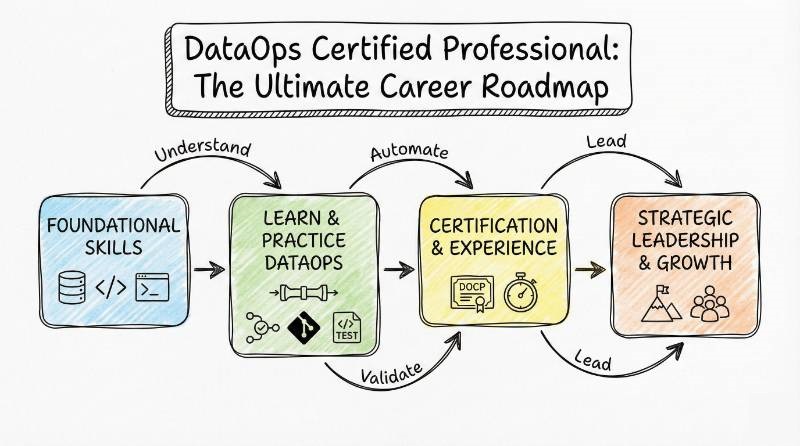
The tech industry has undergone a massive transformation in how we handle information. Years ago, data was a static asset stored in a single database, but today, it has become a living, breathing ecosystem that dictates the success of every application. Consequently, the “old way” of managing data—manual, siloed, and slow—is no longer sustainable. This shift has given birth to a new discipline that every software engineer and manager must understand: DataOps.
By pursuing the DataOps Certified Professional (DOCP), you are not just earning a credential; you are mastering a philosophy. This guide serves as a mentor’s playbook, designed to help you navigate the complexities of data automation and quality. Whether you are based in India or working for a global enterprise, the principles outlined here will elevate your technical standing and career trajectory.
Moving from Data Engineering to DataOps
Modern businesses are no longer satisfied with “having” data; they demand “instant” data. In the past, data engineers spent most of their time manually cleaning spreadsheets or fixing broken ETL (Extract, Transform, Load) jobs. However, the modern market moves too fast for these manual interventions. Instead, we now require systems that are self-healing, automated, and highly transparent.
This is exactly where DataOps bridges the gap. By integrating the collaborative spirit of Agile with the automation power of DevOps, DataOps creates a seamless flow of data from source to consumer. Therefore, becoming a certified professional in this field proves that you can design pipelines that are not just functional, but also resilient and scalable.
Choose Your Path: 6 Modern Engineering Tracks
The technical landscape is vast, and it is easy to feel overwhelmed by the number of specializations available. To help you find your focus, let’s explore the six primary learning paths that define the current industry.
1. The DevOps Path
This remains the fundamental pillar for all modern software delivery. It focuses on the intersection of development and operations, prioritizing automation, speed, and continuous integration. For those who love the rhythm of code deployment, this is the starting point.
2. The DevSecOps Path
Safety is a non-negotiable requirement in today’s threat landscape. This track teaches you how to embed security protocols directly into the automated pipeline. As a result, security becomes a shared responsibility rather than a final, separate stage.
3. The SRE (Site Reliability Engineering) Path
SREs are essentially software engineers who have been tasked with operations. They use code to ensure systems are highly available and reliable. If you enjoy solving complex infrastructure puzzles and managing uptime at scale, this path is for you.
4. The AIOps / MLOps Path
This represents the cutting edge of automation. MLOps focuses on the lifecycle of machine learning models, ensuring they move from a notebook to production smoothly. AIOps, on the other hand, uses artificial intelligence to monitor and fix IT operations automatically.
5. The DataOps Path
Our primary focus today. This track is for the architect who wants to master the flow of data. It ensures that the right data reaches the right person with 100% accuracy. Specifically, it applies CI/CD principles to the data lifecycle.
6. The FinOps Path
Cloud spending can become a nightmare if not managed properly. FinOps practitioners bring financial accountability to the world of cloud infrastructure. By mastering this, you help organizations maximize the value of every dollar spent on the cloud.
Role → Recommended Certifications Mapping
Aligning your current job title with the right certification is the fastest way to see a return on investment. Use this mapping to guide your next career move.
| Your Current Role | The Ideal Certification |
| DevOps Engineer | Certified DevOps Professional (CDP) |
| SRE / Systems Engineer | SRE Certified Professional (SREC) |
| Platform Engineer | Certified DevOps Architect (CDA) |
| Cloud Engineer | AWS/Azure/Google DevOps Specialist |
| Security Engineer | DevSecOps Certified Professional (DSOCP) |
| Data Engineer | DataOps Certified Professional (DOCP) |
| FinOps Practitioner | Certified FinOps Professional |
| Engineering Manager | Certified DevOps Manager (CDM) |
The Master Certification Table
To understand the broader ecosystem, refer to this comprehensive list of certifications. These programs are designed to take you from a foundational level to an expert status.
| Track | Level | Who it’s for | Prerequisites | Skills Covered | Recommended Order |
| DevOps | Foundation | Beginners | Basic Linux | Git, Docker, CI/CD | 1st |
| DevOps | Professional | Engineers | 2+ yrs exp | Kubernetes, Terraform | 2nd |
| DataOps | Professional | Data Engineers | Python/SQL | Airflow, Kafka, dbt | Specialist |
| SRE | Professional | Ops Experts | DevOps basics | Observability, SLAs | Advanced |
| DevSecOps | Professional | Security Pros | CI/CD basics | Vault, SonarQube | Advanced |
| MLOps | Professional | Data Scientists | Python, ML | MLFlow, Model CI/CD | Specialist |
| AIOps | Professional | Managers/SREs | Ops knowledge | ELK, AI for Ops | Specialist |
Deep Dive: DataOps Certified Professional (DOCP)
What it is
The DataOps Certified Professional (DOCP) is a technical certification focused on the automation of data lifecycles. It validates your proficiency in designing, deploying, and maintaining high-quality data pipelines using a variety of modern tools and methodologies.
Who should take it
This program is specifically built for Data Engineers, Software Developers, and Database Administrators. Furthermore, it is an excellent fit for Technical Managers who need to oversee data-driven digital transformations and lead high-performing technical teams.
Skills you’ll gain
- Workflow Orchestration: You will learn to use Apache Airflow to manage complex dependencies and schedules.
- Stream Processing: You will master real-time data ingestion and processing with Apache Kafka.
- Automated Data Quality: You will implement testing frameworks that catch “bad data” before it impacts the business.
- Cloud-Native Infrastructure: You will learn to deploy data stacks using Docker and Kubernetes for maximum portability.
- Data Governance: You will understand how to maintain security, privacy, and lineage across the entire pipeline.
Real-world projects you should be able to do
- Create a fully automated “End-to-End” data pipeline from an external API to a cloud data warehouse.
- Build a monitoring dashboard that visualizes pipeline latency and data accuracy in real-time.
- Develop a CI/CD pipeline for data schemas using Git and automated migration tools.
- Implement a self-healing data ingestion system that automatically retries failed jobs and alerts the team.
The DOCP Preparation Roadmap
Success in the DOCP exam requires a mix of theoretical understanding and hands-on lab work. Here are three suggested timelines based on your current experience.
The Intensive Sprint (7–14 days)
This path is suitable for those already working in an automated environment. First, focus your energy on the unique syntax of Airflow and Kafka. Next, dedicate several hours each day to practice exams and core conceptual questions. Ultimately, your goal should be to bridge the gap between general DevOps and data-specific automation.
The Professional Build (30 days)
This is the most balanced approach for working engineers. Spend the first two weeks focusing on the “Data” aspect: SQL optimization and pipeline design. Moreover, dedicate the final two weeks to the “Ops” aspect: CI/CD, containerization, and monitoring. By building one small project every week, you will ensure the knowledge is practical and retained.
The Strategic Mastery (60 days)
If you are transitioning from a different field or aiming for a leadership role, choose this path. In addition to technical labs, spend significant time reading the DataOps Manifesto and studying enterprise case studies. Consequently, you will develop a holistic view of how DataOps impacts the entire organization, which is vital for long-term career success.
Common Mistakes to Avoid
- Neglecting Data Quality: Many engineers focus so much on the “speed” of the pipeline that they forget to check if the data is actually correct.
- Manual Bottlenecks: If you are still manually updating databases or spreadsheets, you aren’t doing DataOps. Everything must be in the code.
- Tool Overload: Don’t try to learn every single tool at once. Instead, master the core principles of orchestration and streaming first.
- Ignoring the Business Goal: Always remember that the goal of DataOps is to provide value to the end-user. If the user can’t use the data, the pipeline is a failure.
Next Certifications to Take
Growth should never stop. After you achieve your DOCP, consider these three advanced options to further your career.
- Same Track (Advanced): The Certified DataOps Architect will help you move from building pipelines to designing entire organizational data strategies.
- Cross-Track (Hybrid): The MLOps Certified Professional is the natural next step if you want to enter the world of Artificial Intelligence and Machine Learning.
- Leadership (Executive): The Certified DevOps Manager (CDM) is perfect for those who want to lead technical departments and manage large-scale digital transformations.
Training & Certification Support Institutions
Choosing the right training partner can make the difference between a struggle and a success. Here are the top institutions that provide expert help for the DataOps Certified Professional (DOCP).
- DevOpsSchool: This institution is widely considered a global leader in technical training. They offer deep, lab-centric courses that focus on real-world projects, providing students with lifetime access to materials and a highly supportive community of experts.
- Cotocus: Known for its boutique style of education, Cotocus provides high-quality, customized training environments. Their labs are designed to mimic the exact challenges faced by large enterprise organizations, ensuring you are “job-ready” from day one.
- Scmgalaxy: This is a massive resource hub and community platform for professionals in the SCM and DevOps space. They offer thousands of tutorials and expert-led sessions that supplement their formal certification programs, making them a top choice for continuous learners.
- BestDevOps: If you prefer intensive bootcamps, BestDevOps is an excellent choice. Their curriculum is streamlined for speed and impact, taking engineers through the complex world of DataOps in a very short amount of time without sacrificing quality.
- devsecopsschool: This school specializes in the security side of the pipeline. They are perfect if you want to ensure your DataOps practices meet the highest standards of data privacy and cybersecurity compliance.
- sreschool: Focusing on reliability, this institution teaches you how to build pipelines that don’t just run fast, but also never go down. They are experts in observability and self-healing systems.
- aiopsschool: As AI becomes integrated into every tool, this school helps you stay ahead of the curve. They provide specialized modules on how to use AI to optimize your data workflows.
- dataopsschool: A dedicated branch that focuses purely on the data lifecycle. Their curriculum is incredibly deep, covering advanced data governance and automated orchestration for big data environments.
- finopsschool: For the cost-conscious professional, this school is essential. They teach you how to maintain high-performance data pipelines while keeping your cloud costs under strict control.
Frequently Asked Questions (Career & General)
- Is DataOps a new job title? It is both a job title and a methodology. Many “Data Engineers” are now being rebranded as “DataOps Engineers” as their roles become more automated.
- What programming languages do I need? You should have a strong command of SQL and at least one scripting language, preferably Python.
- Is the DOCP recognized globally? Yes, the certification is highly valued across the globe, especially in tech-heavy regions like India, Europe, and North America.
- How much can I expect my salary to increase? While it varies, many professionals see a 20% to 50% increase in their market value after gaining specialized automation certifications.
- Can I take this course if I am a manager? Absolutely. Managers who understand the technical details of DataOps are better equipped to build efficient teams and set realistic goals.
- Does the course cover cloud platforms? Yes, the DOCP program typically includes hands-on labs for major cloud providers like AWS and Azure.
- Is there a lot of math involved? DataOps is more about engineering and automation than pure mathematics, though a basic understanding of data structures is helpful.
- What is the “DataOps Manifesto”? It is a set of 18 principles that prioritize automation, quality, and collaboration over manual processes and siloes.
- How long is the final exam? The exam usually lasts about 2 to 3 hours and includes both conceptual questions and practical lab assessments.
- Do I need to be a DevOps expert first? While it helps, the DOCP course is designed to teach you the necessary DevOps principles as they apply to data specifically.
- How does DataOps relate to Big Data? DataOps is the “engine” that makes Big Data usable. Without DataOps, Big Data is just a large, unorganized mess.
- Are there any community groups for students? Yes, institutions like Scmgalaxy and DevOpsSchool offer vibrant forums and alumni groups for ongoing support and networking.
FAQs: DataOps Certified Professional (DOCP)
- What is the core objective of the DOCP? The goal is to turn you into an expert who can deliver high-quality data to the business faster than ever before.
- Which specific tools will I learn? You will primarily focus on Apache Airflow, Kafka, Docker, Kubernetes, and various data transformation tools like dbt.
- Is the certification exam online? Yes, most providers offer remote proctoring so you can take the exam from your home or office.
- How hard is the certification? It is a professional-level certification, so it is challenging. However, with consistent lab practice, it is very achievable.
- Does it cover Data Privacy? Yes, a significant part of the curriculum is dedicated to ensuring data remains secure and compliant with global laws.
- Will I get a certificate of completion? Yes, upon successfully passing the exam, you will receive a globally recognized certificate and a digital badge.
- Is there a prerequisite for the DOCP? A basic understanding of databases and Linux command-line tools is generally recommended before you start.
- Does it cover real-time data? Yes, mastering real-time data streaming and ingestion is a major component of the professional certification.
Conclusion
The landscape of software and data is changing faster than ever. For those who are willing to adapt, the rewards are immense. The DataOps Certified Professional (DOCP) is more than just a line on a resume; it is a testament to your ability to lead in a data-driven world.
Whether you are looking to secure a high-paying role in a global enterprise or simply want to build better, faster systems for your own team, mastering DataOps is the most logical next step.
