Limited Time Offer!
For Less Than the Cost of a Starbucks Coffee, Access All DevOpsSchool Videos on YouTube Unlimitedly.
Master DevOps, SRE, DevSecOps Skills!
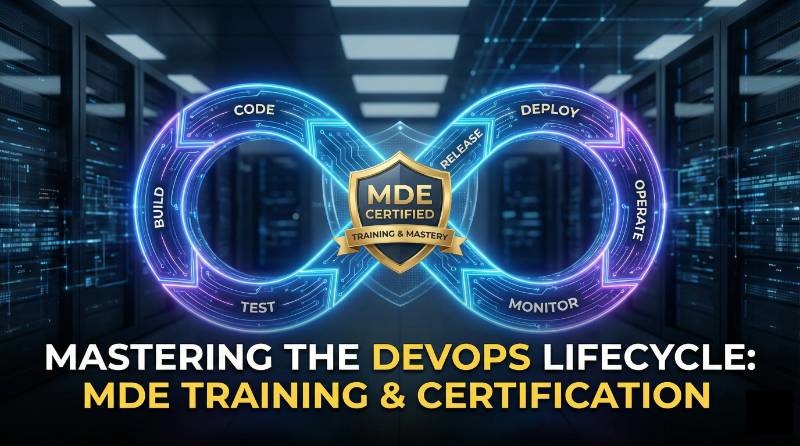
The modern world of software development has undergone a massive transformation. Consequently, the traditional silos between developers and operations teams are disappearing. Today, companies require professionals who can navigate the entire lifecycle of an application with ease. Therefore, the Master in DevOps Engineering (MDE) has emerged as the definitive standard for those who wish to lead this change.
As an expert who has watched the industry evolve from manual deployments to fully automated cloud environments, I can tell you that the shift is permanent. Consequently, engineers who fail to adapt risk becoming obsolete. Conversely, those who master the MDE framework find themselves at the forefront of innovation. This guide will walk you through everything you need to know about this prestigious certification.
Understanding the MDE Landscape
Why Mastery is Essential
To start with, we must recognize that simple automation is no longer enough. Businesses now demand speed, security, and reliability simultaneously. As a result, a “Master” level professional must understand how to integrate these three pillars. For instance, you cannot have a fast pipeline if it is not secure, and you cannot have a secure pipeline if it is not reliable. Therefore, the MDE program bridges these gaps effectively.
The Evolution of the Role
Furthermore, the role of a DevOps engineer has expanded significantly. In the past, it was mostly about writing scripts. However, it now involves complex architecture, cost management, and AI integration. Consequently, the MDE certification is designed to cover these advanced domains, ensuring you are prepared for the challenges of tomorrow.
Detailed Master Certification Guide: MDE
What it is
The Master in DevOps Engineering (MDE) is a comprehensive training and certification program. Specifically, it focuses on the advanced integration of over 30 industry-leading tools. It provides a deep dive into CI/CD, containerization, and automated infrastructure. Ultimately, it aims to create architects who can design resilient and scalable systems.
Who should take it
- Working Software Engineers who want to master the deployment side of the house.
- Systems Administrators looking to transition into modern cloud-native roles.
- Technical Managers who need to oversee high-performing engineering teams.
- IT Graduates who want to jumpstart their careers with a high-value specialization.
Skills you’ll gain
- Advanced CI/CD Orchestration: You will learn to build complex, multi-stage pipelines that handle code from development to production.
- Infrastructure as Code (IaC): Specifically, you will master tools like Terraform and Ansible to manage cloud resources via code.
- Container Mastery: You will gain expert knowledge of Docker and Kubernetes for managing microservices.
- Security Integration: You will learn how to “Shift Left” by integrating security checks directly into the automation process.
- Observability & Monitoring: You will develop the ability to use metrics and logs to predict and prevent system downtime.
Real-world projects you should be able to do after it
- Zero-Downtime Deployment: Implement a Blue-Green or Canary deployment strategy for a global application.
- Self-Healing Infrastructure: Build a system that automatically detects and replaces failing cloud nodes.
- Automated Compliance Pipeline: Create a workflow that automatically scans for security vulnerabilities and stops non-compliant code from reaching production.
Preparation plan
- 7–14 days: This is suitable for experts. You should focus on tool-specific syntax and integration patterns.
- 30 days: This is the recommended duration. Spend 3 hours daily. Devote the first two weeks to CI/CD and Containers. Then, spend the final two weeks on IaC, Security, and SRE.
- 60 days: Ideal for those new to the field. Spend the first month mastering Linux and basic scripting before diving into the core MDE modules.
Common mistakes
- Ignoring the Fundamentals: Many people try to learn Kubernetes before they understand basic Linux networking.
- Tool Obsession: Do not just memorize commands; instead, focus on the underlying architectural principles.
- Manual Habits: Avoid the temptation to fix things manually in the console. Always use code to ensure consistency.
Best next certification after this
Once you achieve your MDE, you should look toward specialization. Specifically, the DevSecOps Certified Professional (DSOCP) is an excellent next step to deepen your security expertise.
Comprehensive Certification Table
The following table lists the critical certifications within the ecosystem to help you plan your professional trajectory.
| Track | Level | Who it’s for | Prerequisites | Skills Covered | Recommended Order |
| DevOps | Master | Engineers/Managers | Basic IT | CI/CD, Docker, K8s | 1 |
| DevSecOps | Professional | Security Engineers | DevOps Basics | Vault, SAST/DAST | 2 |
| SRE | Professional | Reliability Leads | MDE Foundation | SLOs, Error Budgets | 2 |
| DataOps | Professional | Data Engineers | MDE + SQL | Data Pipelines | 3 |
| AIOps | Professional | AI Engineers | MDE + ML Basics | Model Ops, AI Monitoring | 3 |
| FinOps | Professional | Finance & Ops | Cloud Basics | Cost Optimization | 3 |
Choose Your Path: 6 Specialized Learning Tracks
To succeed, you must choose a path that aligns with your career goals. Therefore, I have outlined the six primary tracks below:
1. The DevOps Path
This is the foundational journey. It focuses on breaking down the walls between development and operations. Consequently, you will spend most of your time building automation pipelines and improving developer productivity.
2. The DevSecOps Path
In this track, security is the priority. You will learn to treat security as code. As a result, you will be able to protect the organization from threats without slowing down the speed of delivery.
3. The SRE (Site Reliability Engineering) Path
Reliability is the goal here. You will apply software engineering principles to operations tasks. Specifically, you will focus on system uptime, scalability, and incident response.
4. The AIOps/MLOps Path
This is the future of the industry. You will learn how to apply DevOps principles to Machine Learning models. Therefore, you will be responsible for the automated deployment and monitoring of AI systems.
5. The DataOps Path
Data is the lifeblood of modern companies. This path ensures that data flows through the organization reliably. Consequently, you will focus on automating data pipelines and ensuring data quality.
6. The FinOps Path
Cost management is becoming a top priority for CEOs. In this track, you learn to manage cloud spending. Therefore, you will help the organization get the most value out of every dollar spent on the cloud.
Role → Recommended Certifications
To guide your journey, here is a mapping of roles to the most relevant certifications.
| Role | Recommended Certifications |
| DevOps Engineer | MDE + CDE |
| SRE | MDE + SRECP |
| Platform Engineer | MDE + Certified DevOps Architect |
| Cloud Engineer | MDE + AWS/Azure Professional |
| Security Engineer | MDE + DSOCP |
| Data Engineer | MDE + DOCP |
| FinOps Practitioner | MDE + Certified FinOps Professional |
| Engineering Manager | MDE + CDM (DevOps Manager) |
Top Institutions for MDE Training & Certification
Selecting the right partner for your training is crucial. Below are the top institutions that provide help in Training cum Certifications for the Master in DevOps Engineering.
- DevOpsSchool: As the primary provider of the MDE program, they offer a massive, industry-recognized curriculum. Specifically, their program features over 120 hours of live instruction and 30+ tools. Furthermore, they emphasize practical learning with direct mentorship from industry experts like Rajesh Kumar.
- Cotocus: This institution is highly regarded for its corporate-level training and upskilling programs. They specialize in helping entire engineering departments transition to DevOps. Additionally, their training labs are designed to mimic real-world enterprise chaos for authentic skill building.
- Scmgalaxy: This is a comprehensive community-driven platform for SCM and DevOps professionals. They provide extensive resources, workshops, and specialized certifications. Consequently, they are a top choice for those looking for a strong support network and long-term career resources.
- BestDevOps: They focus on making complex DevOps concepts easy to understand. Their training methodology is highly structured and step-by-step. As a result, it is perfect for professionals who want a clear and punchy mastery path without unnecessary jargon.
- devsecopsschool: This institution is the premier choice for professionals looking to specialize in “Shift-Left” security. They provide specialized training on integrating security tools directly into the pipeline. Therefore, they are essential for anyone pursuing the DevSecOps track.
- sreschool: Dedicated exclusively to Site Reliability Engineering, this school focuses on observability and incident management. Their curriculum is tailored for engineers who want to manage complex, high-traffic systems. Consequently, they are the go-to for deep-dive reliability training.
- aiopsschool: They provide niche training at the intersection of AI and Operations. They help professionals learn how to use machine learning to automate remediation. Specifically, their courses cover predictive monitoring and automated incident response.
- dataopsschool: This school focuses on the emerging field of DataOps. They teach data engineers how to apply agile practices to data pipelines. Consequently, they ensure that data flows through an organization as reliably as code does.
- finopsschool: They address the growing need for cloud financial management. They provide training that helps engineers and finance teams collaborate to optimize cloud spend. As a result, they are vital for organizations looking to maximize cloud value.
Next Certifications to Take
After completing your MDE, you should consider these three directions to further your career:
- Same Track (Deep Expertise): If you love the core DevOps role, pursue the Certified DevOps Architect (CDA). This will prepare you to design large-scale enterprise systems.
- Cross-Track (Broad Knowledge): If you want to expand, try the AIOps Certified Professional. This will give you a competitive edge in the growing AI market.
- Leadership (Career Growth): If you aim for the C-suite or management, the Certified DevOps Manager (CDM) is essential. It focuses on leading people and processes rather than just tools.
FAQs: Mastering Your DevOps Career
1. How difficult is the MDE certification?
While the concepts are made simple, the breadth of tools makes it a challenge. However, with consistent practice, most engineers find it manageable within 3 months.
2. Is there a specific time required for the training?
Usually, you should expect about 100 hours of live instruction. Furthermore, you will need another 100 hours of personal lab time to truly master the tools.
3. What are the prerequisites?
To start with, you should have a basic understanding of IT. Additionally, knowing the basics of Linux and one scripting language like Python is very helpful.
4. Should I take the certifications in a specific sequence?
Yes, you should always start with the MDE (Master in DevOps Engineering). Because it provides the foundation, it makes all subsequent specialized certifications much easier to understand.
5. What is the value of this certification in the market?
This certification is highly valued by MNCs globally. As a result, many professionals see a significant salary increase after becoming certified MDE masters.
6. Does it cover multiple cloud providers?
Absolutely. The MDE focuses on multi-cloud strategies. Consequently, you will learn how to apply these practices on AWS, Azure, and Google Cloud equally.
7. Is the MDE program suitable for managers?
Yes, it is very beneficial. Specifically, it helps managers understand the technical hurdles their teams face, allowing them to make better strategic decisions.
8. What are the career outcomes?
Graduates often transition into roles like Senior DevOps Engineer, Infrastructure Architect, or Site Reliability Engineer. Therefore, it opens many high-paying doors.
9. Do I need to be a developer to succeed?
No, you do not need to be a full-time coder. However, you must be comfortable reading code and writing scripts to automate tasks.
10. How long does the certification stay valid?
Generally, the certification is valid for 2-3 years. After that, you can renew it by taking an advanced exam or proving continuous learning in the field.
11. Are there hands-on projects included?
Yes, you cannot pass without them. You must complete several capstone projects that prove you can solve real-world problems.
12. Why choose MDE over vendor certs?
MDE is vendor-neutral. Consequently, it teaches you the universal principles of DevOps that apply to any company, regardless of the specific tools they use.
FAQs on Master in DevOps Engineering (MDE)
1. What is the official URL for the MDE program?
You can find all the official details at: Master in DevOps Engineeringl.
2. Is this certification recognized in India?
Yes, it is very popular in Indian tech hubs. Consequently, most major IT companies in India recognize and value MDE certified professionals.
3. Who provides the training for MDE?
The primary provider is DevOpsSchool, which is a global leader in professional DevOps education.
4. Can I take the exam online?
Yes, the exam is conducted online in a proctored environment. Therefore, you can complete your certification from anywhere in the world.
5. How many tools are covered in the MDE?
The program covers over 30 tools. Specifically, this includes Git, Jenkins, Docker, Kubernetes, Ansible, and many observability tools.
6. Is there job assistance provided?
Many of the listed institutions, like Scmgalaxy, have strong alumni networks. Consequently, they often help graduates with job referrals and interview preparation.
7. Who is the lead mentor for this program?
The curriculum is often overseen by Rajesh Kumar, an industry veteran with extensive experience in leading DevOps transformations globally.
8. What is the cost of the MDE program?
The cost depends on the training format you choose. Therefore, you should visit the official website for the most accurate and up-to-date pricing.
Conclusion
The journey to becoming a Master in DevOps Engineering is both challenging and rewarding. However, the benefits far outweigh the effort. By mastering the integration of development, security, and reliability, you become an indispensable asset to any organization. Therefore, do not wait for the industry to move past you. Instead, take control of your career and start your MDE journey today.


Leave a Reply