Limited Time Offer!
For Less Than the Cost of a Starbucks Coffee, Access All DevOpsSchool Videos on YouTube Unlimitedly.
Master DevOps, SRE, DevSecOps Skills!
In the current era of high-speed software delivery, speed is nothing without stability. Organizations have moved beyond just “moving fast and breaking things.” Today, the gold standard is moving fast while ensuring that systems remain rock-solid, observable, and scalable. This is where Site Reliability Engineering (SRE) comes into play.
Site Reliability Engineering is the discipline that bridges the gap between software development and IT operations. It applies a software engineering mindset to system administration problems. If you are an engineer or a manager looking to master this bridge, the SRE Certified Professional (SREC) is the premier credential to validate your expertise.
Master Certification Table: The Engineering Roadmap
This table provides a bird’s-eye view of the essential certifications for modern engineers. It outlines the logical progression from core DevOps to specialized tracks like SRE and FinOps.
| Track | Level | Who it’s for | Prerequisites | Skills Covered | Recommended Order |
| SRE | Professional | SREs, DevOps Engineers, Cloud Admins | Basic DevOps/Cloud knowledge | SLIs/SLOs, Error Budgets, Toil Reduction, Observability | 1st (Core SRE) |
| DevOps | Foundational | Beginners, Software Engineers | Basic IT skills | CI/CD Pipelines, Git, Docker, Automation Culture | 1st (Entry) |
| DevSecOps | Professional | Security Engineers, Developers | DevOps Fundamentals | Security as Code, Vulnerability Scanning, Compliance | 2nd (Specialist) |
| DataOps | Professional | Data Engineers, DBAs | SQL & Data Pipeline basics | Data Pipelines, Quality Automation, Orchestration | 2nd (Specialist) |
| FinOps | Professional | Finance, Cloud Architects | Cloud Platform basics | Cost Optimization, Unit Economics, Cloud Billing | 2nd (Specialist) |
| AIOps | Advanced | SREs, Data Scientists | Python & Monitoring tools | Anomaly Detection, ML-driven Monitoring, Auto-remediation | 3rd (Expert) |
SRE Certified Professional (SRECP)
The SRE Certified Professional (SRECP) is a comprehensive program designed to turn engineers into reliability experts. It focuses on the practical application of Google’s SRE principles within any organization.
What it is
The SRECP certification validates your ability to design, build, and maintain highly available and scalable systems. It moves beyond simple “monitoring” and dives deep into “observability,” using software engineering to automate away manual operational tasks (toil).
Who should take it
- DevOps Engineers who want to specialize in system stability and performance.
- System Administrators moving toward a software-defined infrastructure model.
- Software Engineers who are now responsible for the production health of their applications.
- Engineering Managers who need to implement SLOs and Error Budgets to manage team priorities.
Skills you’ll gain
- Service Level Management: Mastery of SLIs, SLOs, and SLAs to define “reliability” in business terms.
- Error Budgeting: Learning how to balance the risk of new releases with the need for stability.
- Full-Stack Observability: Implementing advanced logging, metrics, and distributed tracing.
- Incident Management: Orchestrating blameless post-mortems and rapid incident response.
- Automation of Toil: Identifying and eliminating repetitive manual work through scripting and tools.
- Capacity Planning: Using data to predict and manage infrastructure growth.
Real-world projects you should be able to do
- SLO Dashboard Creation: Build a real-time dashboard that tracks service health against defined error budgets.
- Automated Incident Response: Create a “Self-healing” workflow that triggers automated fixes for common production issues.
- Distributed Tracing Implementation: Set up end-to-end tracing for a microservices-based application to find latency bottlenecks.
- Toil Audit & Reduction: Analyze a team’s weekly tasks, identify “toil,” and write a Go/Python tool to automate it.
Preparation Plan
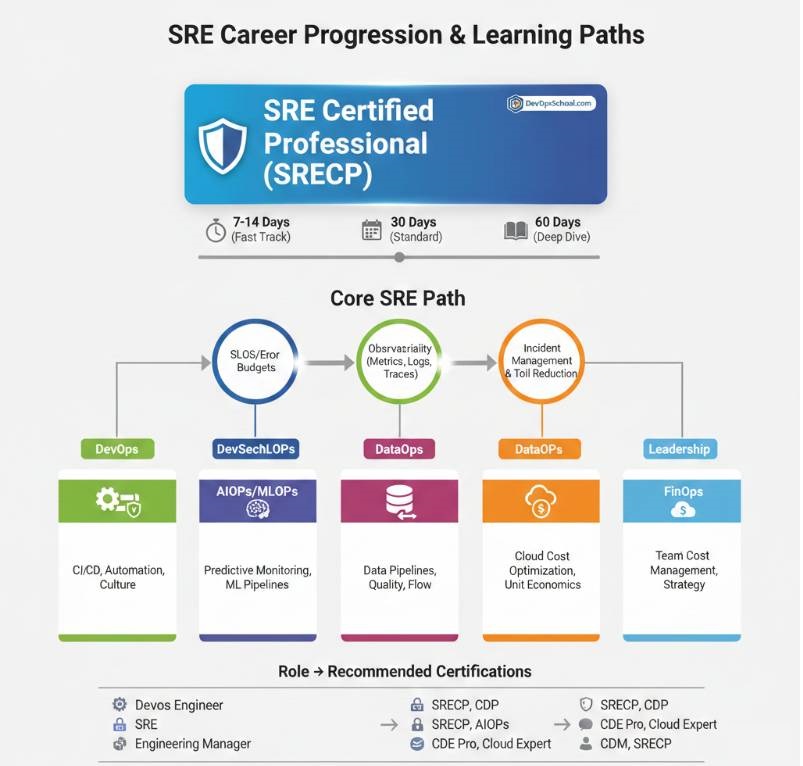
7–14 Days (The Fast Track)
- Days 1-3: Focus on SRE vocabulary and the relationship between DevOps and SRE.
- Days 4-7: Study SLOs, SLIs, and the math behind Error Budgets.
- Days 8-14: Practice with monitoring tools like Prometheus and Grafana. Take mock exams.
30 Days (The Standard Path)
- Week 1: Deep dive into SRE culture and the Google SRE handbook principles.
- Week 2: Hands-on labs focusing on Linux internals and container orchestration (Kubernetes).
- Week 3: Focus on Incident Management, On-call rotation strategies, and Blameless Post-mortems.
- Week 4: Detailed review of Observability-driven development and final certification practice.
60 Days (The Deep Dive)
- Month 1: Comprehensive study of distributed systems, networking, and cloud-native architecture.
- Month 2: Intense project work—building pipelines, setting up alerting hierarchies, and practicing chaos engineering.
Common Mistakes
- Focusing only on tools: SRE is a culture and a mindset, not just knowing how to use Prometheus.
- Ignoring the “Math”: Failing to understand how to calculate error budgets correctly leads to useless SLOs.
- Manual Firefighting: Continuing to fix things manually instead of writing code to prevent the issue from happening again.
Best next certification after this
Once you have achieved the SRECP, the best next step is the AIOps Certified Professional. This is because AIOps uses artificial intelligence to manage the massive amounts of data that SRE systems generate.
Choose Your Path: 6 Learning Journeys
1. The DevOps Path
Focuses on the lifecycle of the application. It’s about the “Continuous” everything—Integration, Delivery, and Deployment. It is the foundation for all other paths.
2. The DevSecOps Path
Integrates security into every phase of the pipeline. You move from “Security as a Gatekeeper” to “Security as Code.”
3. The SRE Path
The focus here is reliability and scalability. You treat operations as a software problem and use metrics to drive all engineering decisions.
4. The AIOps/MLOps Path
This is the future of operations. You use AI to manage the massive amounts of data generated by modern systems and MLOps to manage the lifecycle of machine learning models.
5. The DataOps Path
Focuses on the “Data Pipeline.” It ensures that data is high-quality, available, and flows seamlessly from source to consumer with automated testing.
6. The FinOps Path
The “Financial” side of the cloud. You learn how to bridge the gap between engineering, finance, and business to optimize cloud spend.
Role → Recommended Certifications
If you are currently in one of these roles, here is your target certification list:
- DevOps Engineer: Certified DevOps Professional (CDP) + SRE Certified Professional (SRECP).
- SRE: SRE Certified Professional (SRECP) + AIOps Certified Professional.
- Platform Engineer: Certified DevOps Architect (CDA) + Kubernetes Master.
- Cloud Engineer: CDE Professional + Cloud Provider Specific (AWS/Azure/GCP) Expert.
- Security Engineer: DevSecOps Certified Professional (DSOCP).
- Data Engineer: DataOps Certified Professional (DOCP).
- FinOps Practitioner: Certified FinOps Professional.
- Engineering Manager: Certified DevOps Manager (CDM) + SRE Certified Professional (SRECP).
Next Certifications to Take (The Expansion)
Once you have completed your SRE certification, you should consider expanding your horizon in one of three ways:
- Same Track (Deepening): AIOps Certified Professional. This allows you to apply artificial intelligence to the SRE domain, moving from reactive to predictive reliability.
- Cross-Track (Broadening): DevSecOps Certified Professional. Reliability is impossible without security. Learning how to bake security into your reliable systems makes you a “Full-Stack” operational expert.
- Leadership (Advancing): Certified DevOps Manager (CDM). This is for those looking to move into people and process management, helping whole organizations adopt the SRE and DevOps mindset.
Top Training & Certification Institutions
When seeking help for your SRE Certified Professional (SRECP) journey, these institutions offer the best resources and mentor support:
- DevOpsSchool: A global leader in DevOps and SRE training. They provide live instructor-led sessions, massive resource libraries, and real-world project labs mentored by industry veterans like Rajesh Kumar.
- Cotocus: Known for their specialized technical bootcamps. They offer deep-dive practical sessions that focus on the “Engineering” part of Site Reliability Engineering.
- Scmgalaxy: One of the oldest communities for software configuration management. They provide excellent community-driven content and structured certification paths for SRE and DevSecOps.
- BestDevOps: A niche provider focusing on high-end certifications. Their curriculum is updated frequently to match the changing landscape of cloud-native technologies.
- devsecopsschool: The go-to place for security-focused engineering. They offer integrated tracks that show how SRE and Security work together in a modern enterprise.
- sreschool: A dedicated portal for SRE professionals. It offers highly focused modules on observability, incident response, and error budgeting.
- aiopsschool: Specializes in the intersection of AI and Operations. Ideal for SREs looking to advance their career into the predictive monitoring space.
- dataopsschool: Focuses on the reliability of data systems. They provide certifications for engineers managing massive data lakes and complex ETL pipelines.
- finopsschool: The leading authority on cloud financial management. They offer training for engineers who want to add “Cost Efficiency” to their reliability toolkit.
FAQs (General Career & Value)
1. How difficult is the SRE certification compared to DevOps?
SRE is generally considered more difficult because it requires a deeper understanding of software engineering and system internals. While DevOps focuses on the “flow,” SRE focuses on “stability at scale.”
2. Is there a prerequisite for the SRE Certified Professional?
A basic understanding of DevOps, cloud platforms, and Linux system administration is highly recommended but not mandatory for the foundational modules.
3. How long does it take to get certified?
Depending on your experience, it typically takes 4-6 weeks of dedicated study and hands-on lab work to be ready for the exam.
4. What is the sequence I should follow?
The ideal sequence is: DevOps Foundation -> SRE Certified Professional -> AIOps/DevSecOps.
5. Does this certification help in getting a salary hike?
Yes. SRE is currently one of the highest-paying roles in the tech industry. Certified professionals often see a significant increase in market value.
6. Is the exam online or offline?
Most certifications, including the SRECP, are conducted online via proctored platforms, allowing you to take them from anywhere globally.
7. How long is the certification valid?
Most industry-standard certifications are valid for 2-3 years, after which you may need to renew or take an advanced level to keep your credentials current.
8. Is SRE relevant for small companies?
Absolutely. While the term originated at Google, every company that has a website or an app needs to ensure it is reliable and stays up.
9. Can a manual QA move into SRE?
Yes, but it requires a significant upskilling in automation and system design. SRE is a great path for “Automation Engineers.”
10. What tools are most important for the SRECP?
Prometheus, Grafana, Kubernetes, Terraform, and a scripting language like Python or Go are the core tools you will master.
11. Is this certification recognized globally?
Yes, DevOpsSchool certifications are recognized by major tech hubs in India, the USA, Europe, and the Middle East.
12. What is the biggest career outcome of being SRE certified?
The biggest outcome is moving from a “reactive” role (fixing things when they break) to a “proactive” role (building systems that don’t break).
FAQs Specific to SRE Certified Professional (SRECP)
1. What is the primary focus of the SRECP curriculum?
The core focus is on the “Golden Signals” of monitoring (Latency, Traffic, Errors, and Saturation) and managing them via SLOs and Error Budgets.
2. Does the SRECP cover Kubernetes?
Yes, Kubernetes is a central part of the curriculum as it is the standard platform for running reliable, distributed systems today.
3. How are the practical assessments structured?
The SRECP includes scenario-based labs where you must set up monitoring for a failing application and implement an automated fix.
4. Is Rajesh Kumar the main mentor for this program?
Yes, Rajesh Kumar, a globally recognized expert, mentors the SRECP program at DevOpsSchool, bringing decades of technical wisdom to the sessions.
5. Does the course cover “Chaos Engineering”?
Yes, the professional level introduces Chaos Engineering principles to help you test the resilience of your systems by intentionally injecting failures.
6. Will I learn how to write a “Blameless Post-mortem”?
Yes, the course places heavy emphasis on SRE culture, which includes the art of conducting blameless incident reviews.
7. Can I choose my preferred cloud for the labs?
The principles are cloud-agnostic, but most labs are conducted on AWS or GCP to provide a realistic environment.
8. What happens if I fail the exam?
Most training providers like DevOpsSchool offer a second attempt or additional coaching to help you clear the certification on your next try.
Conclusion
Mastering Site Reliability Engineering is more than just learning a new set of tools; it is about adopting a mindset that prioritizes stability as a core feature of the product. In my experience, the transition from traditional operations to SRE is the single most impactful move an engineer can make in today’s cloud-native world. It shifts your focus from manual firefighting to high-value engineering, ensuring that systems remain resilient even as they scale to millions of users. The SRE Certified Professional (SRECP) certification serves as your gateway to this elite community. It provides the structured knowledge and hands-on validation needed to prove you can handle the pressures of modern production environments. Whether you are an engineer looking to increase your market value or a manager aiming to build a more reliable team, this guide provides the roadmap to get you there. By investing in these skills, you aren’t just protecting your uptime—you are future-proofing your career.


Leave a Reply