
Limited Time Offer!
For Less Than the Cost of a Starbucks Coffee, Access All DevOpsSchool Videos on YouTube Unlimitedly.
Master DevOps, SRE, DevSecOps Skills!
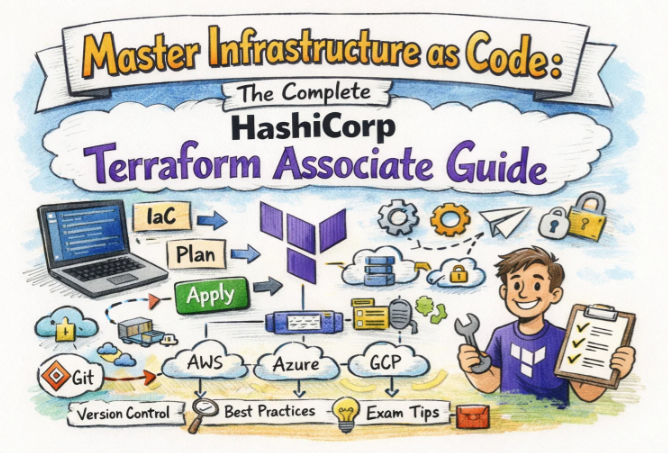
In today’s fast-moving tech world, manual work is a risk. If you are still setting up servers by clicking buttons in a cloud portal, you are falling behind. The industry has moved toward Infrastructure as Code (IaC). This means we treat our hardware, networks, and security just like software code. We write it, we test it, and we deploy it automatically.
At the center of this change is HashiCorp Terraform. It is the tool that everyone—from startup engineers in India to managers in global tech firms—is using to manage the cloud. As a mentor who has seen the industry change from physical server rooms to the cloud, I can tell you that learning Terraform is the best move you can make for your career. This guide will help you understand the certification path and how to grow from an engineer to a domain expert.
Understanding the HashiCorp Terraform Certification
The certification program is built to prove you can handle real-world tasks. It is not just about passing a test; it is about showing you can build stable systems.
Terraform Certification Summary
| Track | Level | Who it’s for | Prerequisites | Skills Covered | Recommended Order |
| Infrastructure Automation | Associate | DevOps, SRE, Cloud Engineers | Basic Cloud Knowledge | CLI, State, HCL Syntax, Modules, Workflows | 1st |
Detailed Look: HashiCorp Certified: Terraform Associate
This is the main certification you need. It proves you understand the core logic of how Terraform works with different cloud providers.
What it is
The HashiCorp Certified: Terraform Associate is an official exam that tests your knowledge of the open-source version of Terraform. It checks if you know how to use the HashiCorp Configuration Language (HCL) to create and manage cloud resources. It also covers how teams work together using Terraform Cloud and Enterprise features.
Who should take it
- Software Engineers: To learn how to deploy the apps they build.
- DevOps & SREs: Since automation is their main job.
- Platform Engineers: Who build the systems other developers use.
- Engineering Managers: To understand the tools their teams use every day.
Skills you’ll gain
When you study for this, you learn more than just commands. You learn a new way of working.
- HCL Basics: You will learn how to write clean, simple code to describe your cloud setup.
- State Management: You will understand how Terraform remembers what it built, which is the most important part of the tool.
- The Core Workflow: You will master the
init,plan, andapplysteps that keep your infrastructure safe. - Using Modules: You will learn how to write code once and use it many times, saving hours of work.
- Provider Knowledge: You will learn how to connect Terraform to AWS, Azure, Google Cloud, and more.
Real-world projects you should be able to do after it
Certification should lead to action. After passing, you should be able to:
- Build a Web Stack: Set up a full network, database, and web server in the cloud with one command.
- Create Standard Templates: Build “modules” so your whole company uses the same secure setup for every project.
- Fix “Drift”: Use Terraform to find and fix any manual changes someone made to your servers.
- Multi-Cloud Setup: Set up resources in two different clouds (like AWS and Azure) that talk to each other perfectly.
Preparation Plan
The 7-Day Quick Start (For those with experience)
- Day 1-2: Read the CLI documentation. Focus on commands like
state,import, andfmt. - Day 3-4: Study Terraform Cloud features like Workspaces and Sentinel.
- Day 5-6: Take practice tests to get used to the question style.
- Day 7: Review your mistakes and take the exam.
The 30-Day Steady Path (Recommended)
- Week 1: Learn the basics of HCL and Providers. Build a simple project on a free cloud account.
- Week 2: Focus on “State.” Learn how to store it safely in an S3 bucket or Azure Blob.
- Week 3: Learn about Variables, Outputs, and Modules. Make your code dynamic.
- Week 4: Final review and practice exams.
The 60-Day Foundation Path (For beginners)
- Month 1: Learn basic cloud concepts (what is a VPC, a Subnet, an Instance?).
- Month 2: Follow a step-by-step course and build at least five different small projects.
Common Mistakes
Many people fail because they rush or overlook the basics.
- Losing the State File: If you don’t store your state file in a remote, locked location, your team will break things.
- Hardcoding Secrets: Never put passwords in your code. The exam and your boss will penalize you for this.
- Skipping the ‘Plan’: Always run
terraform planto see what will happen before you do it. Beginners often skip this and delete important data by mistake.
Best Next Certification After This
After you master Terraform, you should move to Certified Kubernetes Application Developer (CKAD). Terraform builds the ground (infrastructure), and Kubernetes runs the apps. Having both makes you a top-tier engineer.
Choose Your Path: 6 Learning Directions
Once you know Terraform, you can specialize in one of these areas:
1. The DevOps Path
Focus on making the software delivery process faster and safer.
- Goal: Use Terraform to build the “pipelines” that move code from a developer’s laptop to the cloud.
2. The DevSecOps Path
Focus on keeping everything secure.
- Goal: Use code to scan your infrastructure for security holes before it is even built.
3. The SRE (Site Reliability Engineering) Path
Focus on making sure things never break.
- Goal: Use Terraform to set up monitoring and automatic recovery systems.
4. The AIOps/MLOps Path
Focus on the infrastructure needed for Artificial Intelligence.
- Goal: Automatically set up the heavy-duty servers needed to train AI models.
5. The DataOps Path
Focus on managing big data.
- Goal: Use code to manage data lakes and databases like Snowflake or BigQuery.
6. The FinOps Path
Focus on the cloud bill.
- Goal: Use Terraform to ensure you only pay for what you use by shutting down idle servers.
Role → Recommended Certifications Mapping
| Your Goal Role | Certifications to Get |
| DevOps Engineer | Terraform Associate, CKA, AWS DevOps Pro |
| SRE | Terraform Associate, CKAD, Google DevOps Engineer |
| Platform Engineer | Terraform Associate, CKA, CKS |
| Cloud Engineer | Terraform Associate, Azure Administrator |
| Security Engineer | Terraform Associate, CKS, Security+ |
| Data Engineer | Terraform Associate, Data Engineer Professional |
| FinOps Practitioner | Terraform Associate, FinOps Practitioner |
| Engineering Manager | Terraform Associate, PMP, Cloud Practitioner |
Next Certifications to Take
Looking at career data for software engineers, here are three smart moves:
- Same Track: Certified Kubernetes Administrator (CKA). This keeps you in the world of infrastructure.
- Cross-Track: Certified Kubernetes Application Developer (CKAD). This helps you understand how apps run on the infra you build.
- Leadership: Cloud Solutions Architect Professional. This helps you design big systems for large companies.
Training Institutions for CKAD (CDE)
If you want to master Certified Kubernetes Application Developer (CKAD), these schools provide excellent training:
- DevOpsSchool: They offer practical training with real projects. They focus on making sure you can do the work, not just pass the test.
- Cotocus: Known for deep technical bootcamps that help you understand complex cloud systems quickly.
- Scmgalaxy: A great place for resources and community help regarding DevOps tools and certifications.
- BestDevOps: They provide simple and clear training for working professionals who want to get certified.
- DevSecOpsSchool: The best place to learn how to add security into your Kubernetes and DevOps work.
- Sreschool: Focuses on teaching you how to keep large systems running without downtime.
- Aiopsschool: Helps you learn how to use Kubernetes for AI and Machine Learning tasks.
- Dataopsschool: Focuses on managing data and databases inside container systems.
- Finopsschool: Teaches you how to manage and lower the cost of running apps on the cloud.
FAQs: Certified Kubernetes Application Developer (CKAD)
1. Is the CKAD exam hard?
It is a practical exam. You have to solve problems on a live system, so it tests your actual skills.
2. How long does it take to study?
Most people study for 1 to 2 months while working their regular jobs.
3. Do I need to be a developer?
You don’t need to be a coding expert, but you should know how to read simple code and use the Linux command line.
4. Why take CKAD after Terraform?
Terraform sets up the cloud environment. CKAD teaches you how to run and manage the apps inside that environment.
5. What is the exam format?
It is 100% hands-on. You get a list of tasks and a terminal. No multiple-choice questions.
6. Does it help with my career in India?
Yes, Kubernetes is one of the most in-demand skills in Bangalore, Hyderabad, and Pune.
7. How long is it valid?
It is valid for 3 years.
8. Can I use the internet during the test?
You can only use the official Kubernetes documentation website.
General FAQs
1. Is the Terraform Associate exam hard?
It is fair. If you have used Terraform for a few months, you should pass.
2. How long is the exam?
You have 60 minutes to finish it.
3. What is the passing score?
It is usually around 70%.
4. Is there a lab in the Terraform exam?
No, it is currently multiple-choice and drag-and-drop questions.
5. Do I need to know AWS or Azure?
You should know one cloud provider fairly well to understand the questions.
6. Can I take it from home?
Yes, it is an online-proctored exam.
7. How much does it cost?
It is about $70 USD.
8. Is Terraform better than Ansible?
They do different things. Terraform builds the infrastructure; Ansible configures the software inside it.
9. Why is Terraform so popular?
Because it works with almost every cloud provider in the world.
10. Do I get a badge for LinkedIn?
Yes, you get a digital badge to show off your skills.
11. How many questions are there?
Usually around 57-60 questions.
12. Can I retake it if I fail?
Yes, but you have to pay for the exam again.
Conclusion
Mastering HashiCorp Terraform is a major step toward becoming a leader in the tech industry. It moves you away from manual, repetitive tasks and allows you to build systems that are stable, secure, and easy to manage. By getting certified, you prove to your company and the global market that you are ready for the future of cloud computing. But remember, the certification is just the start. The real goal is to use these skills to solve problems, whether that is through the DevOps, SRE, or FinOps paths. When you combine Terraform with Kubernetes skills like those found in the CKAD program, you become an essential part of any modern engineering team. Take the time to practice, build your own projects, and keep learning. The cloud is the future, and with Terraform, you hold the key to building it.


0 Comments
Most Voted