
Limited Time Offer!
For Less Than the Cost of a Starbucks Coffee, Access All DevOpsSchool Videos on YouTube Unlimitedly.
Master DevOps, SRE, DevSecOps Skills!
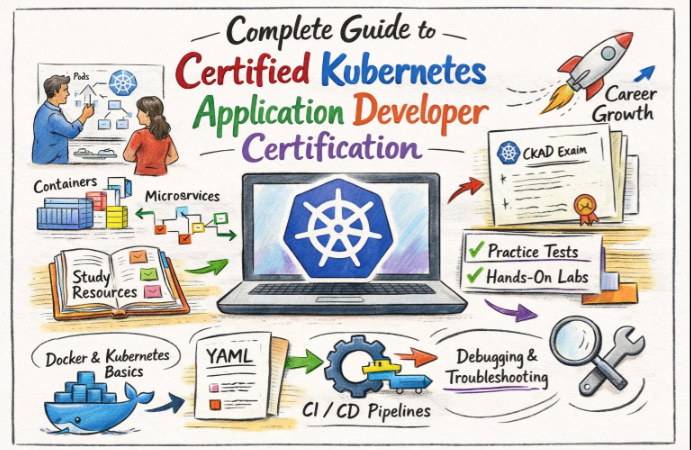
The global tech market is currently going through a major shift. It is no longer enough to just write code that works on your local machine. Companies today are looking for engineers who can navigate the complex world of cloud-native infrastructure. If you want to stay competitive, you need to understand how to deploy and manage your applications in a containerized world.
Kubernetes has become the backbone of modern software. While many people talk about it, few truly master it. The Certified Kubernetes Application Developer (CKAD) program is the industry-recognized way to prove you have the actual skills to build and run applications at scale. This isn’t just a test of your memory; it is a test of your ability to solve real problems under pressure.
In this guide, we will break down everything you need to know about the CKAD. Whether you are an engineer looking to level up or a manager trying to build a high-performing team, this roadmap will show you the way forward.
Global Certification Landscape: Mapping Your Growth
Before we focus on the CKAD, let’s look at the broader certification world. Understanding where you are and where you want to go is the first step in a successful career plan.
| Track | Level | Who it’s for | Prerequisites | Skills Covered | Recommended Order |
| Cloud Foundations | Associate | Beginners & Managers | General IT knowledge | Cloud basics, Container theory | 1 |
| K8s Application | Professional | Software Engineers | Basic Container knowledge | App Design, Pods, Networking, Security | 2 |
| K8s Administration | Professional | SREs & DevOps | Linux & Networking | Cluster setup, maintenance, logging | 3 |
| K8s Security | Specialist | Security Engineers | CKA Certification | Hardening, supply chain security | 4 |
| Infrastructure | Associate | DevOps Engineers | Basic Cloud usage | Terraform, IaC, Automation | 5 |
| Leadership | Foundation | Engineering Managers | Delivery experience | DevOps culture, ROI, metrics | 6 |
The Gold Standard: Certified Kubernetes Application Developer (CKAD)
The CKAD is the most practical certification a software engineer can earn today. It focuses on the specific tasks you need to perform to get an application running smoothly in a cluster.
What it is
The Certified Kubernetes Application Developer (CKAD) is a performance-based exam managed by the CNCF and The Linux Foundation. It is a two-hour challenge where you work in a live terminal. There are no multiple-choice questions. You are given a set of tasks—like creating a deployment or fixing a broken service—and you must complete them correctly to pass. It is the definitive proof that you can handle Kubernetes in a real-world setting.
Who should take it
This certification is designed for Software Engineers, Application Developers, and DevOps practitioners. If you are responsible for building, configuring, or exposing applications in the cloud, the CKAD is for you.
Engineering Managers should also take this program seriously. When a manager understands the technical details of Kubernetes, they can communicate better with their teams, set more accurate deadlines, and make smarter choices about the tools the company uses.
Skills you’ll gain
Preparing for the CKAD forces you to learn the “Kubernetes way” of doing things. You will move away from manual configurations and learn how to use automated, declarative patterns.
- Application Architecture (20%): You will learn to build multi-container pods using sidecar and ambassador patterns.
- Deployment Strategies (20%): You will master rolling updates and learn how to use Helm to package your apps.
- Observability and Maintenance (15%): You will learn to set up health checks (probes) and use logs to find out why an app is failing.
- Environment and Security (25%): You will learn to manage secrets and config data safely and set resource limits for your containers.
- Services and Networking (20%): You will learn how to connect your apps together and how to use Ingress to let users access your services.
Real-world projects you should be able to do after it
Once you have mastered the CKAD curriculum, you will be ready to take on high-impact projects at your company.
- Modernizing Legacy Apps: You will be able to take an old application, containerize it, and deploy it as a scalable microservice.
- Implementing Security Best Practices: You will know how to mount secrets securely and use Network Policies to protect your data.
- Automating Updates: You will be able to set up rolling deployments so your team can push code multiple times a day without downtime.
- Troubleshooting Production Issues: You will have the skills to quickly look at a failing pod, find the error in the logs, and fix the configuration.
- Optimizing Cloud Costs: By setting resource limits and requests correctly, you will ensure that your apps don’t waste expensive cloud resources.
Preparation plan (7–14 days / 30 days / 60 days)
The time you need to study depends on your starting point. Here is how you should plan your time.
The 14-Day “Fast Track” (For the Active K8s User)
This is for engineers who already use kubectl every day.
- Days 1-7: Go through every topic in the official curriculum. Focus on areas you don’t use often, like CronJobs or NetworkPolicies.
- Days 8-14: Practice speed. The exam is a race against time. Use mock exams and learn how to use imperative commands to save every second.
The 30-Day “Standard” (For the Working Developer)
This is the most common path for someone who knows Docker but is new to Kubernetes.
- Week 1-2: Focus on the core building blocks: Pods, Deployments, Services, and ConfigMaps.
- Week 3: Learn about more complex topics like Ingress, Persistent Volumes, and multi-container patterns.
- Week 4: Take multiple mock exams. Practice searching the official documentation quickly.
The 60-Day “Foundation” (For the Beginner)
If you are new to the world of cloud-native, take your time to build a strong foundation.
- Month 1: Focus on Linux and Docker. You must be comfortable with the command line and how container images work before you touch Kubernetes.
- Month 2: Follow the 30-day plan. Spend a lot of time on hands-on labs to build your muscle memory.
Common mistakes
I have seen many smart engineers fail because they didn’t have a plan for the exam itself.
- Wasting time on YAML: Don’t write YAML files from scratch. Use
kubectl runorkubectl createwith the--dry-run=client -o yamlflag to generate your files. - Forgetting the Namespace: Many tasks must be done in a specific namespace. If you do the work in the wrong one, you get no credit.
- Ignoring the Timer: If you get stuck on a 2% question, skip it. Focus on the high-value questions first.
- Lack of Practice: You cannot pass this exam by just reading books. You must spend dozens of hours in a real terminal.
Choose Your Path: 6 Career Directions
Mastering Kubernetes is just the start. Once you have your CKAD, you can specialize in one of these six modern engineering paths.
1. The DevOps Path
Focus on the speed of delivery. You will work on automating the entire software lifecycle, ensuring that code moves from a developer’s brain to a production server as fast as possible.
2. The DevSecOps Path
Focus on security. You will learn how to build security into every step of the process, ensuring that your Kubernetes clusters and your code are always protected.
3. The SRE Path
Focus on reliability. You will use your engineering skills to make sure systems are always available, fast, and able to handle huge amounts of traffic.
4. The AIOps/MLOps Path
Focus on intelligence. You will learn how to manage and scale AI models on Kubernetes, handling the massive amounts of data and processing power they need.
5. The DataOps Path
Focus on data flow. You will work on automating data pipelines and managing large-scale databases on Kubernetes, ensuring that data is always where it needs to be.
6. The FinOps Path
Focus on value. You will learn how to track and manage the cost of the cloud, ensuring that your company gets the best possible performance for the lowest price.
Role → Recommended Certifications: Your Career Map
If you are looking for your next role, use this table to see which certifications will help you get there.
| Your Role | Must-Have Certification | Next Step for Growth |
| Software Engineer | CKAD | Cloud Associate |
| DevOps Engineer | CKA | Terraform Associate |
| SRE | CKA | CKAD |
| Platform Engineer | CKA | CKS |
| Security Engineer | CKS | DevSecOps Foundation |
| Data Engineer | DataOps Foundation | CKAD |
| FinOps Practitioner | FinOps Practitioner | Cloud Basics |
| Engineering Manager | Cloud Basics | CKAD |
What’s Next? Building on Your CKAD
Once you pass the CKAD, you have three great ways to keep growing your skills.
- Deepen Your Tech Skills: Take the CKA (Administrator) exam. This will teach you how to manage the clusters that your apps run on.
- Broaden Your Skills: Learn Terraform. While Kubernetes manages your apps, Terraform manages the servers and networks they live on.
- Move into Leadership: Take the DevOps Foundation course. This will teach you the cultural and strategic skills needed to lead a modern engineering team.
Top Training Partners for CKAD Success
If you want to pass the first time and really learn the skills, I recommend partnering with one of these institutions. They focus on hands-on learning and real-world scenarios.
- DevOpsSchool: A world leader in tech training. They provide very deep, hands-on courses led by instructors who have worked in the industry for a long time. They focus on real skills, not just passing the test.
- Cotocus: They specialize in corporate training and technical workshops. If you want your whole team to learn Kubernetes together, they are a great choice.
- Scmgalaxy: A very established provider that focuses on configuration and source code management. Their training is very practical and easy to follow.
- BestDevOps: They offer training that is focused on results. Their courses are designed to help you build the speed and accuracy you need for the CKAD exam.
- devsecopsschool: If you want to learn how to build secure apps on Kubernetes from the start, this is the place to go.
- sreschool: Their training is built around reliability and uptime, which is perfect for anyone moving into an SRE role.
- aiopsschool: If you want to work with AI, they teach you how to manage those heavy workloads on a Kubernetes cluster.
- dataopsschool: They focus on the data side of engineering, teaching you how to run large data pipelines in a containerized world.
- finopsschool: A great resource for learning how to manage cloud costs, which is a vital skill for senior engineers and managers.
Strategic FAQs: Questions for Leaders and Seniors
1. How difficult is the CKAD compared to other exams?
It is significantly harder than a multiple-choice exam. Because it is performance-based, you have to prove you can actually do the work. There is no guessing.
2. How much time should my team set aside for study?
For a software engineer, 30 days is usually the right amount of time. This allows for learning the concepts and plenty of time for hands-on practice.
3. Are there prerequisites for the CKAD?
No formal ones, but your team should know Linux basics and have a good understanding of containers (like Docker) before they start.
4. Is the CKAD better than the CKA?
They are for different people. CKAD is for those who build apps; CKA is for those who manage clusters. Most senior engineers should have both.
5. Is this certification recognized globally?
Yes. It is the gold standard for Kubernetes skills and is respected by hiring managers at top tech companies all over the world.
6. Can my team learn this through self-study?
It is possible, but it takes much longer. Guided training usually cuts the learning time in half by pointing out the common mistakes people make.
7. Does the certification expire?
Yes, it is valid for two years. Because Kubernetes changes so fast, this ensures that engineers are always up to date with the latest features.
8. Can we use the official documentation during the test?
Yes, you can look at the official Kubernetes docs during the exam. This makes the test more like a real workday where you look things up when you need to.
9. What is the most common reason for failure?
Time management. Most people know the answers but they aren’t fast enough in the terminal to finish all the tasks.
10. Should managers take the CKAD?
Yes. A manager who understands the platform their team uses can make better plans, set realistic goals, and lead with more credibility.
11. What is the value of the free retake?
It takes away the stress. Knowing you have a second chance allows engineers to treat the first attempt as a learning experience.
12. Is Kubernetes too complex for every company?
It can be, but the CKAD teaches you the standard, reliable way to do things. Following these patterns prevents expensive mistakes later on.
Practical FAQs: Questions About the CKAD Exam
1. Where do I register for the exam?
The official site is here: CKAD Official URL. Training is provided by DevOpsSchool.
2. How long is the exam session?
The exam is exactly two hours long and is proctored online.
3. What is the passing score?
You need to score at least 66% to earn your certification.
4. Can I take the exam from my house?
Yes, it is an online exam. You just need a quiet room, a webcam, and a stable internet connection.
5. When will I receive my results?
Results are usually sent to you via email within 24 to 48 hours after you finish.
6. Do I need any other certifications first?
No, the CKAD is a standalone certification. You can take it whenever you are ready.
7. Can I use my own laptop?
Yes, you can use your own computer as long as it meets the basic technical requirements for the proctoring software.
8. How can I save time during the exam?
The first thing you should do is set up a few aliases, like alias k=kubectl, to save time on every command you type.
Conclusion
The shift to cloud-native technology is a permanent change in our industry. Mastering Kubernetes is no longer an optional skill for those who want to reach the top of their field. The Certified Kubernetes Application Developer (CKAD) program is the most practical and respected way to prove you have these essential skills. It is a challenging journey, but it builds the technical strength and confidence you need to lead in a modern engineering environment. Whether you are an engineer looking to grow or a manager looking to build a high-performing team, investing in this certification is a smart move that will pay off for years to come. Start your journey today, find a solid training partner, and become a master of the modern cloud.


0 Comments
Most Voted