Limited Time Offer!
For Less Than the Cost of a Starbucks Coffee, Access All DevOpsSchool Videos on YouTube Unlimitedly.
Master DevOps, SRE, DevSecOps Skills!
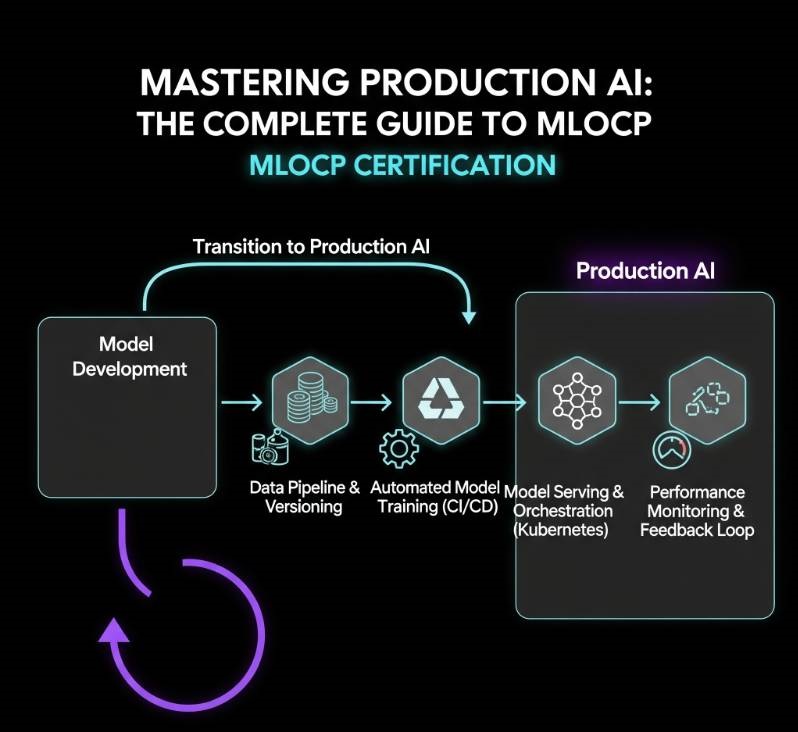
The tech landscape is shifting beneath our feet. For those of us who have spent decades in the trenches of software engineering—witnessing everything from the birth of the cloud to the total dominance of containerization—we know a fundamental change when we see one. Today, we are moving beyond the era of simply deploying code; we are entering the era of deploying intelligence. But here is the hard truth that many organizations are learning the expensive way: building a machine learning model is the easy part. The real challenge is the “deployment gap.” I have seen brilliant models, developed by world-class data scientists, fail to deliver a single rupee of value because the infrastructure and processes weren’t there to support them. A model running on a local Jupyter notebook is a research project; a model running at scale, serving thousands of users while being monitored for accuracy and drift, is a product. This is where MLOps (Machine Learning Operations) becomes the most critical skill set in the modern enterprise. It is the fusion of Data Engineering, DevOps, and Machine Learning. It is the discipline of creating a repeatable, automated factory for AI. Whether you are a Software Engineer in Bangalore looking to pivot, a DevOps veteran in Silicon Valley, or an Engineering Manager leading a global team, the MLOps Certified Professional (MLOCP) program is your roadmap. This certification, provided by industry leaders like DevOpsSchool, isn’t just about learning a few new tools. It’s about mastering the operational muscle required to make AI work in the real world. In this guide, we’ll dive deep into the MLOCP journey, breaking down how you can bridge the gap between “experimental” and “operational” to become an indispensable architect of the AI era.
What is MLOps and Why Now?
We used to think of Machine Learning as a math problem. We were wrong. In production, ML is a systems engineering problem. A typical ML system consists of only a small fraction of “ML code.” The rest is configuration, data collection, feature extraction, resource management, and monitoring.
MLOps is the fusion of Machine Learning, DevOps, and Data Engineering. It ensures that when a data scientist builds a great model, it can be deployed, scaled, and monitored automatically.
The Rise of the MLOps Engineer
Companies are no longer looking for people who just “know AI.” They are looking for people who can build the factory that produces AI. This demand has created a massive gap in the market in India and globally. The MLOCP certification from DevOpsSchool was created to fill this specific gap.
Master Certification Guide: The MLOCP Snapshot
This table outlines the core certification path for anyone entering the MLOps domain.
| Certification | Track | Level | Who it’s for | Prerequisites | Skills covered | Recommended order |
| MLOps Certified Professional (MLOCP) | AIOps / MLOps | Professional | Engineers, Managers, Data Scientists | Linux, Python, SDLC knowledge | CI/CD for ML, Kubernetes, Model Drift, Feature Stores | Start Here |
Deep Dive: MLOps Certified Professional (MLOCP)
What it is
The MLOCP is a professional-grade certification that validates your ability to manage the entire Machine Learning lifecycle. It moves beyond theory and focuses on “Operationalizing” ML—turning experimental models into high-availability services using automation and best practices.
Who should take it
- Software Engineers wanting to move into AI/ML infrastructure.
- DevOps Engineers who need to support Data Science teams.
- Data Engineers looking to automate model deployment.
- Engineering Managers who need to oversee ML platform teams.
Skills you’ll gain
- Continuous Integration & Deployment (CI/CD): Automating the build and test phases specifically for ML artifacts.
- Container Orchestration: Using Docker and Kubernetes to manage complex ML environments.
- Model Serving: Implementing REST APIs and gRPC for real-time model predictions.
- Monitoring & Observability: Detecting “Model Drift” and “Concept Drift” before they impact business.
- Data Versioning: Learning how to version data just like you version code using tools like DVC.
- Infrastructure as Code (IaC): Provisioning ML resources (GPUs/TPUs) using automated scripts.
Real-world projects you should be able to do
- Automated Retraining Pipeline: Build a system that triggers a model retrain when new data hits a storage bucket.
- Canary Deployments for ML: Roll out a new version of a model to 5% of traffic to test performance.
- Centralized Feature Store: Create a repository where features are stored and shared across different ML teams.
- Drift Detection System: Set up automated alerts that fire when the input data distribution changes significantly.
Preparation plan
- 7-14 Day Sprint: Focus exclusively on tool-specific syntax (Kubeflow, MLflow) and the differences between standard CI/CD and ML CI/CD.
- 30-Day Path: Spend 10 days on Containers/K8s, 10 days on ML Lifecycle (MLflow), and 10 days on Monitoring/Drift detection.
- 60-Day Deep Dive: Ideal for those new to Ops. Spend 30 days mastering Linux and Docker before touching ML-specific tools.
Common mistakes
- Ignoring Data Quality: You can have the best pipeline in the world, but if the data is “garbage in,” it will be “garbage out.”
- Over-complicating the Stack: Starting with 20 different tools instead of mastering the core workflow.
- Manual Deployments: Failing to automate the hand-off between the Data Scientist and the Production environment.
Best next certification after this
Once you have mastered the MLOCP, the most logical next step is the AIOps Certified Professional to learn how to apply these ML skills to optimize the rest of your IT operations.
Choose Your Learning Path
Modern engineering is no longer a single track. Depending on your goals, you can branch out into these six critical areas:
- DevOps Path: The foundation of everything. You learn to automate software delivery.
- DevSecOps Path: You add a layer of security to the automation, ensuring ML models are secure.
- SRE Path: You focus on the reliability and “uptime” of your machine learning services.
- AIOps/MLOps Path: The specific path for building and scaling Artificial Intelligence platforms.
- DataOps Path: You focus on the “plumbing”—getting data from point A to point B reliably.
- FinOps Path: You manage the massive costs associated with training ML models in the cloud.
Role → Recommended Certifications Mapping
Use this table to find the best sequence for your specific career stage.
| Current Role | Recommended Certifications (Step-by-Step) |
| DevOps Engineer | DevOps CP → MLOCP → AIOps CP |
| SRE | SRE CP → MLOCP → DevSecOps CP |
| Platform Engineer | Kubernetes Cert → MLOCP → SRE CP |
| Cloud Engineer | Cloud Architect → MLOCP → FinOps CP |
| Security Engineer | DevSecOps CP → MLOCP → AIOps CP |
| Data Engineer | DataOps CP → MLOCP → SRE CP |
| FinOps Practitioner | FinOps CP → Cloud Architect → MLOCP |
| Engineering Manager | DevOps Leader → MLOCP → SRE CP |
Training and Support Institutions for MLOCP
If you are looking for structured training, these institutions provide comprehensive support for the MLOCP certification.
- DevOpsSchool: The primary provider for MLOCP. They offer deep-dive, instructor-led sessions with a focus on real-world labs and industry use cases.
- Cotocus: This institution is excellent for corporate teams. They specialize in transforming traditional IT departments into high-performing MLOps units.
- Scmgalaxy: A massive resource hub. They provide extensive documentation, community support, and troubleshooting guides for MLOps tools.
- BestDevOps: Known for their hands-on workshops. They focus on the practical “how-to” of setting up ML pipelines from scratch.
- devsecopsschool: They provide a unique angle by teaching you how to secure your MLOps pipelines against adversarial attacks.
- sreschool: If you want your ML models to never go down, this is where you learn the reliability side of the MLOps house.
- aiopsschool: They bridge the gap between managing models and using those models to manage infrastructure.
- dataopsschool: Essential for understanding how to build the data pipelines that feed your MLOps system.
- finopsschool: Provides the financial frameworks to ensure your ML projects don’t blow your cloud budget.
Next Certifications to Take
After completing your MLOCP, consider these three directions to further your career:
- Same Track (Specialization): AIOps Certified Professional. This allows you to apply machine learning to the infrastructure itself, predicting outages before they happen.
- Cross-Track (Versatility): DevSecOps Certified Professional. With ML models becoming targets for hackers, security is the next major hurdle for MLOps.
- Leadership (Strategy): Site Reliability Engineering (SRE) Professional. This moves you into a high-level architectural role, designing global-scale resilient systems.
FAQs about MLOps Certified Professional (MLOCP)
1. Is MLOCP difficult for someone without a Data Science background?
It is challenging but designed for engineers. You don’t need to be a mathematician, but you do need to understand how models behave in production.
2. How much time does it take to get certified?
For a working professional, 30 days of consistent study (1 hour a day) is usually sufficient to pass and gain practical skills.
3. Are there any prerequisites?
You should be comfortable with the Linux command line and have a basic understanding of Python and the Software Development Life Cycle (SDLC).
4. What is the sequence I should follow?
Start with the MLOCP. Once you understand the lifecycle, move to AIOps for automation or DevSecOps for security.
5. Is this certification recognized globally?
Yes, MLOps is a global discipline. The principles taught in MLOCP apply to companies from Bangalore to Silicon Valley.
6. Does the certification cover specific cloud providers like AWS or Azure?
It focuses on cloud-agnostic tools like Kubernetes and MLflow, meaning your skills will be valuable regardless of the cloud provider you use.
7. How will this help my career as a Manager?
It gives you the technical vocabulary to lead ML teams and helps you understand the resource and time requirements for AI projects.
8. Can I take the exam online?
Yes, the certification process is designed to be accessible to professionals worldwide through online platforms.
Frequently Asked Questions (Master List)
1. What is the main difference between DevOps and MLOps?
DevOps focuses on code; MLOps focuses on code + data + models. MLOps requires handling “drift,” which doesn’t exist in traditional software.
2. Do I need to know Deep Learning for MLOCP?
No. You need to know how to deploy Deep Learning models, not necessarily how to design the neural networks themselves.
3. Is Python the only language used?
While Python is the industry standard for ML, the operational skills you learn (Docker, K8s, CI/CD) are language-independent.
4. How does MLOCP impact my salary?
MLOps engineers are among the highest-paid professionals in the tech industry today due to the extreme scarcity of these combined skills.
5. Is there a lab requirement for the certification?
Yes, the program emphasizes hands-on labs because you cannot learn operations through reading alone.
6. How often should I renew this certification?
The field moves fast. While the certification is a milestone, we recommend refreshing your skills every two years as new tools emerge.
7. Does MLOCP cover Generative AI and LLMs?
Yes, the principles of MLOps are exactly what is needed to deploy and manage Large Language Models (LLMs) in production.
8. Is financial aid or team discounting available?
You should check the official DevOpsSchool site for current offers and corporate training packages.
Conclusion
In my time in this industry, I’ve learned that tools are temporary, but principles are permanent. We can talk about Kubeflow, MLflow, or Jenkins all day, but at the end of the day, MLOps is about a culture of automation and accountability. It is about ensuring that when a model makes a prediction that impacts a customer’s life, we know exactly why that model was deployed, what data it was trained on, and how it is performing in real-time.
The journey to becoming an MLOps Certified Professional (MLOCP) is demanding. It requires you to step out of your comfort zone—whether that’s a Data Scientist learning about Kubernetes clusters or a DevOps Engineer learning about model weights and data drift. But that discomfort is exactly where your professional growth lies. By earning this certification, you aren’t just adding a line to your resume; you are positioning yourself at the intersection of the two most powerful forces in tech: Automation and Artificial Intelligence.
The institutions listed in this guide, like DevOpsSchool and its partners, provide the hands-on environment needed to bridge the gap between theory and practice. As you move forward, remember that the goal isn’t just to pass an exam—it’s to build systems that are resilient, ethical, and scalable. The world doesn’t need more “perfect” models in notebooks; it needs engineers who can make those models work in the real world. Your path starts with the MLOCP. Take that first step, embrace the complexity, and start building the future of operations today.
