
Limited Time Offer!
For Less Than the Cost of a Starbucks Coffee, Access All DevOpsSchool Videos on YouTube Unlimitedly.
Master DevOps, SRE, DevSecOps Skills!
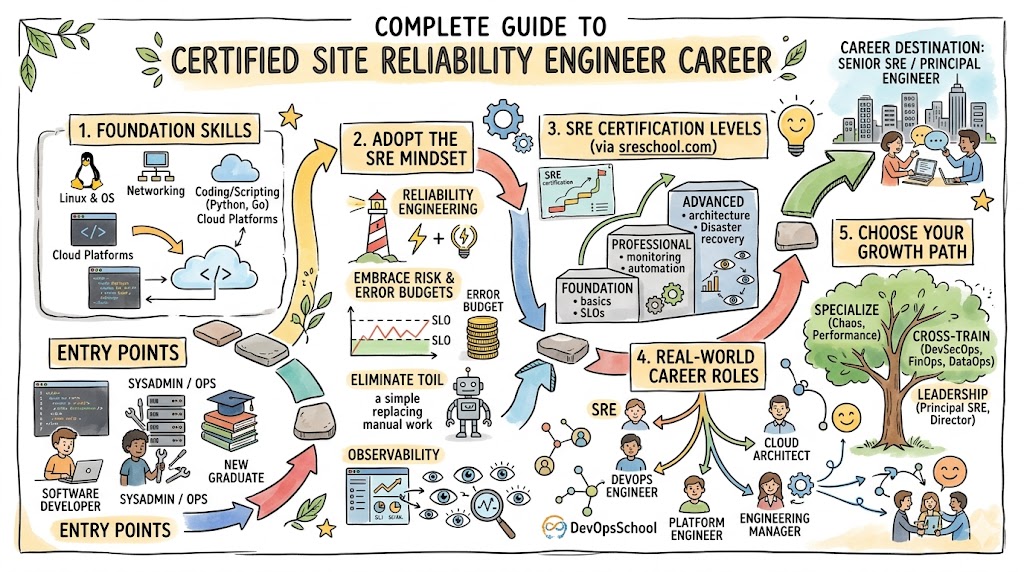
The Certified Site Reliability Engineer program is a comprehensive framework designed to bridge the gap between traditional operations and modern software engineering. This guide is written for professionals looking to navigate the complexities of cloud-native infrastructure, high availability, and automated operations. Whether you are a software developer transitioning into infrastructure or a sysadmin looking to modernize your skill set, understanding the roadmap provided by sreschool is crucial for making informed career decisions. By following the standards set by DevOpsSchool, this certification ensures that engineers are equipped with the mental models and technical rigor required to manage large-scale production environments effectively.
What is the Certified Site Reliability Engineer?
The Certified Site Reliability Engineer represents a standard of excellence in the field of production engineering and systems management. It exists to formalize the bridge between development and operations through the lens of software engineering principles. Unlike traditional certifications that focus on specific cloud provider tools, this program emphasizes real-world, production-focused learning over abstract theory. It aligns with modern engineering workflows by focusing on error budgets, service level objectives, and the reduction of manual toil in enterprise practices.
Who Should Pursue Certified Site Reliability Engineer?
This certification is highly beneficial for software engineers who want to understand the lifecycle of their code in production and DevOps professionals aiming to deepen their automation expertise. It is equally relevant for platform engineers, cloud architects, and security professionals who need to build resilient systems. In both the Indian market and the global landscape, it serves as a benchmark for technical leaders and engineering managers who must oversee reliability at scale. Even beginners with a strong foundation in Linux and networking can use this as a structured path to transition into high-demand SRE roles.
Why Certified Site Reliability Engineer is Valuable and Beyond
The demand for reliability engineering continues to grow as organizations move away from monolithic architectures toward distributed microservices. This certification offers long-term career longevity because it focuses on principles that remain constant despite the rapid turnover of specific tools or cloud providers. By mastering the art of balancing innovation with stability, professionals can ensure they remain indispensable to enterprise employers. The return on time and career investment is significant, as it transforms an engineer from a reactive troubleshooter into a proactive architect of reliable systems.
Certified Site Reliability Engineer Certification Overview
The program is delivered via the official training modules and is hosted on the primary platform of the certification provider. It follows a structured approach that moves from foundational concepts to advanced architectural patterns. The assessment is designed to be practical, often involving hands-on scenarios that mirror the challenges faced by on-call engineers in real-world environments. The ownership of the certification ensures that the curriculum is updated regularly to reflect the evolving standards of the global SRE community.
Certified Site Reliability Engineer Certification Tracks & Levels
The certification is divided into three distinct levels: Foundation, Professional, and Advanced. The Foundation level introduces core concepts like SLIs, SLOs, and incident management basics. The Professional level dives deeper into automation, observability, and capacity planning. The Advanced level is geared toward architects who design self-healing systems and manage organization-wide reliability policies. These levels are designed to align with career progression, allowing an engineer to grow from a junior contributor to a principal site reliability engineer.
Complete Certified Site Reliability Engineer Certification Table
| Track | Level | Who it’s for | Prerequisites | Skills Covered | Recommended Order |
| Core SRE | Foundation | Junior Engineers | Basic Linux | SLOs, Error Budgets, Toil | 1 |
| Engineering | Professional | Mid-level SREs | Python/Go, Docker | Observability, Automation | 2 |
| Architecture | Advanced | Senior/Principal | Distributed Systems | Resilience, Disaster Recovery | 3 |
| Performance | Specialist | Performance Eng | Cloud Computing | Benchmarking, Profiling | 4 |
Detailed Guide for Each Certified Site Reliability Engineer Certification
What it is
This certification validates a candidate’s understanding of the core SRE philosophy. It ensures that the individual understands the difference between traditional operations and the engineering-led approach to reliability.
Who should take it
It is suitable for junior developers, system administrators, and fresh graduates who want to enter the DevOps and SRE domain. No prior experience in SRE is required, but a basic understanding of IT infrastructure is helpful.
Skills you’ll gain
- Understanding the SRE implementation of DevOps.
- Defining Service Level Indicators (SLIs) and Objectives (SLOs).
- Calculating and managing Error Budgets.
- Identifying and reducing manual toil through automation.
Real-world projects you should be able to do
- Create a reliability dashboard for a simple web application.
- Draft an incident response plan for a small-scale production outage.
- Automate a recurring manual task using a scripting language.
Preparation plan
- 7–14 days: Focus on the official SRE handbook and core definitions.
- 30 days: Implement basic monitoring on a local lab environment.
- 60 days: Conduct a deep dive into case studies of major system failures.
Common mistakes
- Focusing too much on specific tools rather than the underlying principles.
- Underestimating the importance of cultural change in SRE adoption.
Best next certification after this
- Same-track: Certified SRE Professional Level.
- Cross-track: Certified DevOps Professional.
- Leadership: SRE Team Lead Certification.
Choose Your Learning Path
DevOps Path
The DevOps path focuses on the integration of development and operations through automation. Engineers on this path learn to build seamless delivery pipelines that incorporate security and quality checks at every stage. This is the foundational route for those who want to master the entire software delivery lifecycle. It emphasizes the cultural shift required to break down silos between functional teams.
DevSecOps Path
The DevSecOps path prioritizes the “Shift Left” mentality by integrating security into the very beginning of the development cycle. Professionals learn to automate vulnerability scanning, manage secrets securely, and ensure compliance without slowing down the release process. This path is essential for those working in highly regulated industries or sensitive data environments. It ensures that reliability and security are treated as inseparable goals.
SRE Path
The SRE path is the most technical and focused on the health of production systems. It treats operations as a software problem, emphasizing the use of code to manage infrastructure and respond to incidents. Engineers on this path spend their time building internal tools to improve system visibility and resilience. This is the ideal route for those who enjoy troubleshooting complex distributed systems and optimizing performance.
AIOps Path
The AIOps path focuses on the application of artificial intelligence and machine learning to IT operations. It involves using big data and algorithms to automate incident detection, correlate events, and predict potential outages before they occur. This is a forward-looking path for engineers who want to manage massive-scale environments where manual monitoring is no longer feasible. It bridges the gap between data science and systems engineering.
MLOps Path
The MLOps path is specialized for those managing the production lifecycle of machine learning models. It applies SRE and DevOps principles to the unique challenges of data drift, model versioning, and high-compute training environments. Engineers on this path ensure that ML models are deployed reliably and can scale to meet user demand. This path is critical for organizations that rely on real-time AI insights for their core business.
DataOps Path
The DataOps path focuses on the reliability and quality of data pipelines. It brings the discipline of SRE to the world of data engineering, ensuring that data flows are consistent, accurate, and highly available. Professionals learn to automate data testing and monitor the health of large-scale databases and streaming platforms. This path is vital for companies where data is the primary product or decision-making tool.
FinOps Path
The FinOps path introduces financial accountability to the variable spend model of the cloud. It involves a mix of engineering, finance, and business logic to optimize cloud costs while maintaining system performance. Engineers on this path learn to track cloud usage, identify waste, and implement automated cost-saving measures. This is a high-impact role that directly correlates engineering efficiency with the company’s bottom line.
Role → Recommended Certified Site Reliability Engineer Certifications
| Role | Recommended Certifications |
| DevOps Engineer | Certified SRE Foundation, Certified DevOps Professional |
| SRE | Certified SRE Professional, Certified SRE Advanced |
| Platform Engineer | Certified SRE Professional, Certified Kubernetes Expert |
| Cloud Engineer | Certified SRE Foundation, Cloud Provider Certifications |
| Security Engineer | Certified SRE Foundation, Certified DevSecOps |
| Data Engineer | Certified SRE Foundation, Certified DataOps |
| FinOps Practitioner | Certified SRE Foundation, Certified FinOps |
| Engineering Manager | Certified SRE Foundation, Leadership in SRE |
Next Certifications to Take After Certified Site Reliability Engineer
Same Track Progression
Once the advanced level of the SRE certification is achieved, the natural progression is toward deep specialization. This might involve mastering specific domains like Chaos Engineering or Advanced Observability. Deepening knowledge in these areas allows an engineer to become a subject matter expert who can handle the most critical and complex system failures.
Cross-Track Expansion
For those who want to broaden their impact, expanding into security or data operations is highly recommended. A reliable system must also be a secure system, making the transition to DevSecOps a logical step. Similarly, understanding the data pipelines that power applications can make an SRE much more effective in modern, data-driven enterprises.
Leadership & Management Track
Experienced SREs often transition into leadership roles where they define the reliability strategy for entire organizations. This involves moving from individual technical tasks to managing teams, budgets, and cross-departmental relationships. Certifications in engineering management or technical leadership help in making this transition from the terminal to the boardroom.
Training & Certification Support Providers for Certified Site Reliability Engineer
DevOpsSchool
This provider offers extensive training programs that cover the entire spectrum of modern software delivery. They are known for their practical, lab-based approach and have helped thousands of professionals transition into DevOps and SRE roles. Their curriculum is designed by industry veterans who bring real-world scenarios into the classroom. They provide a strong community support system for learners.
Cotocus
A specialized consulting and training organization that focuses on high-end technical transformations. They provide deep-dive workshops on site reliability engineering, cloud architecture, and automation strategies. Their trainers are often active practitioners who bring the latest industry trends to their students. They are a preferred partner for corporate training initiatives globally.
Scmgalaxy
This is a comprehensive resource hub for everything related to software configuration management and DevOps. They offer a wide range of tutorials, certifications, and community forums that help engineers stay updated with the latest tools and methodologies. Their focus on the practical implementation of SRE principles makes them a valuable resource for working professionals.
BestDevOps
Focusing on the highest standards of DevOps education, this provider offers curated learning paths for various engineering roles. They emphasize the integration of quality and reliability into the deployment pipeline. Their certification programs are recognized for being rigorous and well-aligned with the needs of the modern tech industry.
devsecopsschool.com
This platform is dedicated to the integration of security into the DevOps lifecycle. They provide specialized training on automating security checks, managing compliance, and building resilient, secure infrastructures. It is an essential resource for SREs who want to broaden their expertise into the security domain.
This is the primary destination for professionals seeking to master site reliability engineering. The platform provides a structured roadmap, official certification tracks, and a wealth of documentation on SRE best practices. It serves as the central hub for the SRE community to learn, share, and get certified.
aiopsschool.com
This site focuses on the intersection of artificial intelligence and operations. It provides training on how to use machine learning to improve system monitoring, incident response, and predictive maintenance. It is the go-to place for engineers looking to future-proof their careers with AI-driven operational skills.
dataopsschool.com
Dedicated to the discipline of data operations, this platform provides certifications for managing reliable data pipelines. They cover the tools and techniques needed to ensure data quality and availability at scale. It bridges the gap between traditional SRE roles and the specific needs of data engineering teams.
finopsschool.com
This provider focuses on the growing field of cloud financial management. They offer training on how to align cloud spending with business value through technical and cultural changes. It is an essential platform for engineers and managers who want to master the art of cloud cost optimization.
Frequently Asked Questions (General)
1. How difficult is the Certified Site Reliability Engineer exam?
The difficulty depends on your level of experience with production systems. While the Foundation level is accessible to most IT professionals, the Professional and Advanced levels require significant hands-on experience and a deep understanding of distributed systems and automation.
2. How long does it take to prepare for the certification?
A typical candidate with some background in operations can prepare for the Foundation level in about 30 days. For the Professional level, we recommend 60 to 90 days of consistent study and practical application in a lab environment.
3. What are the prerequisites for the SRE track?
For the entry-level certification, a basic understanding of Linux and at least one programming language is recommended. For higher levels, candidates should have experience with containerization, cloud platforms, and basic networking.
4. Will this certification help me get a job in India?
Yes, the demand for SREs in India is at an all-time high as major tech hubs and global capability centers expand. Companies are actively looking for certified professionals who can demonstrate a structured approach to system reliability.
5. Is the certification recognized globally?
The principles taught in this program are based on global industry standards popularized by major tech companies. The certification is recognized by enterprises worldwide as a mark of technical competence in modern operations.
6. Do I need to be a coder to become an SRE?
While you don’t need to be a senior developer, a “software engineering” mindset is required. You should be comfortable writing scripts and small applications to automate tasks and interact with APIs.
7. What is the return on investment for this certification?
The ROI is typically seen through higher salary brackets, better job opportunities, and increased efficiency in your current role. It moves you from being a generalist to a specialized professional in a high-demand field.
8. How often do I need to renew my certification?
Most professional-grade certifications require renewal every two to three years to ensure that your skills stay current with the rapidly changing technological landscape.
9. Can I skip the Foundation level and go straight to Professional?
It is generally recommended to follow the sequence to ensure a solid grasp of the core philosophy, but candidates with significant industry experience can sometimes challenge the higher-level exams directly.
10. Are there hands-on labs included in the training?
Yes, the best training providers emphasize hands-on labs where you build and break systems in a controlled environment to simulate real-world production incidents.
11. What tools will I learn during the certification?
While the focus is on principles, you will likely work with tools like Kubernetes, Prometheus, Grafana, Terraform, and various CI/CD platforms during your practical training.
12. How does SRE differ from traditional DevOps?
SRE is often described as a specific implementation of DevOps. While DevOps is a broad cultural philosophy, SRE provides the concrete practices and metrics to measure and achieve reliability.
FAQs on Certified Site Reliability Engineer
1. How does the Certified Site Reliability Engineer program address the concept of Error Budgets?
The curriculum provides a rigorous framework for defining Error Budgets, which represent the acceptable amount of downtime or errors a service can tolerate. It teaches engineers how to use these budgets as a data-driven negotiation tool between development teams (who want velocity) and operations teams (who want stability), ensuring that reliability remains a shared responsibility.
2. Is Incident Management and Response a major part of this certification?
Yes, a significant portion of the Professional and Advanced tracks is dedicated to the lifecycle of a production incident. This includes mastering real-time detection through alerting, effective mitigation strategies to reduce Mean Time to Recovery (MTTR), and the creation of detailed, blameless post-mortems that identify systemic root causes rather than human error.
3. Does the certification curriculum cover multi-cloud and hybrid infrastructure?
The principles taught in the program are intentionally cloud-agnostic. Whether your organization uses AWS, Azure, Google Cloud, or a private on-premises data center, the strategies for observability, automation, and capacity planning remain applicable. This ensures that the certification provides long-term value regardless of the specific vendor or platform an enterprise chooses.
4. How does this certification help in reducing manual “Toil”?
A core pillar of the Certified Site Reliability Engineer program is the identification and elimination of toil—repetitive, manual, and tactical work. The course provides specific methodologies for automating these tasks using code, allowing engineers to redirect their time toward high-value project work that improves system architecture and long-term scalability.
5. Are there specific paths within the certification for Engineering Managers?
The program offers a leadership track specifically designed for technical leaders. This path focuses on the cultural and organizational aspects of SRE, such as building high-performing reliability teams, managing organizational change, and aligning technical Service Level Objectives (SLOs) with overarching business goals and customer satisfaction.
6. How is “Observability” treated differently from traditional “Monitoring” in this course?
While traditional monitoring tells you if a system is failing, this certification teaches observability, which explains why it is failing. You will learn to implement the three pillars—logs, metrics, and traces—to gain deep insights into distributed microservices, allowing for faster debugging of complex, non-linear system failures in production.
7. What role does Automation play in the Certified Site Reliability Engineer assessment?
Automation is treated as a first-class citizen rather than an afterthought. The assessment validates your ability to treat infrastructure as code (IaC) and your proficiency in building self-healing systems. You are expected to demonstrate how to use automation to enforce consistency across environments and reduce the risk of human-induced configuration drift.
8. Does the program include training on Chaos Engineering?
The advanced levels of the certification introduce Chaos Engineering as a proactive way to build resilience. You will learn how to safely inject failures into a system to identify weaknesses before they cause actual outages. This discipline transforms reliability from a reactive “hope-based” strategy into a proactive, experimental engineering practice.
Final Thoughts
As a mentor who has seen the industry evolve from physical data centers to serverless architectures, I can say that the principles of reliability never go out of style. The Certified Site Reliability Engineer program is not just a badge; it is a mental framework for handling the chaos of modern production environments. It provides the language and the tools needed to communicate with developers and business leaders effectively. If you are willing to move beyond just “keeping the lights on” and want to start “engineering the future,” this path is worth every hour of study. It is a commitment to quality that will serve you well throughout your entire career.


0 Comments
Most Voted