Limited Time Offer!
For Less Than the Cost of a Starbucks Coffee, Access All DevOpsSchool Videos on YouTube Unlimitedly.
Master DevOps, SRE, DevSecOps Skills!
Introduction
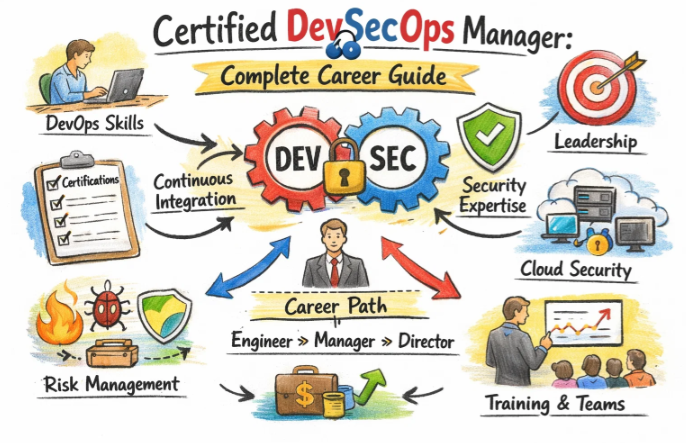
In the rapidly evolving world of software engineering, organizations are demanding professionals who can integrate development, security, and operations seamlessly. The Certified DevSecOps Manager certification is designed to prepare engineers and managers to handle security as a foundational aspect of software delivery. This guide provides a comprehensive overview of this certification, including the skills you’ll gain, projects you can execute, preparation plans, career paths, and the best training institutions to help you achieve it
The Master Certification Landscape
Selecting the right certification depends on where you are and where you want to go. This table provides a clear look at the paths available to modern software professionals.
| Track | Level | Who it’s for | Prerequisites | Skills covered | Recommended order |
| DevOps | Associate | Junior Engineers | Basic Scripting | CI/CD, Linux, Docker | 1 |
| DevOps | Expert | Senior Engineers | 2+ Years Exp | IaC, Orchestration, Scaling | 2 |
| DevSecOps | Master | Team Leads & Managers | 3-5 Years Exp | Governance, Risk, Strategy | 3 |
| SRE | Specialist | Reliability Engineers | Coding & Systems | SLOs, Incident Response | 2 |
| AIOps/MLOps | Specialist | ML & Data Leads | Python, Cloud | Model Pipelines, Auto-tuning | 3 |
| DataOps | Specialist | Data Architects | SQL, Big Data | Data Pipeline Integrity | 3 |
| FinOps | Specialist | Cloud Managers | Financial Basics | Unit Economics, Optimization | 2 |
| Observability | Master | Architects / Leads | Deep Telemetry | Distributed Tracing, Metrics | 4 |
The Definitive Guide: Certified DevSecOps Manager
The Certified DevSecOps Manager (CDOM) is not just a technical badge. It is a credential for those who want to own the security culture of an entire organization.
What it is
The Certified DevSecOps Manager is a professional certification focused on the strategic oversight of secure software delivery. While an engineer might focus on how to fix a vulnerability, a manager focuses on how to prevent that vulnerability from ever entering the pipeline. This program covers the high-level management of security gates, compliance as code, and the leadership required to align development and security teams. Much like the Master in Observability Engineering Certifications Program, it provides you with the high-level data needed to make informed, risk-based decisions.
Who should take it
This is for the professional who is ready to step away from the keyboard and start leading the roadmap.
- Engineering Managers who want to standardize security across multiple teams.
- Senior DevOps Engineers looking to pivot into a formal leadership role.
- Security Leads who need to understand how to integrate with agile, fast-moving teams.
- CTOs and Directors responsible for organizational risk and compliance.
Skills you’ll gain
This certification shifts your focus from tactical tasks to strategic outcomes.
- Cultural Leadership: You will learn how to persuade developers to care about security without slowing them down.
- Automated Governance: Mastering the ability to set “guardrails” that allow for speed while ensuring every piece of code is safe.
- Compliance Strategy: Turning complex regulations (like SOC2 or HIPAA) into automated checks that run every time code is committed.
- Threat Architecture: Designing systems that are resilient to attacks from the very first line of code.
- Business Alignment: Learning how to report security progress to stakeholders in a way that proves business value.
Real-world projects you should be able to do after it
The goal of this program is to give you the ability to deliver massive, organization-wide impact.
- Building a Secure Delivery Roadmap: You will be able to design a multi-quarter plan that integrates security into every phase of the company’s product lifecycle.
- Automating Audit Readiness: You can create a system where your team is always “audit-ready,” saving hundreds of hours of manual work.
- Orchestrating Vulnerability Response: Developing a cross-functional process that identifies, prioritizes, and fixes security issues in minutes, not months.
- Cost-Benefit Security Analysis: Managing the budget for security tools and proving that the investment is reducing organizational risk.
Preparation Plan (Tailored for Working Professionals)
- 7–14 Days (The Expert Sprint): This is for those who already have a strong background in management. Focus exclusively on the CDOM exam structure and the specific compliance frameworks you might not use daily.
- 30 Days (The Career Pivot): This is the most common path. Spend the first two weeks on technical security tools and the final two weeks on management theory, risk assessment, and leadership modules.
- 60 Days (The Foundation Builder): If you are moving from a strictly non-security background, take the first 30 days to learn the technical basics of DevSecOps. Use the second month to focus on the management and strategic aspects of the CDOM.
Common Mistakes
Knowing what to avoid is just as important as knowing what to learn.
- The “Policeman” Mentality: Managers often fail because they try to “police” developers. The CDOM teaches you to be an “enabler” instead.
- Tool Overload: Don’t assume that buying 10 security tools makes you secure. The manager’s job is to ensure the process works, not just the tools.
- Ignoring the Data: Without proper metrics, you are just guessing. This is why many managers find the Master in Observability Engineering so valuable—it provides the evidence you need to lead.
- Siloed Thinking: Security isn’t a department; it’s a feature. If you keep security in a silo, your DevSecOps strategy will fail.
Best Next Certification After This
Leadership is a continuous learning process. After your CDOM, consider:
- Same Track: Advanced Security Leadership for C-suite roles.
- Cross-Track: FinOps Practitioner (to manage the high cost of cloud security).
- Leadership Path: Master in Observability Engineering (to gain a total view of system reliability).
Choose Your Path
Every leader’s journey is different. Here are the six primary paths you can take to reach your career peak.
- DevOps Path: Focuses on the speed and efficiency of the software delivery process.
- DevSecOps Path: Focuses on integrating automated security into every step of the lifecycle.
- SRE Path: Focuses on the reliability, scalability, and uptime of large-scale systems.
- AIOps/MLOps Path: Focuses on using artificial intelligence to automate complex operational tasks.
- DataOps Path: Focuses on the smooth and secure flow of data within an organization.
- FinOps Path: Focuses on the financial side of the cloud, ensuring that resources are used efficiently.
Role → Recommended Certifications Mapping
| If your role is… | Your next big step should be… | Priority |
| DevOps Engineer | SRE Expert → CKA | High |
| SRE | Master in Observability Engineering | Critical |
| Platform Engineer | Certified DevSecOps Manager | Strategic |
| Cloud Engineer | FinOps Practitioner → Cloud Architect | High |
| Security Engineer | Certified DevSecOps Manager | Career-Changing |
| Data Engineer | DataOps Specialist → MLOps | High |
| FinOps Professional | FinOps Expert → Cloud Economics | High |
| Engineering Manager | Certified DevSecOps Manager → Observability (M) | Executive |
Top Training Institutions for Leadership
To clear the Certified DevSecOps Manager exam, you need guidance that understands both the technology and the business.
- DevOpsSchool: This is the primary destination for professionals. They offer deep, hands-on training that focuses on the practical application of DevSecOps in real-world environments.
- Cotocus: They specialize in corporate training, helping entire engineering departments shift their mindset and adopt new tools collectively.
- Scmgalaxy: Known for their technical depth and massive library of resources, they provide the “under-the-hood” knowledge required for advanced automation.
- BestDevOps: They offer a personalized mentoring approach, helping individuals chart a long-term career path that goes beyond just one certification.
- Devsecopsschool: The official home for the CDOM certification, providing the most up-to-date curriculum designed specifically for modern managers.
- Sreschool: If your focus is on reliability and uptime, this institution provides the most comprehensive path to becoming a master SRE.
- Aiopsschool: Leading the charge in the future of ops, they teach you how to use AI to handle the scale of modern cloud environments.
- Dataopsschool: The best resource for data professionals who want to apply DevOps principles to their data pipelines.
- Finopsschool: The essential stop for learning how to manage the financial health of your cloud infrastructure.
General Career FAQs (Software Engineers & Managers)
- Is it too late to switch to a management track? Never. In fact, some of the best managers are those who have a deep history of engineering behind them.
- How long do these certifications usually take? With focused study, most master-level certifications can be completed in 30 to 60 days.
- Are these certifications valid globally? Yes. The principles of DevSecOps and SRE are universal, and these credentials are recognized in India and across the world.
- Do I need to be a coding expert to be a DevSecOps Manager? You need to be “code-aware.” You don’t need to write production code daily, but you must understand it to lead.
- What is the return on investment? Beyond a potential salary boost, these certs provide the “strategy” that moves you from a replaceable worker to an indispensable leader.
- Can I self-study? You can, but for a management level, formal training is recommended to understand the complex scenarios and case studies.
- Why is Observability so important now? Systems are too complex for traditional monitoring. Observability gives you the “why” behind the “what.”
- How do I choose between SRE and DevSecOps? Choose SRE if you love performance and uptime. Choose DevSecOps if you are passionate about security and governance.
- Are these exams proctored? Yes, to maintain the value of the certification, the exams are typically proctored online.
- How often should I update my certifications? Usually every 2–3 years, as the technology moves incredibly fast.
- Do I need an MBA to be an Engineering Manager? No. For most technical companies, a CDOM and years of experience are far more valuable than a generic business degree.
- What is the first step? Pick a track that aligns with your current job and start with the “Associate” or “Expert” level.
FAQs: Certified DevSecOps Manager (CDOM)
- What is the core focus of the CDOM? It focuses on the “Management” of secure delivery—culture, strategy, risk, and automated compliance.
- Is there a lot of hands-on work in the training? Yes. About half of the course involves setting up secure pipelines and leadership simulations.
- How does the CDOM help with SOC2 or ISO audits? It teaches you how to automate evidence collection so that audits are a “non-event” for your team.
- Can I take the exam from home? Yes, the official providers offer secure online testing options.
- Is previous security experience mandatory? It helps, but the course is designed to teach you the security strategy you need from the ground up.
- Does this certification help with remote leadership? Absolutely. Managing distributed teams requires the standardized processes that the CDOM provides.
- What programming languages should I know? A basic understanding of Python, Go, or YAML (for configuration) is very helpful.
- Why is devsecopsschool.com the best place for this? Because they specialize in this specific domain and update their content based on the latest global security threats.
Conclusion
Advancing your career from a technical engineer to a Certified DevSecOps Manager is about more than just a title change; it is a fundamental shift in how you view the software lifecycle. By embracing the responsibility of secure leadership, you position yourself at the very heart of the modern business world. You become the person who ensures that innovation never comes at the cost of security. Whether you are focusing on the technical excellence of SRE, the fiscal discipline of FinOps, or the strategic depth of DevSecOps, your journey must be built on a foundation of visibility. This is why incorporating a program like the Master in Observability Engineering Certifications Program is the ultimate move for any aspiring manager—it gives you the clarity to lead through any crisis. The roadmap is clear, the tools are ready, and the institutions are there to support you. Now is the time to take that first step toward becoming the leader your organization needs.



0 Comments
Most Voted